Poli Alert Politics & Civics
Related Articles


President Donald Trump has overseen a sweeping effort to place his name and likeness across the federal government, with branding initiatives now reaching everything from buildings and military hardware to currency, passports and public-facing websites.
Administration officials have framed the campaign as part of a broader celebration of the nation’s 250th anniversary. But the scale of the effort — and its focus on a sitting president — has sparked legal challenges and intensified debate over the boundaries between public institutions and personal political identity.
A government rebranded
The push began late last year with the renaming of the United States Institute of Peace headquarters in Washington, marking the first time a federal building has been named after a sitting president.
Weeks later, the board of the John F. Kennedy Center for the Performing Arts voted to add Trump’s name to the iconic venue — a move now facing a legal challenge from Democrats and members of the Kennedy family, who argue the center’s status as a memorial to President John F. Kennedy makes the change unlawful.
At the same time, the administration expanded its branding into defense policy, unveiling plans for a new class of “Trump-class” warships. Officials said the vessels would represent the next generation of naval power, though critics questioned the decision to name them after a sitting commander in chief.
Currency, coins and identification
The administration’s imprint has extended into financial and identification systems traditionally insulated from political branding.
The Treasury Department announced plans to add Trump’s signature to future U.S. paper currency — a departure from longstanding practice, in which only the treasury secretary and treasurer sign bills.
Separately, a federal design panel approved a commemorative gold coin bearing Trump’s likeness as part of the country’s semiquincentennial celebration, alongside a circulating $1 coin featuring the president.
The State Department has also prepared a limited run of passports displaying Trump’s image on the inside cover, describing the redesign as a “patriotic” update tied to the anniversary.
Programs, platforms and policy
Trump’s branding has also been embedded into new federal programs and digital platforms.
The administration launched TrumpIRA.gov, a government-run website aimed at helping Americans compare retirement savings options, as well as “Trump Accounts,” tax-advantaged savings accounts for children born during his second term.
In immigration policy, Trump introduced a high-cost visa program dubbed the “Trump gold card,” allowing wealthy foreign nationals to obtain U.S. residency in exchange for a $1 million payment.
A separate initiative, TrumpRx.gov, offers prescription drug discounts through a federal platform bearing the president’s name.
Parks, banners and public imagery
The Interior Department has drawn criticism for placing Trump’s image on annual national park passes alongside President George Washington, prompting a lawsuit from environmental advocates who argue the move violates federal law requiring the pass to feature a contest-winning photograph.
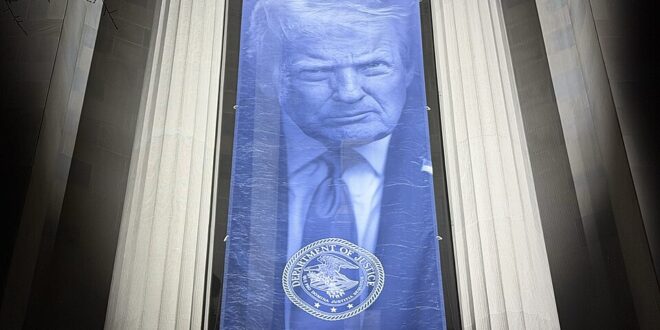
Across Washington, large banners featuring Trump’s image and policy slogans have been installed on federal buildings, including at the Justice Department, where one display reads “Make America Safe Again.”
Legal scrutiny and political fallout
Several of the initiatives are already being challenged in court, while others have prompted broader concerns among legal scholars and ethics experts.
Opponents argue that affixing a sitting president’s name to government assets risks politicizing institutions designed to serve the public independent of any administration. Supporters counter that the branding reflects Trump’s leadership and aligns with efforts to mark a historic milestone for the country.
The administration has continued to defend the moves as appropriate and celebratory, even as critics warn they could set a precedent for future presidents.
With additional anniversary-related initiatives expected in the months ahead, the reach of the branding campaign may continue to expand.
Whether courts intervene — or the effort reshapes long-standing norms around presidential conduct — will likely determine how enduring Trump’s imprint on the federal government ultimately becomes.