Poli Alert Politics & Civics
Related Articles


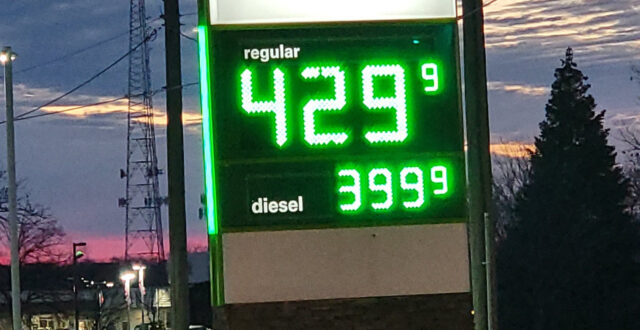
The national average gas price climbed to a new wartime high Friday, underscoring the growing economic toll of the U.S. conflict with Iran as energy markets react to prolonged instability in the Middle East.
Prices jumped to $4.39 per gallon, marking the largest single-day increase since a ceasefire was announced in early April and one of the sharpest spikes since the war began. Just a day earlier, prices had already risen seven cents, before surging another nine cents overnight. Since the start of the conflict, gas prices have climbed more than 47%.
The surge tracks closely with rising oil prices. U.S. crude hovered around $103 per barrel in early trading Friday, while the global benchmark Brent crude reached roughly $110 — both reflecting sustained pressure tied to supply disruptions and geopolitical risk.
Much of that pressure stems from the Trump administration’s decision to maintain a naval blockade on Iranian ports, a move President Donald Trump defended Thursday as a key lever against Tehran.
“The power of the blockade is incredible,” Trump said at the White House, adding that gas prices would “drop like a rock” once the war ends.
Energy analysts, however, are far less optimistic. Many warn that prices could remain elevated long after hostilities subside, particularly given ongoing threats to the Strait of Hormuz — a critical chokepoint for global oil shipments that Iran has demonstrated it can disrupt.
“If the strait remains closed through the end of June, Brent could rise as high as $150 per barrel,” analysts at Citigroup wrote in a note Friday.
Even if the conflict de-escalates, restoring normal oil flows could take months. Exxon Mobil CEO Darren Woods said it could take up to two months for production to stabilize after the strait reopens, with additional delays before supply reaches global markets.
“The global energy system continues to be under extreme stress,” said Chevron CEO Mike Wirth, warning that prolonged supply constraints could force a reduction in demand across sectors of the economy.
Despite those warnings, some administration officials have suggested the conflict may already be winding down. A senior official told NBC News that, for purposes of the War Powers Resolution, hostilities have effectively ended — a position echoed by House Speaker Mike Johnson, who said the United States is “not at war.”
Markets appear to disagree. Oil prices are on track for an 8% weekly gain, signaling investor concern that tensions could persist or escalate.
Meanwhile, the economic effects are increasingly visible at home. Consumers across the country are voicing frustration as fuel costs rise sharply, with some regions seeing increases approaching $2 per gallon since the conflict began.
Analysts say the full financial impact of the war may not yet be reflected in prices. According to energy data firm Kpler, disruptions to Iran’s oil exports could take months to fully materialize due to shipping and payment timelines, delaying the blockade’s intended economic pressure.
That lag could complicate the administration’s strategy, leaving global markets in a prolonged state of uncertainty.
“Hope is fading” for a near-term resolution, analysts at ING wrote Friday, warning that the situation could quickly swing back toward escalation.
For now, with no clear end to the conflict and supply chains under strain, both markets and consumers are bracing for continued volatility — and higher costs at the pump.