

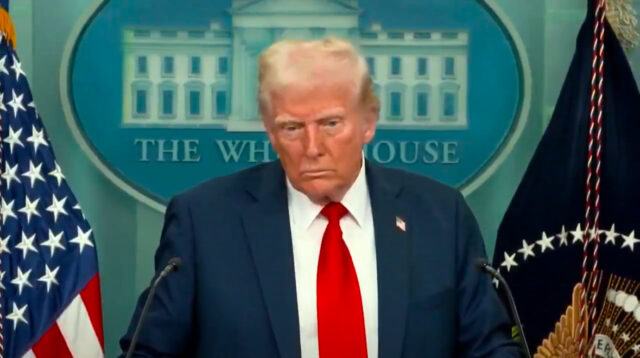
President Donald Trump said Sunday that U.S. officials will return to Pakistan for another round of high-stakes negotiations with Iran, even as he threatened sweeping military strikes if Tehran does not agree to a deal to end the war.
Trump announced that American representatives would arrive in Islamabad on Monday evening for talks expected to continue into midweek, just days before a fragile two-week ceasefire is set to expire. The president coupled the diplomatic push with a stark warning, saying the United States could target Iran’s critical infrastructure if negotiations collapse.
“We’re offering a very fair and reasonable DEAL,” Trump wrote on social media. “If they don’t, the United States is going to knock out every single Power Plant, and every single Bridge, in Iran.”
The renewed diplomatic effort follows days of volatility in the region, centered on the strategic Strait of Hormuz — a vital global shipping lane responsible for a significant share of the world’s oil supply.
After briefly reopening Friday, the strait was closed again by Iran on Saturday, according to U.S. and Iranian statements, raising fresh concerns about global energy markets and maritime security. The disruption stranded thousands of seafarers and contributed to sharp swings in oil prices, which had briefly eased on optimism that a ceasefire could hold.
Trump had previously said Iran agreed to keep the strait open, but Tehran blamed renewed restrictions on an ongoing U.S. naval blockade of its ports — a pressure tactic the administration says will remain in place until a broader agreement is reached.
The administration’s dual-track approach — combining diplomacy with military pressure — reflects the high stakes of the negotiations, which could determine not only the trajectory of the war but also the stability of global energy markets.
Trump reiterated that the U.S. blockade would continue until a deal is finalized, telling reporters Friday that it would end “as soon as the agreement gets signed.”
U.S. officials argue the strategy is necessary to force Iran back to the negotiating table, while critics warn it risks escalating the conflict further if miscalculations occur.
The potential for expanded military action looms large. Trump’s threat to target Iranian infrastructure marks one of his most aggressive statements since the conflict began and signals the administration’s willingness to significantly escalate if talks fail.
U.S. special envoy Steve Witkoff and senior adviser Jared Kushner are expected to lead the American delegation in Islamabad, where security has tightened ahead of the talks.
Roads around the diplomatic enclave in Pakistan’s capital have been closed, and hotels previously used by negotiators were cleared as officials prepare for another round of intensive discussions following last week’s failed marathon talks.
Iranian officials signaled cautious openness to continued negotiations while maintaining a defiant tone.
Mohammad Bagher Ghalibaf, leading Iran’s delegation, said in a televised address that Tehran seeks a “lasting settlement” but remains “deeply distrustful of the United States.” He also warned that Iran would continue to control access to the Strait of Hormuz if the U.S. blockade persists.
“The Strait of Hormuz is under the control of the Islamic Republic of Iran,” Ghalibaf said, according to state media.
Tensions escalated over the weekend as commercial vessels reported attacks while attempting to navigate the strait. A tanker was fired upon by gunboats linked to Iran’s Islamic Revolutionary Guard Corps, according to the United Kingdom Maritime Trade Operations center, while a container ship was struck by an unidentified projectile. No casualties were reported.
Meanwhile, a separate 10-day ceasefire between Israel and Hezbollah in Lebanon — which helped facilitate the temporary reopening of the strait — appeared largely intact Sunday, though both sides reported alleged violations.
Israel’s military said it identified attacks on United Nations peacekeepers and outlined a new “Forward Defence Line” in southern Lebanon, where forces are continuing operations against Hezbollah infrastructure. Hezbollah denied responsibility for the reported strike that killed a UN peacekeeper, an incident condemned by French President Emmanuel Macron.
The escalating tensions highlight the interconnected nature of conflicts across the Middle East, where developments in one theater can quickly reverberate across others.
The Strait of Hormuz has long been a flashpoint in U.S.-Iran relations due to its strategic importance to global oil shipments. Any prolonged disruption risks significant economic fallout worldwide, including spikes in energy prices and supply chain instability.
Trump’s strategy reflects a broader effort to leverage economic and military pressure simultaneously — a hallmark of his foreign policy approach — though it has drawn criticism from analysts who warn it could undermine diplomatic efforts.
With the ceasefire set to expire Wednesday, the upcoming talks in Islamabad are seen as a critical window to reach at least a temporary agreement and prevent further escalation.
Diplomats on both sides have indicated negotiations remain active, but the gap between the two countries — particularly over sanctions, military activity and control of strategic waterways — remains substantial.
Whether the latest round of talks can produce a breakthrough or instead deepen the crisis may become clear within days.