

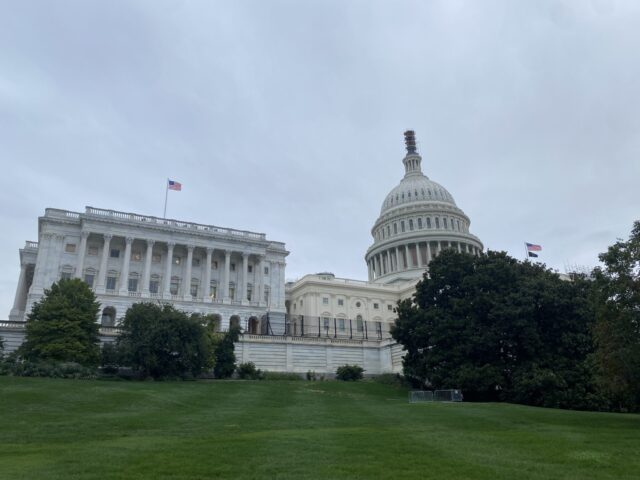
Congress on Friday approved a temporary extension of a key U.S. surveillance authority set to expire, buying lawmakers 10 more days to resolve deep divisions — particularly among Republicans — over the future of the controversial program.
The Senate passed the 10-day extension hours after a turbulent overnight session in the House, where Speaker Mike Johnson (R-La.) struggled to unify his narrow majority around a longer-term reauthorization of Section 702 of the Foreign Intelligence Surveillance Act. The provision allows U.S. intelligence agencies to collect communications of foreign nationals abroad from American tech and telecommunications companies without a warrant.
Background
Section 702, first enacted in 2008, is a cornerstone of U.S. intelligence gathering and is scheduled to expire Monday absent congressional action. The authority permits the collection of emails, texts and phone calls of foreign targets located overseas, but has long drawn scrutiny because Americans’ communications can be incidentally swept up in the process.
Efforts to renew the law have repeatedly stalled in the House, where a coalition of conservative Republicans and civil libertarians has pushed for stricter limits on how the government accesses data involving U.S. citizens.
Policy and Legal Debate
At the center of the debate is whether intelligence agencies should be required to obtain a warrant before searching databases for Americans’ communications — even if those messages were collected legally under foreign surveillance.
Members of the conservative House Freedom Caucus have made that requirement a red line. Rep. Chip Roy (R-Texas) said lawmakers support the broader mission of Section 702 but are seeking “greater protections” for Americans’ privacy.
Rep. Warren Davidson (R-Ohio), another GOP holdout, said Friday the program would not be renewed “without a suitable warrant requirement,” though he suggested negotiations were nearing a resolution.
Administration officials have pushed back, arguing that imposing a warrant requirement could slow intelligence operations and jeopardize national security by delaying access to critical information.
Government Response
Officials in President Donald Trump’s administration have mounted an aggressive campaign to secure reauthorization, warning that allowing Section 702 to lapse would weaken U.S. defenses against terrorism and other threats.
CIA Director John Ratcliffe traveled to Capitol Hill this week to lobby lawmakers, while Chairman of the Joint Chiefs of Staff Gen. Dan Caine wrote to Congress that failure to renew the program would “increase risk to the Joint Force” and impair military effectiveness.
Trump also weighed in directly, urging Republicans to unite behind the measure. In a social media post, he said he was willing to risk his own rights “for our Great Military and Country” and described the surveillance authority as critical to U.S. success abroad.
Despite those efforts, House Republicans failed twice early Friday to pass competing reauthorization proposals, including a compromise bill that would have extended the program for five years with modest reforms, and a separate 18-month extension without changes.
Political Reactions
The impasse underscores ongoing fractures within the Republican Party during Trump’s second term, where ideological disputes have complicated efforts to advance key parts of the president’s legislative agenda.
Senate Majority Leader John Thune (R-S.D.) acknowledged the uncertainty facing House leaders after the upper chamber passed the temporary extension.
“I don’t know what the House is going to be able to do, so we’ll be preparing accordingly,” Thune told reporters.
Democrats remain divided as well. Some, particularly those focused on civil liberties, have warned the program could be abused without stronger safeguards. Others, including Rep. Jim Himes (D-Conn.), the top Democrat on the House Intelligence Committee, have supported reauthorization while advocating for targeted reforms.
Himes has proposed requiring court approval before the FBI can access certain sensitive data involving Americans, political organizations or nonprofits — a middle-ground approach aimed at balancing privacy concerns with national security needs.
In the Senate, longtime surveillance critic Sen. Ron Wyden (D-Ore.) allowed the short-term extension to move forward, arguing that a lapse in the program could undermine efforts to secure meaningful reforms.
“The reality is that the country believes that security and liberty are not mutually exclusive,” Wyden said. “We can have both.”
Broader Context
Debates over government surveillance have intensified in recent years, particularly following disclosures of compliance issues and past investigative errors.
A Justice Department inspector general previously found significant flaws in the FBI’s surveillance of former Trump campaign associate Carter Page under a different FISA provision, fueling skepticism among Trump allies.
At the same time, multiple intelligence assessments — including a bipartisan Senate investigation — concluded that Russia interfered in the 2016 election to benefit Trump, underscoring the continuing role of foreign intelligence threats in U.S. policymaking.
Next Steps
The 10-day extension sets a new deadline of April 30 for Congress to reach a longer-term agreement. Johnson, who can afford to lose only two Republican votes, faces a narrow path forward as he attempts to balance demands from privacy-focused conservatives with those of national security hawks and pro-surveillance Democrats.
If lawmakers fail to act, administration officials warn that intelligence collection could be disrupted, particularly if telecommunications companies become reluctant to cooperate without clear legal authorization.
Still, some lawmakers argue the short-term extension provides a crucial window to negotiate reforms.
“Congress should not needlessly rush,” Sens. Mike Lee (R-Utah) and Dick Durbin (D-Ill.) wrote in a joint opinion piece, citing concerns about transparency and oversight.
Whether a compromise can be reached before the new deadline remains uncertain.