Poli Alert Politics & Civics
Related Articles


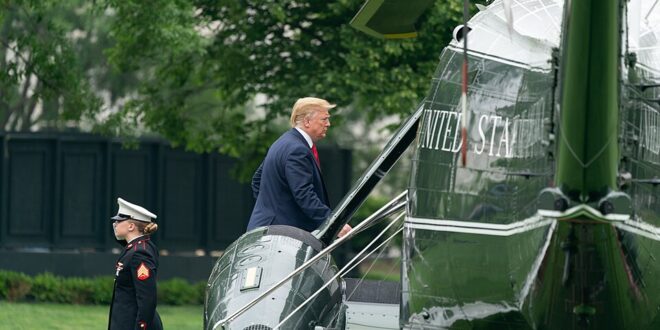
President Donald Trump is considering a major change to the White House grounds by building a permanent helipad to accommodate the next generation of Marine One helicopters, according to multiple people familiar with internal planning discussions.
The proposal, which could move forward as early as this summer, stems from a long-running problem involving the military’s new presidential helicopter fleet, the VH-92A Patriot. Officials say the aircraft’s downward-facing exhaust vents generate enough heat to scorch the White House South Lawn during landings and takeoffs.
The issue has prevented the Marine Corps from fully deploying the new helicopters at the White House despite years of development and nearly $5 billion invested in the fleet.
For decades, presidents have used the South Lawn as the iconic departure point for Marine One flights, with images of commanders-in-chief boarding the helicopter becoming one of the most recognizable visuals of the presidency. Trump’s proposed helipad could permanently alter that tradition.
The VH-92A helicopters, manufactured by Sikorsky Aircraft, a subsidiary of Lockheed Martin, were selected during the Obama administration to replace the aging presidential fleet. The Marine Corps completed delivery of the 23-aircraft fleet nearly two years ago at an estimated total cost of $4.95 billion.
But despite being intended as the future of presidential air travel, the helicopters still are not used for routine South Lawn transport operations.
Instead, presidents continue relying on older models — the VH-3D Sea King and VH-60N White Hawk — that had originally been scheduled for retirement several years ago. According to a February Marine Corps aviation plan, the Sea King is now expected to remain operational through at least 2026, while the White Hawk could stay in service until 2030.
The Marine Corps confirmed in a statement that the VH-92A currently supports presidential travel outside the Washington region while officials continue working toward a full transition.
“The VH-92A continues to support administrative lifts of the President outside the National Capital Region,” the Marine Corps said, adding that the transition would be “event-driven, not time-driven.”
White House officials have not publicly commented on the possibility of constructing a helipad.
Current and former officials familiar with the discussions stressed that the idea predates Trump’s second administration and has circulated within military and White House planning circles for years.
“This is not a Trump wild idea,” one retired military officer said, describing it as a practical solution that previous administrations hesitated to pursue because of the political sensitivity surrounding changes to the historic White House grounds.
Trump, however, has already overseen significant physical changes to the White House complex during his presidency, including renovations to the East Wing and alterations to the West Wing colonnade.
Still, critics argue a permanent helipad would damage the visual and historic character of the White House grounds.
Retired Marine Col. Ray L’Heureux, who previously oversaw Marine One missions, said the proposal resurfaces periodically but remains a mistake.
“I do think that nothing there is broken — so don’t mess with it,” L’Heureux said, arguing that temporary landing pads or other technical fixes could solve the scorching issue without permanently altering the South Lawn.
The helicopter problem first became public during Trump’s first term. A 2018 Government Accountability Office report found the VH-92A was “not meeting a key system capability requirement” because it risked damaging the South Lawn during landings.
Officials in the Biden administration later discovered the issue still lacked a long-term solution and worried the aircraft could create similar problems during overseas travel when presidential helicopters often land on grass surfaces.
Some officials have also raised questions about whether Sikorsky or Lockheed Martin should bear responsibility for funding any White House helipad installation if it ultimately becomes necessary.
Trump has frequently spoken about the symbolism surrounding Marine One flights. During remarks to the Marine One squadron in 2017, he described the helicopter’s arrival and departure from the South Lawn as one of the presidency’s most striking traditions.
“Today, there are few sights more awe-inspiring than Marine One flying up the Potomac … and landing on the South Lawn of the White House,” Trump said at the time.