

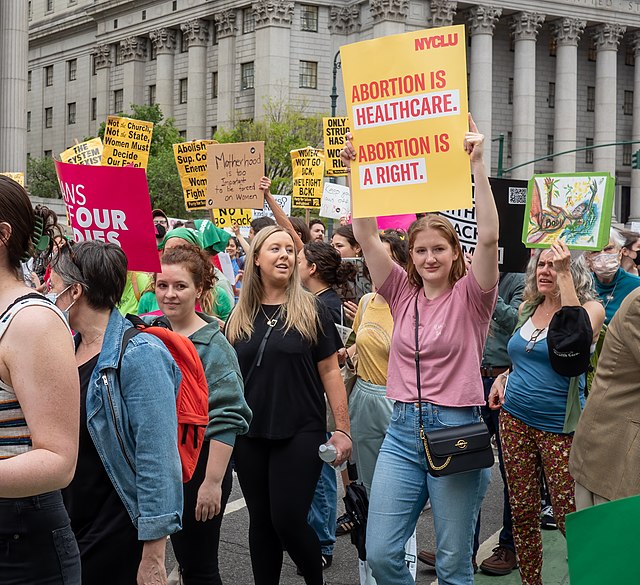
A Tazewell County judge said he will decide by December 4 whether to temporarily block Virginia from certifying the reproductive rights amendment that voters approved on November 3, according to reports from WSLS, Cardinal News, WDBJ and the Virginia Mercury.
Circuit Court Judge Jack Hurley heard arguments on Tuesday, November 24, in a lawsuit filed in April by the Founding Freedoms Law Center, the legal arm of The Family Foundation of Virginia. WSLS reported that the suit was brought on behalf of the Association of American Physicians and Surgeons, the Virginia Medical Freedom Alliance and Bluefield Town Council member Meagan Kade. Founding Freedoms lawyer Josh Hetzler told the Virginia Mercury the hearing was scheduled for three hours and ran closer to five.
About 62 percent of voters said yes to the reproductive rights amendment, according to unofficial results on the State Board of Elections website cited by Cardinal News. The amendment adds protections for abortion, contraception, fertility treatment and miscarriage care to the Virginia Constitution, WDBJ reported. Cardinal News reported that the result becomes official on December 7, when the State Board of Elections is set to certify it, and that the amendment would take effect January 1.
The political news that affects your wallet, your rights and your vote, broken down in plain language. Free in your inbox.
The plaintiffs are asking for a preliminary injunction, which is a court order that freezes something in place while a case is still being decided. If Hurley grants one, certification of this amendment would be paused. Cardinal News reported that the plaintiffs ultimately want the court to void the election result, and that an injunction could keep the amendment from taking effect if the case is not resolved by early 2027.
The core of the challenge is a notice rule. State law required that copies of a proposed constitutional amendment be sent to local circuit court clerks and posted in courthouses before the election. WSLS and WDBJ reported that both sides agree the copies were never sent. The General Assembly later repealed that requirement, but Cardinal News reported the repeal did not take effect until this summer. “It’s the law. It certainly was the law when the violation took place,” Michael Sylvester, a lawyer for the Founding Freedoms Law Center, said in court, according to Cardinal News.
The plaintiffs also argue the ballot wording misled voters about how the reproductive rights amendment would change Virginia law. The Virginia Mercury reported that The Family Foundation gathered sworn statements from four Virginians who said the language confused them and that they would have voted differently. “Our position is that when you’re going to amend the state Constitution, there’s got to be strict compliance with the procedures,” Hetzler told the Mercury. Victoria Cobb, president of The Family Foundation, told WDBJ that “a voter has a right to not be defrauded by their own government.”
Lawyers for the state pushed back. Erin McNeill, a senior assistant attorney general for Virginia, argued that lawmakers who set the process for amending the constitution can also change it. “How can the General Assembly have this authority to prescribe a process but not have the authority to change that process?” she said, according to the Virginia Mercury. Cardinal News reported she also told the court, “They’re making a policy argument about the amendment itself. That’s not the question before this court.”
McNeill argued there was not enough evidence that Kade would suffer irreparable harm, meaning damage that could not be fixed later, without an injunction. Under questioning, Kade said she worried her children could make decisions without her knowledge or consent but declined to go into detail. “We just met, and I’m not speaking of my three children’s medical conditions or lives to you,” she told McNeill, according to Cardinal News. McNeill said the state would appeal if Hurley issues an injunction.
The state and Virginians for Reproductive Freedom, which joined the case as a defendant and is represented by David Fox, also asked Hurley to move the case to Richmond, citing a law that took effect this year requiring challenges to constitutional amendments to be filed there, and to dismiss it entirely, Cardinal News reported. In a statement to the Virginia Mercury, Virginians for Reproductive Freedom called the case a “sham lawsuit” and said the amendment passed with 62.87 percent of the vote.
WSLS reported that by December 4 Hurley will rule on four questions: whether to grant the injunction, whether Tazewell County is the proper place for the case, whether sovereign immunity, the legal rule that shields the state from many kinds of lawsuits, bars the claims against state officials, and whether the complaint makes a legally valid claim at all. Hurley is retiring at the end of the year. Earlier this year he ruled against Virginia’s redistricting amendment effort, and the Supreme Court of Virginia later voted 4 to 3 in a separate case to overturn the redistricting referendum, Cardinal News reported.
If the reproductive rights amendment is ultimately struck down, Virginia’s existing abortion laws would stay in place, WDBJ reported. If Hurley denies the injunction, the State Board of Elections is set to certify the result on December 7. Virginians can follow the certification schedule through the Virginia Department of Elections.