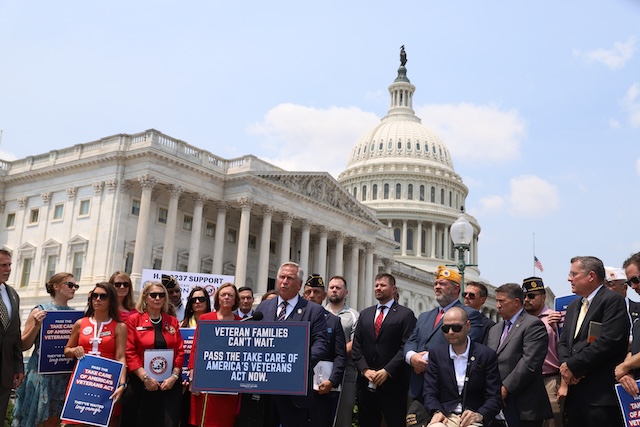
The House passed a sweeping veterans benefits bill on Veterans Day, Wednesday, Nov. 11, sending a package of more than 60 veterans measures to the Senate while two of the country’s largest veterans groups warned that one section could shrink disability pay for veterans who file future claims.
The veterans benefits bill is formally called the Take Care of America’s Veterans Act, numbered H.R. 9237. It passed by voice vote, meaning members called out yes or no together and the presiding officer judged which side was louder, so no individual votes were recorded. House Veterans’ Affairs Committee Chairman Mike Bost, an Illinois Republican who led the bill, celebrated the passage on social media as a package that strengthens veterans’ health care, expands benefits and cuts through bureaucracy at the Department of Veterans Affairs.
The veterans benefits bill folds in several measures that veterans and military families have pushed for years. The Major Richard Star Act would let about 54,000 combat injured military retirees collect both their full military retirement pay and their VA disability compensation. Under current law, many service members who are medically retired with fewer than 20 years of service have their retirement pay reduced. The Love Lives On Act would let surviving spouses of fallen service members remarry without losing their benefits, a change the Tragedy Assistance Program for Survivors says would reach more than 30,000 surviving military families.
The political news that affects your wallet, your rights and your vote, broken down in plain language. Free in your inbox.
The package also includes the Sharri Briley and Eric Edmundson Veterans Benefits Expansion Act, which raises certain monthly payments for veterans with severe service connected disabilities and for survivors of those who die from service related injuries. Rep. Jared Golden, a Maine Democrat, said in a statement that the bill also expands residential treatment for veterans dealing with substance use or mental health challenges, raises the monthly housing allowance under the GI Bill for students taking online courses or apprenticeships, and widens access to tech career training. The bill would also write into law the rules for when veterans can get care from private doctors outside the VA, known as community care.
The fight is over Section 108. That section changes how the VA rates certain service connected conditions, including tinnitus, a constant ringing in the ears, and obstructive sleep apnea. The Veterans of Foreign Wars and Disabled American Veterans say the change would lower compensation for future claimants and use those savings to help pay for the rest of the veterans benefits bill. Disabled American Veterans cites a VA analysis estimating the changes could affect up to 1.5 million veterans and cut compensation payments by as much as $57 billion over 10 years, according to Military.com. Veterans who already receive disability awards would generally be protected, though new claims and some reevaluations could be affected.
VFW National Commander in Chief Cory Geisler said, “It is an insult to America’s veterans that Congress would advance legislation threatening their earned benefits,” and said the proposal “should be dead on arrival in the Senate.” Tragedy Assistance Program for Survivors President and Founder Bonnie Carroll said, “We are so encouraged by today’s House vote,” and urged the Senate to quickly follow the House.
The Trump administration said in a July 15 statement of administration policy that it supports the bill, including the community care rules and support for caregivers, families and survivors. The administration said it had concerns about provisions involving the U.S. Court of Appeals for Veterans Claims and a request for documents it says are protected by executive privilege.
The House took a second vote tied to the Star Act the same day. Members voted 245 to 175 to approve a motion to discharge a resolution that would set up a separate, standalone vote on the Star Act, H.R. 2102. A discharge motion lets a majority of the House force a measure to the floor when leadership or a committee has not moved it. According to the House Republican Cloakroom tally, every Democrat voting and 34 Republicans voted yes. Further action on that measure was postponed.
The veterans benefits bill now goes to the Senate, where Senate Veterans’ Affairs Committee Chairman Jerry Moran, a Kansas Republican, has backed the package approach. If the Senate changes the bill, the House would have to vote again before it could go to the White House. Time is short. The current Congress ends when the new Congress is sworn in on Jan. 3, 2027, and any bill that has not cleared both chambers by then dies and would have to be introduced again.