

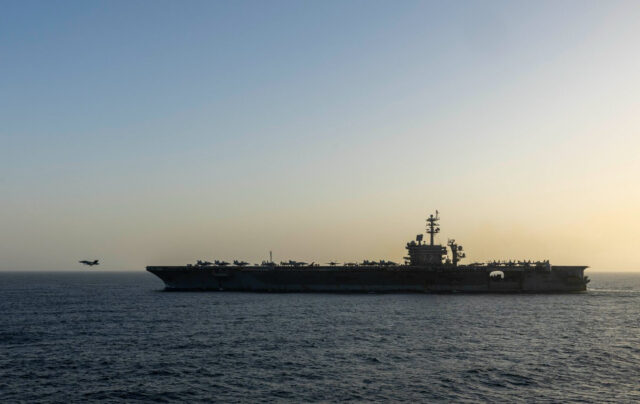
President Donald Trump said Sunday that U.S. forces seized an Iranian-flagged cargo ship accused of attempting to breach an American naval blockade, marking a sharp escalation in tensions just days before a fragile ceasefire with Iran is set to expire.
In a post on Truth Social, Trump said the nearly 900-foot vessel TOUSKA was intercepted in the Gulf of Oman by the Navy destroyer USS Spruance after ignoring repeated warnings. He said the ship was disabled and boarded, and that U.S. Marines had taken control. Iranian officials had not publicly commented on the reported seizure as of Sunday.
The incident underscores the instability of the two-week ceasefire, which is due to expire Wednesday, as both sides accuse each other of violations and negotiations appear increasingly uncertain.
The confrontation comes amid rising tensions in and around the Strait of Hormuz, a critical global shipping route for oil and gas.
Trump earlier accused Iran of firing on vessels transiting the strait, calling it a “total violation” of the ceasefire. Tehran has countered that U.S. enforcement of a naval blockade constitutes a breach of the agreement.
After briefly reopening the waterway Friday, Iran effectively closed it again Saturday, citing continued U.S. military pressure.
Trump coupled the announcement of the ship seizure with renewed threats of broader military action, warning that the United States could target Iran’s infrastructure if negotiations fail.
“We’re offering a very fair and reasonable DEAL,” Trump wrote. “If they don’t, the United States is going to knock out every single Power Plant, and every single Bridge, in Iran.”
The administration has maintained that the naval blockade will remain in place until a broader agreement is reached, a stance Iran has rejected as incompatible with the ceasefire.
Two senior administration officials said Vice President JD Vance, special envoy Steve Witkoff and presidential adviser Jared Kushner are expected to travel to Islamabad, Pakistan, for another round of negotiations.
Trump said the delegation could arrive as early as Monday evening, though Iranian officials have disputed that timeline.
Iran’s state-run IRNA news agency said there is “no clear prospect” for talks under current conditions, citing what it described as excessive U.S. demands and continued enforcement of the blockade.
Iranian President Masoud Pezeshkian said Sunday that Tehran is seeking to end the war “with full dignity” but accused Washington of attempting to deny Iran its “nuclear rights.”
Tensions at sea have intensified in recent days, with multiple reports of vessels being targeted or turned back.
French shipping giant CMA CGM said one of its ships was subjected to warning shots. Maritime authorities also reported gunfire and a projectile strike involving Indian vessels, while Iranian state media confirmed shots were fired to force ships to turn back.
Iran’s Islamic Revolutionary Guard Corps has warned that any vessels attempting to cross the strait could be considered as cooperating with adversaries and may be targeted.
Meanwhile, U.S. Ambassador to the United Nations Mike Waltz said Sunday that “everything’s on the table” as negotiations remain uncertain, adding that Iran faces a choice between engaging diplomatically or continuing its current course.
The standoff highlights the fragile nature of the ceasefire and the broader regional risks tied to disruptions in the Strait of Hormuz, through which a significant portion of the world’s energy supply flows.
The conflict has already affected global shipping, driven volatility in oil markets and raised concerns among international leaders about economic fallout.
Following a summit co-chaired by France and the United Kingdom, leaders including Emmanuel Macron and Keir Starmer called for the “unconditional” reopening of the waterway and announced plans for a neutral mission to protect commercial shipping.
With the ceasefire set to expire Wednesday, the coming days are expected to be critical in determining whether diplomacy can prevent further escalation.
Iran’s Parliament Speaker and chief negotiator Mohammad Bagher Ghalibaf said some progress has been made in talks but warned that significant gaps remain.
“If the ceasefire is not implemented, we will not continue negotiations, and we will start the war,” he said.
U.S. officials said Trump convened a Cabinet-level meeting Saturday to assess the situation, signaling growing concern within the administration as both military and diplomatic paths remain in flux.