Poli Alert Politics & Civics
Related Articles


A federal grand jury has indicted former FBI Director James Comey on charges of threatening President Donald Trump, marking the second time he has faced prosecution under the Trump administration’s Justice Department.
The indictment, returned Tuesday in the Eastern District of North Carolina, charges Comey with two counts: making a threat to kill or inflict bodily harm on the president, and transmitting that threat across state lines.
Authorities allege the charges stem from a social media post last year in which Comey shared an image of seashells arranged to form the numbers “86 47” — a combination prosecutors say could reasonably be interpreted as a call for violence against Trump, the nation’s 47th president.
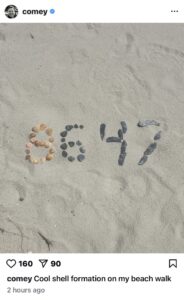
According to the indictment, the image — briefly posted to Instagram — would be understood by a “reasonable recipient” familiar with the context as “a serious expression of an intent to do harm.”
The post sparked backlash from Trump supporters, who interpreted “86” as slang for “eliminate” and “47” as a reference to Trump’s presidency. Comey later deleted the image, saying he believed it conveyed a “political message” and that he had not associated the numbers with violence.
“I oppose violence of any kind,” Comey wrote at the time.
The case follows an earlier indictment against Comey last year on separate charges related to congressional testimony, which was later dismissed by a federal judge over concerns about the prosecutor’s appointment.
Comey’s legal team has denied the new allegations, framing the case as a First Amendment issue.
His attorney, Patrick Fitzgerald, said Comey “vigorously denies the charges” and intends to challenge them in court, adding that the defense looks forward to “vindicating Mr. Comey and the First Amendment.”
Legal experts note that prosecuting alleged threats against the president hinges on whether the statement constitutes a “true threat” under federal law — a standard that considers intent, context and how a reasonable person would interpret the communication.
Comey has argued the image was not intended as a threat, while prosecutors contend its meaning would be widely understood as violent.
Acting Attorney General Todd Blanche defended the charges, saying the department treats all threats against the president seriously.
“Threatening the life of anybody is dangerous and potentially a crime,” Blanche said. “Threatening the life of the president of the United States will never be tolerated.”
U.S. Attorney W. Ellis Boyle said Comey would receive full due process, emphasizing that enforcement of federal law applies regardless of a defendant’s status.
“In the Eastern District of North Carolina, it doesn’t matter who you are,” Boyle said.
Officials said the investigation has been ongoing for roughly a year and remains active.
The case comes amid a broader climate of heightened concern over threats against public officials, as federal authorities report routinely prosecuting such cases each year.
At the same time, the indictment revives longstanding tensions between Trump and Comey, whose relationship deteriorated sharply during Trump’s first term.
A warrant has been issued for Comey’s arrest, and he is expected to appear in federal court in North Carolina. The case has been assigned to U.S. District Judge Louise Wood Flanagan.
Comey has indicated he plans to contest the charges, setting up a legal battle likely to focus on the interpretation of his social media post and the boundaries of protected speech.