Poli Alert Politics & Civics
Related Articles
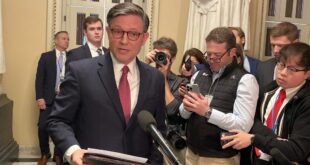

The House ground to a halt Tuesday after Republican leaders failed to advance a key procedural rule needed to consider a slate of major legislation, exposing deep divisions within the GOP conference and freezing floor action.
Lawmakers briefly reconvened before quickly recessing as Speaker Mike Johnson and his leadership team continued closed-door negotiations with rank-and-file Republicans in an effort to break multiple stalemates.
The impasse comes as King Charles III is scheduled to visit Capitol Hill later Tuesday, further compressing the window for negotiations ahead of a planned afternoon address.
At issue is a procedural rule that would allow the House to debate and vote on several high-profile measures, including the reauthorization of Section 702 of the Foreign Intelligence Surveillance Act, a sweeping farm bill and a Senate-passed budget resolution.
Without agreement on the rule, the House cannot move forward on any of the underlying legislation — effectively paralyzing the chamber.
Republican leaders had worked late into the night attempting to revive a plan to extend Section 702, a surveillance authority that allows U.S. intelligence agencies to collect communications of foreign targets abroad. The proposal had already failed once last week after conservatives joined Democrats to block it.
The renewed push to pass the surveillance measure has run into resistance from at least 10 Republicans, with members of the conservative House Freedom Caucus withholding support, according to people familiar with the discussions.
Some hard-line conservatives are demanding the inclusion of a ban on a central bank digital currency as part of any agreement — a provision opposed by GOP leadership, the White House and other Republicans.
At the same time, disagreements over the farm bill have added to the gridlock. Republican leaders are attempting to quell backlash over a pesticide-related provision criticized by some conservatives, while also navigating demands from Midwestern lawmakers seeking a vote on year-round sales of E-15 ethanol.
Those competing priorities have complicated efforts to assemble a coalition broad enough to pass the rule.
Johnson and his leadership team have been engaged in ongoing negotiations aimed at crafting a package that can win over both hard-line conservatives and more moderate Republicans.
Their strategy includes potentially allowing votes on key amendments — such as a proposal from Rep. Anna Paulina Luna to remove the contested pesticide provision — in hopes of easing internal tensions.
However, leaders have so far been unable to bridge the divides, leaving the House in a holding pattern.
The standoff reflects ongoing challenges for House Republicans, who hold a narrow majority and have struggled to unify around major legislative priorities.
Internal disagreements over surveillance authorities, agricultural policy and fiscal strategy have repeatedly derailed floor action in recent months.
The budget resolution adds another layer of tension. Some conservatives are wary of advancing a Senate-backed plan that would limit a future party-line legislative package primarily to immigration enforcement, rather than a broader set of conservative priorities.
House leaders are expected to continue negotiations throughout the day, though it remains unclear when — or if — they will secure enough support to move forward.
Until a rule is adopted, floor action will remain stalled, delaying consideration of the surveillance extension, farm bill and budget resolution.
The outcome of the talks will likely determine whether Republicans can advance their legislative agenda in the coming days or face continued paralysis on the House floor.