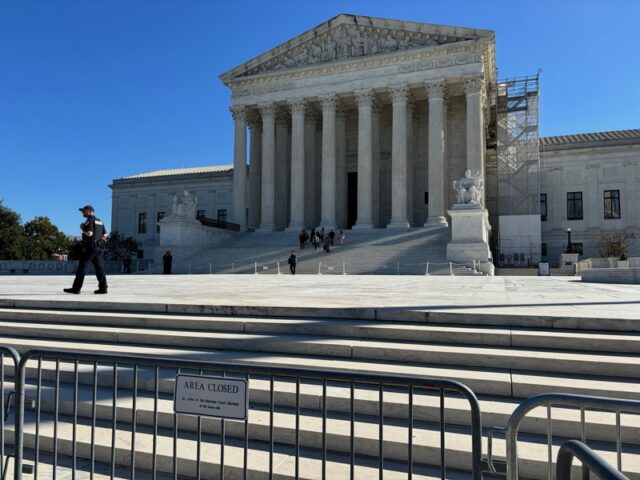
The Supreme Court on Monday declined to hear a challenge to Maryland gun restrictions that prohibit carrying firearms in certain public places, leaving the state’s law in effect despite questions from Justice Clarence Thomas about whether some of those restrictions violate the Second Amendment.
The decision means Maryland can continue enforcing the challenged restrictions while litigation over gun rights and public safety continues across the country. However, the justices did not issue a ruling on whether the state’s law is constitutional.
The case, Novotny v. Moore, challenged provisions of Maryland’s Gun Safety Act of 2023, which expanded restrictions on where people with permits to carry concealed firearms can bring their weapons.
The political news that affects your wallet, your rights and your vote, broken down in plain language. Free in your inbox.
Maryland lawmakers approved the legislation after the Supreme Court’s 2022 decision in New York State Rifle & Pistol Association v. Bruen, which strengthened constitutional protections for carrying firearms in public.
The Maryland law identifies certain locations as sensitive places where carrying firearms is prohibited, even for individuals who otherwise have legal authorization to carry concealed weapons.
The restrictions cover locations including certain government facilities, schools and other designated public spaces. Some provisions involving private property and places open to the public have faced separate constitutional challenges.
Gun rights advocates argued that Maryland’s restrictions went beyond the limits recognized by the Supreme Court and improperly prevented law-abiding citizens from carrying firearms for self-defense.
Maryland officials defended the state’s authority to regulate firearms in locations where lawmakers determined additional public safety protections were necessary.
The legal dispute centered on how far states can go in restricting public gun possession following the Supreme Court’s expansion of Second Amendment protections.
In its 2022 Bruen decision, the Supreme Court ruled that Americans generally have a constitutional right to carry firearms in public for self-defense. The ruling also established a legal test requiring governments to demonstrate that firearm restrictions are consistent with the nation’s historical tradition of gun regulation.
That standard has forced federal courts to examine historical firearm laws when deciding whether modern restrictions are constitutional.
The Supreme Court acknowledged in Bruen that certain sensitive locations, including schools and government buildings, could remain subject to firearm restrictions. But the decision left unresolved questions about how broadly states could define those locations.
Those unanswered questions became central to the Maryland litigation.
The dispute reached the Supreme Court after the 4th U.S. Circuit Court of Appeals upheld the challenged location restrictions. The appeals court concluded that the state could prohibit firearms in those locations under the constitutional framework established by Bruen.
The appeals court also struck down a separate Maryland provision that generally required permission to carry firearms onto private property open to the public. That provision was distinct from the sensitive-place restrictions left standing by Monday’s decision.
Justice Thomas, who wrote the Supreme Court’s majority opinion in Bruen, issued a separate statement explaining why he agreed to reject the Maryland appeal despite his concerns about the law.
“I harbor serious doubts that our Nation’s historical tradition of firearm regulation supports many of these sweeping restrictions,” Thomas wrote.
He questioned whether restrictions covering public demonstrations, mass transit, amusement venues, health care facilities, establishments serving alcohol and extensive areas of state parkland could be justified under the Constitution.
However, Thomas concluded that the Maryland lawsuit challenged too many different restrictions at once, making it difficult for the Supreme Court to evaluate the historical justification for each provision.
He indicated that a future lawsuit challenging a specific restriction could provide a better opportunity for the justices to clarify the constitutional limits on sensitive-place gun laws.
“In an appropriate case, this Court should consider whether particular sensitive-place laws are consistent with the right to public carry,” Thomas wrote.
Thomas’s statement does not establish a new legal precedent or indicate how the other eight justices would decide such a case. The court’s refusal to hear the appeal also does not mean the justices endorsed the appeals court’s reasoning.
For Maryland residents, Monday’s decision leaves the challenged location restrictions in place. Individuals with concealed carry permits must continue following state laws governing where firearms can legally be carried.
The restrictions are particularly relevant to people who use public transportation, visit state parks, attend public demonstrations or enter businesses and facilities designated as sensitive locations.
The case also carries implications beyond Maryland. States including New York, New Jersey, California and Hawaii have faced similar litigation over laws restricting firearms in public places.
According to Reuters, federal appeals courts have reached decisions addressing the constitutional boundaries of those restrictions, creating continuing legal disputes over how the Supreme Court’s Second Amendment rulings should be applied.
The Supreme Court has expanded gun rights in several major decisions while also recognizing that certain firearm regulations remain permissible.
In 2024, the justices upheld a federal law prohibiting people subject to qualifying domestic violence restraining orders from possessing firearms, demonstrating that the Second Amendment does not prohibit every restriction on gun ownership or possession.
The court is also scheduled to hear arguments December 2 in a separate case involving state restrictions on AR-15-style rifles and other semiautomatic firearms.
That case addresses restrictions on particular weapons rather than where firearms may be carried.
For now, the Maryland decision leaves the existing restrictions intact without resolving the larger constitutional dispute. Thomas’s statement makes clear that at least one justice remains interested in reconsidering the limits of sensitive-place gun laws if a narrower challenge reaches the court.