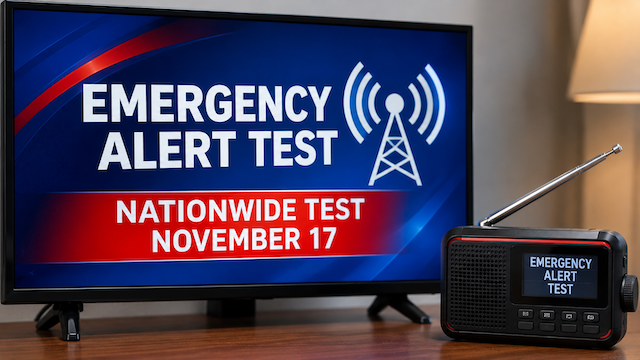
A nationwide emergency alert test is scheduled for Tuesday, Nov. 17, at 2:20 p.m. Eastern, when federal officials will temporarily interrupt television and radio programming to evaluate the system used to warn Americans about major emergencies.
The test will assess the Emergency Alert System, or EAS, a nationwide network that allows federal, state and local authorities to broadcast urgent warnings during natural disasters, national security emergencies and other threats to public safety.
The Federal Emergency Management Agency, known as FEMA, is coordinating the test with the Federal Communications Commission, which regulates the nation’s broadcast and communications systems.
The political news that affects your wallet, your rights and your vote, broken down in plain language. Free in your inbox.
The interruption is expected to last approximately one minute. Viewers and listeners may hear an emergency alert tone followed by a message explaining that the broadcast is only a test.
The public does not need to take any action.
Unlike the nationwide emergency alert test conducted in October 2023, Tuesday’s exercise is focused on television and radio broadcasts. Cellphones are not expected to receive a Wireless Emergency Alert, the separate system that delivers emergency notifications directly to compatible mobile devices.
The test will also reach cable television, satellite television, satellite radio and other participating video services. According to the FCC, the alert will be transmitted in English and Spanish, although the language heard or displayed may depend on the broadcaster.
The federal government uses the Emergency Alert System to distribute urgent information when a national emergency threatens public safety. State and local officials also use the network to warn residents about severe weather, evacuations and other emergencies.
The system operates through thousands of participating broadcasters and communications providers. During a national emergency, it can also be used to deliver messages from the federal government across the country.
Under the Integrated Public Alert and Warning System Modernization Act of 2015, FEMA must conduct nationwide public warning tests at least once every three years. The exercises help officials determine whether participating providers can receive, process and distribute emergency messages properly.
The last nationwide test occurred Oct. 4, 2023, when emergency notifications were delivered through television, radio and compatible cellphones.
This year’s test will be narrower because federal officials are evaluating the broadcast warning network rather than the separate cellphone alert system.
FEMA Administrator Cameron Hamilton said the exercise is intended to uncover problems before an actual emergency occurs.
“During an emergency, every second is crucial,” Hamilton said in a statement released Monday. He added that operational testing allows federal officials to identify and correct potential problems in the warning infrastructure.
The FCC has also directed participating broadcasters and communications providers to document their results. Those reports will help regulators evaluate whether the test message was successfully received and transmitted and identify any technical failures requiring additional attention.
For households that rely on television or radio for news and emergency information, the exercise provides an opportunity to see how a national warning would appear during an actual crisis.
Emergency management officials also encourage residents to review their personal emergency notification settings. The Maryland Department of Emergency Management, for example, recommends enabling emergency alerts on mobile devices, signing up for local government notifications and maintaining more than one way to receive urgent information.
Those precautions are especially relevant during severe storms, flooding, hurricanes and other disasters that can disrupt electricity or communications services.
The National Weather Service has clarified that NOAA Weather Radio receivers will not receive Tuesday’s nationwide test, although those devices remain an important source of weather warnings during emergencies.
Federal officials have designated Thursday, Dec. 3, as a backup date if severe weather, a national emergency or other conditions prevent the scheduled test from proceeding.
Unless the exercise is postponed, Americans watching television or listening to radio at approximately 2:20 p.m. Eastern on Tuesday should expect a brief interruption, an emergency alert tone and a message identifying the broadcast as a test.
Normal programming will resume afterward, and no public response is required.