Poli Alert Politics & Civics
Related Articles



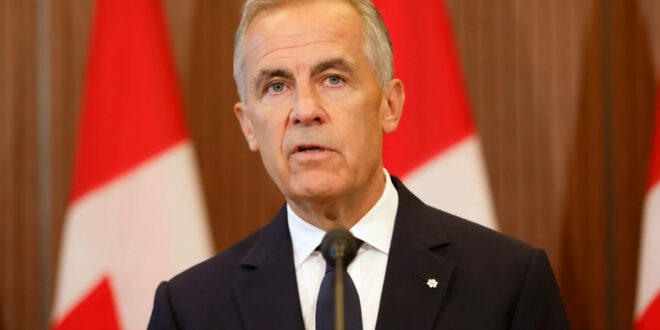
Canada is preparing to impose dollar-for-dollar retaliatory tariffs on U.S. goods beginning Sept. 8, Prime Minister Mark Carney said Saturday, escalating a trade war with Washington after last-minute negotiations failed to prevent new American tariffs on Canadian products.
Carney said Canada’s retaliation will target a broad range of U.S. exports, including steel, dairy products, appliances, agricultural equipment, pulp and paper, and electronics.
The announcement came hours after the United States imposed 50% tariffs on about $20 billion worth of Canadian goods, ending a three-day delay that President Donald Trump had granted to give negotiators more time to reach an agreement.
“In the coming days, we will release the details of these new tariff measures, which will come into force the Tuesday after Labor Day,” Carney said.
The Canadian leader said the measures would match the new U.S. tariffs “dollar for dollar.”
Canada prepares broad retaliation
Carney’s announcement marks a significant escalation in the dispute between the two longtime allies and trading partners.
Canada had been prepared to remove some of its retaliatory tariffs on U.S. steel, aluminum and automobiles if Washington agreed to substantially reduce its own tariffs, according to Carney.
Ottawa also offered to encourage Canadian provinces to restore sales of U.S. alcohol.
But Carney said the final U.S. demands changed at the last minute and ultimately made an agreement impossible.
“Last-minute changes in the U.S. proposed terms were unfair, uneconomic, and called into question the reliability of any deal,” Carney said.
He said Washington “asked too much and offered too little.”
Carney subsequently suspended negotiations and directed Canada’s negotiating team to return to Ottawa.
Trump tariffs trigger Canadian response
The Canadian retaliation follows Trump’s decision to impose 50% tariffs on approximately $20 billion of Canadian products.
U.S. Trade Representative Jamieson Greer said Canada had declined to finalize an agreement based on terms reached earlier in the week.
“We’re moving forward with measures that respond to Canadian retaliation,” Greer said. “After a year of that retaliation, we’ve said enough, and so we’ve taken countermeasures.”
Greer said the Trump administration had offered Canada favorable treatment, including potential tariff reductions involving steel, automobiles and lumber.
But he told Fox News Saturday that there were “no new planned talks with the Canadians.”
That leaves both countries heading into a potentially prolonged period of tariff escalation.
Ottawa warns tariffs are designed to hurt Canada
Carney accused the Trump administration of deliberately using tariffs to pressure Canada and said Ottawa would respond without backing down.
“The new U.S. tariffs are designed to hurt us and divide us,” Carney said. “They’re a miscalculation.”
He said Canada would rely on its own economic strength and unity to withstand the new trade measures.
“We know we’re stronger together,” Carney said.
Ontario Premier Doug Ford, who leads Canada’s most populous province, endorsed Carney’s response and called for retaliation “tariff for tariff, dollar for dollar.”
“Everything needs to be on the table,” Ford said.
Trade dispute threatens $880 billion relationship
The retaliation threatens to deepen a trade fight between two countries that exchanged roughly $880 billion in goods and services last year.
Canada is particularly vulnerable to disruptions in trade with the United States. Nearly 72% of Canada’s goods exports went to the U.S. last year, according to Canadian government data.
The Canadian tariffs could raise costs for American companies that rely on Canadian customers and suppliers, while U.S. tariffs could increase prices and disrupt Canadian businesses that depend heavily on access to the American market.
The affected U.S. exports could include products used throughout Canada’s manufacturing, agricultural and consumer sectors.
Businesses face renewed uncertainty
The latest escalation also creates new uncertainty for companies operating across the North American supply chain.
Most Canadian imports currently enter the United States without the broader U.S. tariff because they comply with the United States-Mexico-Canada Agreement, or USMCA.
But the Trump administration is reviewing the agreement, adding another layer of uncertainty for companies that rely on cross-border trade.
The latest breakdown came just days after Trump announced he was delaying the 50% Canadian tariffs for three days, saying the countries had reached a tentative agreement pending final documents.
That agreement ultimately collapsed.
Tariff fight comes before midterms
The dispute is also unfolding less than three months before the U.S. midterm elections, when economic issues and the cost of living are expected to remain major concerns for voters.
Tariffs are paid initially by importers and can be passed on to consumers through higher prices.
That creates political risks for the Trump administration if the trade fight contributes to higher costs for American households.
For Canada, the challenge is balancing retaliation with the need to protect businesses and consumers from the economic consequences of a prolonged confrontation with its largest trading partner.
Unless negotiations resume, the Sept. 8 Canadian tariffs could mark the beginning of another round of escalating trade measures between Washington and Ottawa.
SEO Package
Meta description: Canada will impose dollar-for-dollar tariffs on U.S. goods Sept. 8 after Trump escalated the trade war with 50% tariffs on Canadian products.
Focus keyphrase: Canada retaliation
SEO keywords:
- Canada retaliation
- Canadian tariffs
- U.S.-Canada trade war
- Mark Carney tariffs
- Trump Canada tariffs
- Canadian retaliatory tariffs
- U.S. trade war
- USMCA trade agreement