Poli Alert Politics & Civics
Related Articles


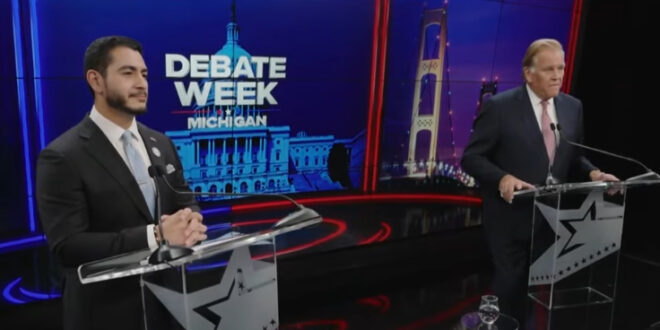
Michigan’s closely watched U.S. Senate race turned into a personal brawl Thursday as Democrat Abdul El-Sayed and Republican Mike Rogers traded insults, challenged each other’s credibility and clashed over the war in Iran, health care, immigration and President Donald Trump’s agenda.
The first televised debate of the campaign featured accusations about campaign donors, foreign property, professional credentials and family members. The candidates repeatedly interrupted one another, prompting moderator Rick Albin to complain that he wanted to participate in the debate, too.
At stake is a Senate seat that could help determine which party controls the chamber after the November midterm elections.
Trump, who has won Michigan twice, loomed over the debate. El-Sayed sought to portray Rogers as an extension of an increasingly unpopular administration, while Rogers attempted to distance himself from some of Trump’s policies without alienating the president’s supporters.
The exchange offered five key takeaways about the candidates, their sharply different priorities and the political challenges facing both campaigns.
1. The personal attacks overshadowed the policy debate
The candidates’ hostility was evident from the opening exchanges, with both men repeatedly steering the discussion toward the other’s finances, personal history and credibility.
El-Sayed, a Rhodes scholar and public health official with a medical degree, criticized Rogers’ wealth and ownership of two yachts, accusing the Republican of prioritizing political power over ordinary voters.
Rogers, a former congressman and FBI agent, called El-Sayed a “con man” and a “glitchy AI chatbot.” He also questioned El-Sayed’s medical credentials and accused him of owning luxury property in the Middle East.
The argument grew more personal when Rogers raised allegations involving El-Sayed’s mother. El-Sayed objected to the attack, while Rogers responded by discussing his own mother’s work at a local chamber of commerce.
Rogers also directed viewers to a website he said featured deleted social media posts from El-Sayed. El-Sayed responded sarcastically: “You made a website. That’s awesome. Good for you.”
The exchanges continued even during a commercial break, Albin said afterward, describing an argument over the candidates’ homes and their respective property values.
The debate’s combative tone reflected a campaign that has already featured months of personal attacks through social media and television advertising.
2. The candidates offered sharply different economic agendas
The debate also highlighted the candidates’ competing approaches to health care, housing, taxation and the rising cost of living.
El-Sayed advocated a broad expansion of public health care, higher taxes on billionaires to help reduce the federal debt, restrictions on investment firms buying single-family homes and changes to campaign finance rules to limit corporate and wealthy donors’ influence.
He argued that economic policy should prioritize working families over the accumulation of additional wealth by the richest Americans.
“I don’t think it’s important for a billionaire to make a second billion. I think it’s more important for the average person to be able to make their first $100,000,” El-Sayed said.
Rogers portrayed El-Sayed’s proposals as financially unrealistic and argued that his opponent’s agenda would make life more expensive.
“We cannot afford Abdul,” Rogers said.
The Republican instead proposed measures including gas-price caps, assistance for farmers facing high diesel costs and reducing regulatory barriers to housing construction.
The candidates also discussed artificial intelligence and surveillance technology. El-Sayed called for federal guardrails on AI and restrictions on controversial surveillance systems, including automated license plate reader networks operated by companies such as Flock Safety.
Rogers defended the use of surveillance cameras to combat terrorism and crime, suggesting that opponents should consider whether their concerns were connected to potential scrutiny of people close to them.
The exchange became another flashpoint in a debate where policy disagreements frequently turned into personal accusations.
3. Israel, Gaza and Iran exposed a deep foreign policy divide
The candidates’ differences over the Middle East were among the debate’s most contentious issues.
El-Sayed has described Israel’s military campaign in Gaza as genocide and called for an end to unconditional U.S. military aid to foreign governments. Those positions were central to his Democratic primary campaign and have continued to draw criticism from Republicans and some Democrats.
Rogers challenged El-Sayed over his response to the third anniversary of Hamas’ Oct. 7, 2023, attack on Israel. He also accused the Democrat of accepting campaign contributions from people with ties to Hamas and Hezbollah.
El-Sayed denied the allegations involving his campaign and said he had condemned the Oct. 7 attack.
“I’ve condemned that. I didn’t turn into political theater like you just did,” he said.
El-Sayed argued that U.S. foreign policy should place greater emphasis on domestic needs rather than military operations overseas. He also blamed Israel for drawing the United States into the war against Iran, a claim that reflects his criticism of Washington’s relationship with the Israeli government.
“Ask yourself: Are we safer because of that war?” El-Sayed said. “He wants unconditional support for a foreign government. I want unconditional support for kids in our schools.”
The candidates also diverged over how to assess threats from Iran and Israel, as well as the appropriate level of U.S. support for Israel.
The debate demonstrated how the conflict in the Middle East has become a defining issue in Michigan politics, where the candidates are competing for voters with sharply different views on military aid, national security and America’s role overseas.
4. Rogers tried to distance himself from Trump without breaking with him
Trump remains central to the Senate contest, creating a challenge for Rogers as the president’s approval ratings have come under pressure over the Iran war, tariffs and the cost of living.
Rogers has supported Trump and campaigned alongside him before Michigan’s Aug. 4 primary. El-Sayed has sought to make that relationship a liability, portraying the Republican as a “sock puppet” for the administration.
“The question is, do you elect a U.S. senator from Michigan who wants to fight the Trump agenda?” El-Sayed said.
Rogers has recently tried to distinguish himself from Trump on tariffs against Canada, a particularly consequential issue in Michigan because of the state’s economic ties to its northern neighbor.
In a campaign advertisement released this week, Rogers said, “We know that Canada is not our enemy. We need to end the tariff war — now.”
The statement marked a shift from his earlier position that Trump was right to use tariffs as part of an America First economic strategy, though Rogers had previously said tariffs should not be applied as a one-size-fits-all policy.
Asked about the change, Rogers said he had contacted the White House to urge Trump to reach a deal ending the tariff dispute with Canada.
The candidates also addressed federal immigration enforcement in Minneapolis, where two protesters were killed by federal agents. Rogers described the enforcement tactics as “probably not appropriate,” saying operations should be conducted more quietly to avoid creating problems in neighborhoods.
El-Sayed rejected the qualification, saying the killings were clearly unacceptable.
After the debate, Rogers said he would welcome Trump campaigning for him in Michigan, underscoring that the Republican was seeking to maintain the president’s support even while creating some distance on individual policies.
5. Both candidates are trying to win voters outside their traditional bases
The debate reflected a broader effort by both campaigns to reach voters who do not automatically align with their party.
Rogers made appeals to Democrats and voters concerned about U.S.-Israel relations, while also seeking support from Black voters in Detroit, a key constituency in Democratic statewide campaigns.
“Our fastest selling sign is ‘Democrats for Mike Rogers,’” Rogers said after the debate, arguing that El-Sayed’s rhetoric had alienated potential supporters.
El-Sayed, meanwhile, has campaigned in rural and conservative parts of Michigan with an economic message focused on the cost of living. He has repeatedly appeared on Fox News and emphasized gas and grocery prices, seeking to reach voters who may support Trump but are frustrated by economic conditions.
El-Sayed also pushed back against questions about whether he could unite Democrats after a divisive primary against Rep. Haley Stevens.
He pointed to support from Gov. Gretchen Whitmer and Sen. Elissa Slotkin, who defeated Rogers in the 2024 Senate race, and cited former President Barack Obama’s planned appearance with him later in October.
“We’ve got a unified party,” El-Sayed said. “Now, look, of course, you’ve always got to keep talking to different groups of people, and I’m going to keep doing that.”
The challenge for both candidates is to broaden their coalitions without alienating the voters who carried them through their primaries. Thursday’s debate showed how difficult that balance may be as the campaigns enter the final stretch.
With the Senate majority potentially at stake, the race is likely to remain a major focus of national political attention. The debate made clear that the contest will be fought not only over policy but also over character, credibility and each candidate’s relationship with a deeply polarized national political landscape.