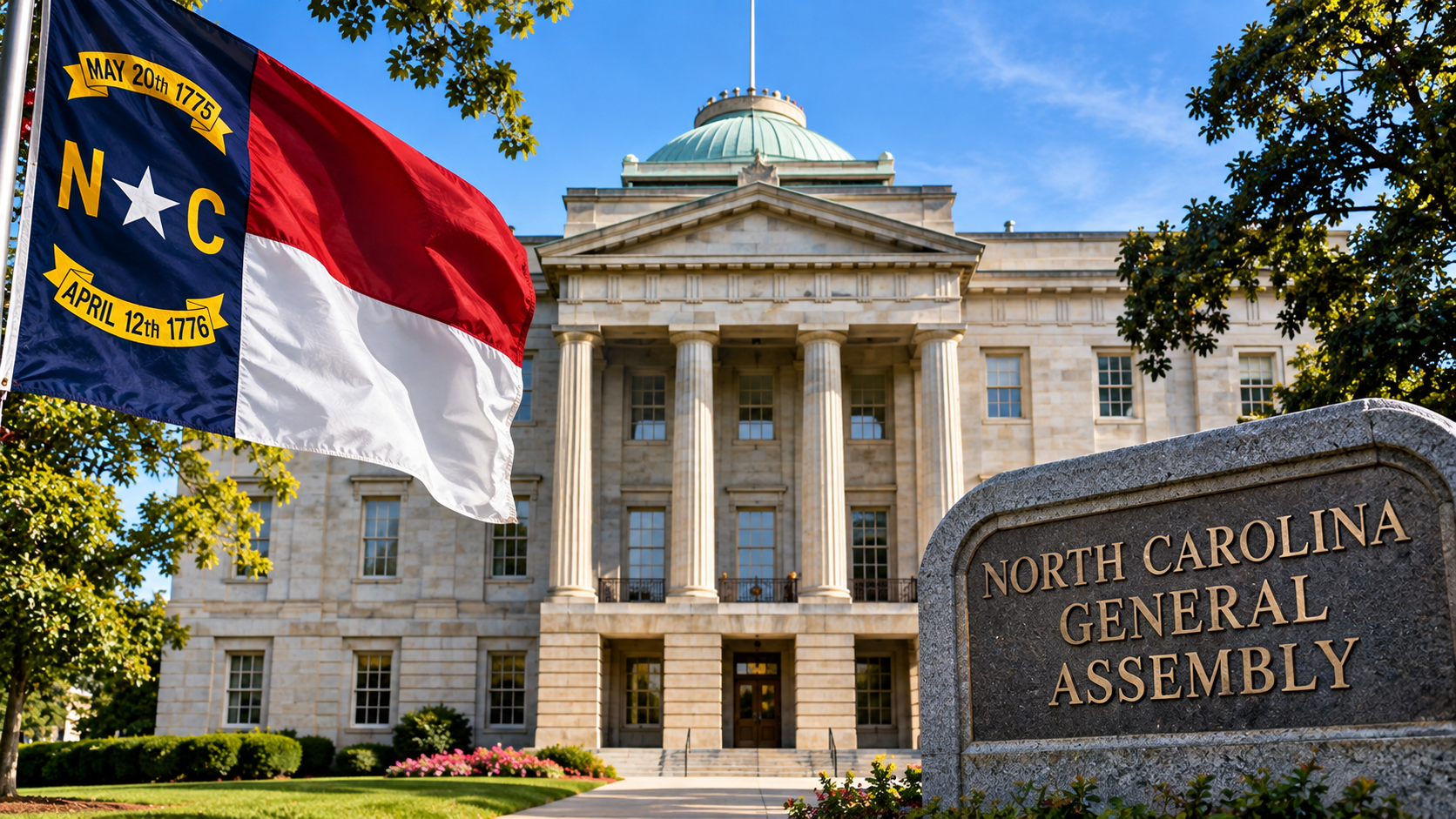
The North Carolina legislature returns to Raleigh on Monday, Nov. 16, for a lame duck session, the stretch between an election and the day newly elected lawmakers take office, giving Republicans one more chance to pass bills and override Gov. Josh Stein’s vetoes before Democrats take control of the state House in January.
Under the adjournment resolution, both chambers are scheduled to meet Nov. 16 through 19, break for Thanksgiving and possibly return Nov. 30, with the option to stay until Dec. 18. Carolina Journal reported that the resolution limits business to veto overrides, certain appointments, constitutional amendments, election laws, conference reports and bills waiting on a final vote. WUNC reported that no agenda or vote schedule had been released, and House Rules Chairman John Bell said he expects members back Tuesday.
Democrats won the state House on Nov. 3 for the first time since 2011, and Republicans are projected to keep the state Senate with a narrower 26 to 24 majority, according to Carolina Journal. Current members of the North Carolina legislature stay in office until their terms end in late December, so Republicans keep their present majorities for now.
The political news that affects your wallet, your rights and your vote, broken down in plain language. Free in your inbox.
The biggest question facing the North Carolina legislature is veto overrides. Overriding a governor’s veto in North Carolina takes three fifths of the members present and voting. Republicans hold 71 of 120 House seats, one short of the 72 votes needed if every member shows up. Earlier this year, the House overrode four vetoes when two Democrats, Reps. Carla Cunningham and Shelly Willingham, were absent, which lowered the threshold to 71. Both lost their March primaries and will not return in January, and Cunningham is now unaffiliated, Carolina Journal reported.
Four vetoed bills are eligible for a House override vote, according to Carolina Journal: Senate Bill 50, which would let people carry concealed handguns without a permit; House Bill 958, an elections bill; House Bill 377, a judicial measure; and House Bill 437, which deals with public camping and drug free zones. The state Senate also has not finished an override of House Bill 171, which restricts diversity, equity and inclusion programs in state government. The House overrode that veto in June.
House Bill 958 would reach voters most directly. The Assembly, a North Carolina news outlet, reported that it would cut the early voting window for primary elections from 17 days to 10, let state Auditor Dave Boliek run audits after elections in randomly selected counties, and allow voters to challenge other people’s early voting ballots for up to three days after Election Day. Stein compared that challenge provision to Jefferson Griffin’s unsuccessful 2024 effort to throw out ballots after he lost a state Supreme Court race.
The North Carolina legislature also has unfinished business that could reach household budgets. Voters approved a constitutional amendment on Nov. 3 that limits property taxes, but it leaves the actual limit to lawmakers without a formula or a deadline. Senate Bill 730, the Ratepayer Protection Act, which would make large data centers carry more of their own electricity costs, is waiting on the Senate to act on changes the House made. The state’s Fiscal Research Division reported about $1 billion in unspent General Fund money as of Sept. 30, and lawmakers could revisit Hurricane Helene recovery spending. The Assembly also reported that the suspension of the state’s 41 cent gas tax runs through the end of November, and leaders must decide whether to extend it or let it end.
Republicans have used past lame duck sessions to shift power. In 2024 they reduced Stein’s appointment powers and moved oversight of the State Board of Elections from the governor to the auditor, according to The Assembly. Senate Minority Leader Sydney Batch said she has heard rumors that Republicans could move public corruption cases away from the Wake County district attorney’s office, which Wiley Nickel takes over in January, WUNC reported. Carolina Journal reported that no such bill has been introduced.
Incoming House Speaker Robert Reives, a Chatham County Democrat, said, “This is the first opportunity to show what kind of atmosphere we’re going to have next year,” according to Carolina Journal. Outgoing Speaker Destin Hall, a Caldwell County Republican, has defended sessions held after elections, saying members would “take advantage of that entire term.”
The new North Carolina legislature, with a Democratic House and a narrower Republican Senate, begins its session Jan. 13, 2027.