


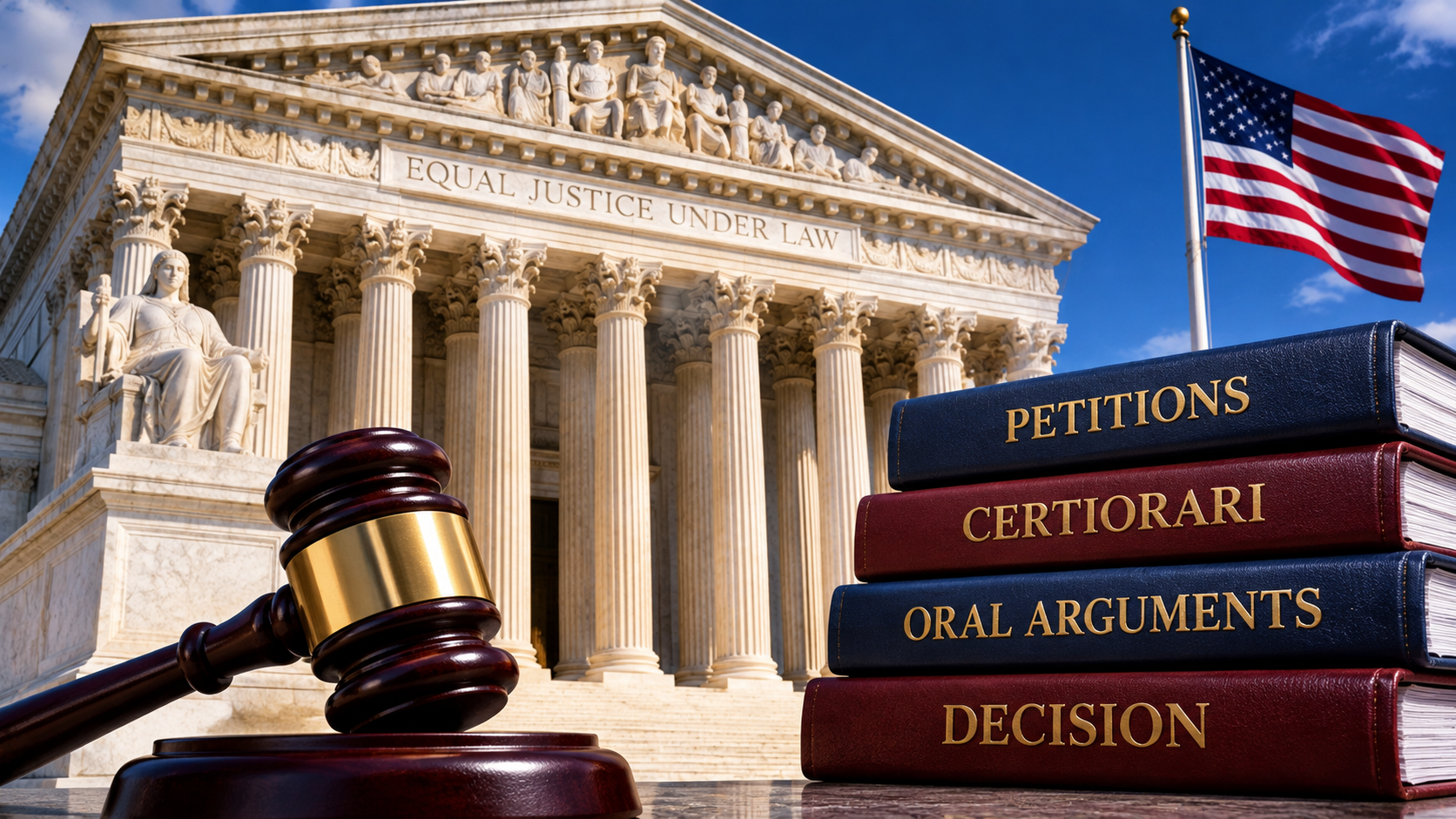
The Supreme Court decides which cases to hear by voting on requests called petitions for a writ of certiorari, and it takes a case only when at least four of the nine justices agree it deserves a full review.
Many people assume the Supreme Court has to hear any case that reaches it. It does not. For nearly all Supreme Court cases, the justices have what lawyers call discretionary jurisdiction, which means they get to choose. Every year thousands of people, businesses and governments ask the court to step in, and the justices agree to hear only a small share, usually a few dozen cases with full arguments in a term.
A case almost always starts somewhere else. It begins in a trial court, either a federal district court or a state court. The side that loses can appeal to a federal court of appeals, or in a state case, to the state’s appeals courts and then the state supreme court. A party that loses at that level can ask the U.S. Supreme Court to review the decision by filing a petition for a writ of certiorari, usually shortened to “cert.” The petition explains what the lower court decided and why the justices should take another look. The other side can file a brief arguing that the case does not need review.
The political news that affects your wallet, your rights and your vote, broken down in plain language. Free in your inbox.
Inside the court, most justices share the work of reading those petitions through a system known as the cert pool, in which one law clerk writes a summary memo that goes to several justices. The chief justice circulates a list of petitions worth discussing, and the justices talk about them at private conferences where no staff are allowed in the room.
If at least four justices vote to grant a writ of certiorari, the court takes the case. This is called the rule of four. It is a long standing custom, not a law written by Congress, and it means a minority of the court can make sure an issue gets heard even if a majority would rather pass.
The court’s own rules explain what the justices look for. Rule 10 says review “is not a matter of right, but of judicial discretion” and that a writ of certiorari will be granted “only for compelling reasons.” The most common reason is a circuit split, which happens when different federal appeals courts reach opposite answers on the same question of federal law, so the law means one thing in one part of the country and something else in another. The justices also take Supreme Court cases that raise major federal questions, such as the limits of a president’s power, or that involve a state court ruling that conflicts with federal law. The court rarely takes a case just because a lower court may have gotten it wrong.
When the court grants or denies petitions, it announces the results in an order list, a public document posted on the court’s website. If a petition is granted, the lawyers file full written briefs, outside groups can file friend of the court briefs supporting one side, and the case is set for oral argument. Decisions in argued Supreme Court cases generally come out by the end of June or early July. If a petition is denied, the lower court’s ruling stands, but the denial does not mean the justices agree with it, and it does not create a rule for the whole country.
There are a few exceptions to this process. The Constitution gives the Supreme Court original jurisdiction, meaning it acts as the first and only court, in a small group of disputes such as lawsuits between two states. Congress has also required the court to hear direct appeals in a few narrow situations. And separate from the writ of certiorari process, the court handles urgent requests on what is often called its emergency docket.
A real example came on Nov. 13, 2026. In an order list released that day, the court agreed to hear Mullin v. Refugee and Immigrant Center for Education and Legal Services, a challenge to Donald Trump’s asylum restrictions at the southern border. A federal district judge and the U.S. Court of Appeals for the D.C. Circuit had ruled against the policy, and the government asked the justices for a writ of certiorari. The justices agreed to decide whether the policy is legal but turned down a separate question the government raised about the group of migrants covered by the lawsuit, which shows the court can accept part of a petition and reject the rest. Another case on the court’s calendar, Crowther v. Board of Regents of the University System of Georgia, shows a circuit split at work. The 11th Circuit ruled that school employees cannot sue under Title IX, while eight other federal appeals courts had gone the other way.
Which Supreme Court cases the justices choose shapes the law in every household. Taking a case can put a national question, like voting rules, immigration or workplace rights, on track for a final answer that binds courts across the country. Turning one down can leave a lower court ruling in place for millions of people in one region, which is why a person’s rights under federal law can depend on where they live until the justices step in.




