Poli Alert Politics & Civics
Related Articles


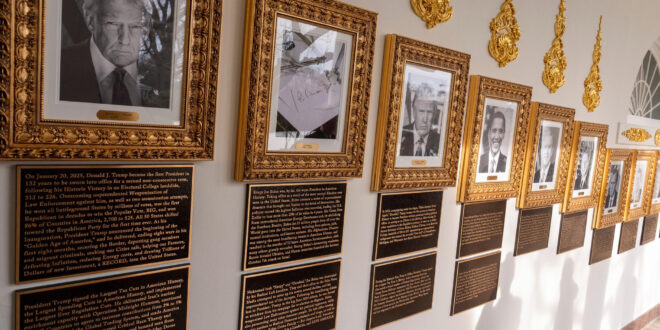
The White House has installed a series of new plaques along its colonnade that sharply attack President Donald Trump’s predecessors — including Presidents Joe Biden and Barack Obama — using inflammatory language, personal insults and claims that critics say promote disinformation about their administrations.
The plaques were mounted beneath presidential portraits that form part of Trump’s recently added “Presidential Walk of Fame,” a display on the White House grounds that now includes aggressively partisan commentary alongside the images of former presidents.
One plaque replacing President Joe Biden’s portrait with an image labeled “Autopen” refers to him as “Sleepy Joe Biden” and calls him “the worst President in American History.” It asserts that Biden suffered from “severe mental decline,” accuses him of running a “Biden Crime Family,” and claims he took office through “the most corrupt Election ever seen in the United States” — echoing Trump’s repeated false claims about the 2020 election.
White House press secretary Karoline Leavitt said in a statement that Trump personally authored much of the language.
“The plaques are eloquently written descriptions of each President and the legacy they left behind,” Leavitt said. “As a student of history, many were written directly by the President himself.”
Biden’s office declined to comment.
False claims and partisan rhetoric
The Biden plaque blames his administration for inflation, denounces the Inflation Reduction Act as the “Green New Scam,” criticizes immigration policy, and characterizes the 2021 U.S. withdrawal from Afghanistan as “among the most humiliating events in American History,” referencing the deaths of 13 U.S. service members.
It further asserts that Biden’s “weakness” emboldened Russia’s invasion of Ukraine and Hamas’ Oct. 7 attack on Israel, claims disputed by national security experts.
The plaque also cites Biden’s poor debate performance in June 2024 and says he was “forced to withdraw from his campaign for re-election in disgrace.”
Obama’s plaque similarly adopts partisan framing, referring to him as “Barack Hussein Obama” — a formulation long used in right-wing attacks — and calls him “one of the most divisive figures in American history.”
It labels the Affordable Care Act the “highly ineffective ‘Unaffordable’ Care Act,” criticizes the Iran nuclear deal and the Paris climate agreement, and repeats Trump’s conspiracy theory that Obama “spied” on Trump’s 2016 campaign and orchestrated what it calls the “Russia, Russia, Russia Hoax.”.
President Bill Clinton’s plaque concludes by noting that Trump defeated Clinton’s wife, Hillary Clinton, in the 2016 election.
Trump plaques laud presidency
By contrast, the plaques describing Trump’s own presidency strike a celebratory tone.
One credits Trump’s first term with creating “the Greatest Economy in the History of the World,” signing the “Largest Tax Cuts in History,” rebuilding the military, destroying the ISIS caliphate, and brokering the Abraham Accords.
A second plaque touts Trump’s current term, praising sweeping tariffs, hard-line immigration policies and cultural initiatives, including removing “Critical Race Theory and transgender insanity from public schools” and banning transgender women from women’s sports.
The plaque also boasts that Trump began construction of a “Golden Dome” missile defense shield, renamed the Gulf of Mexico as the “Gulf of America,” and built a new Trump Presidential Ballroom at the White House.
“But THE BEST IS YET TO COME!” the plaque concludes.
Questions about funding and precedent
The White House did not respond to questions about how the plaques were paid for, whether government funds were used, or whether federal employees installed them.
Historians and ethics experts note that while presidents have long shaped how their legacies are presented, overtly partisan attacks on predecessors displayed on White House grounds are without modern precedent.
Mixed reaction on Capitol Hill
The displays drew criticism from some Republicans on Capitol Hill.
“I’m really disturbed by that,” Sen. Lisa Murkowski of Alaska said. “These are individuals who served who were elected by people around this country. Whether I supported them or not, they were the country’s president.”
“Let’s not have President Trump trying to redefine the contributions or lack of contributions of each,” she added. “That’s inappropriate.”
Other Republicans downplayed the controversy.
“I don’t think that’s going to move the ball for us,” Sen. Lindsey Graham of South Carolina said. “There may be some amusement there.”
Graham quickly pivoted to the stakes of the 2026 midterm elections, warning that a Democratic House victory could lead to impeachment proceedings against Trump.
“We need to focus on fixing people’s problems,” Graham said. “And the more we can focus on that, the better.”