Americans waiting for the $5,000 checks Donald Trump discussed may be wondering what happened to the money. Despite multiple promises involving payments to the public, no $5,000 federal dividend program has been approved or put into operation.
The latest proposal was tied directly to the 2026 midterm elections. Trump promised that every adult U.S. citizen would receive $5,000 if Republicans retained control of both the House of Representatives and the Senate. That condition was not met. Democrats won control of both chambers in the November 3 elections, according to the Associated Press.
But the election results are only part of the story. The proposed payments also faced questions about where the money would come from, whether Congress would approve the spending and whether the administration could legally distribute the money without lawmakers.
The political news that affects your wallet, your rights and your vote, broken down in plain language. Free in your inbox.
The $5,000 proposal was not the first time Trump had discussed sending money directly to Americans.
In February 2025, Trump expressed support for an idea promoted by Elon Musk, who was then leading the Department of Government Efficiency, known as DOGE. The proposal called for distributing 20% of the money DOGE saved through government spending cuts to American taxpayers, with another 20% going toward reducing the national debt.
Trump discussed the idea at the FII Priority Summit in Miami, saying it was under consideration. However, the projected government savings did not materialize at the levels needed to support the payments, and the proposal was never implemented.
Americans never received those so-called DOGE dividend checks.
Trump later floated $2,000 tariff payments
Trump also promoted another payment proposal in 2025, suggesting Americans could receive at least $2,000 each from money collected through tariffs on imported goods.
Tariffs are taxes imposed on imported products, typically paid by the companies bringing those goods into the country. Those costs can also be passed along to American businesses and consumers.
Trump suggested the revenue could finance payments to Americans, but the administration never established a direct payment program.
The Supreme Court later struck down several of Trump’s tariffs, leading to a process for refunding affected companies. Those refunds did not create an automatic requirement for companies to send money back to consumers.
Why the latest $5,000 promise never became a payment
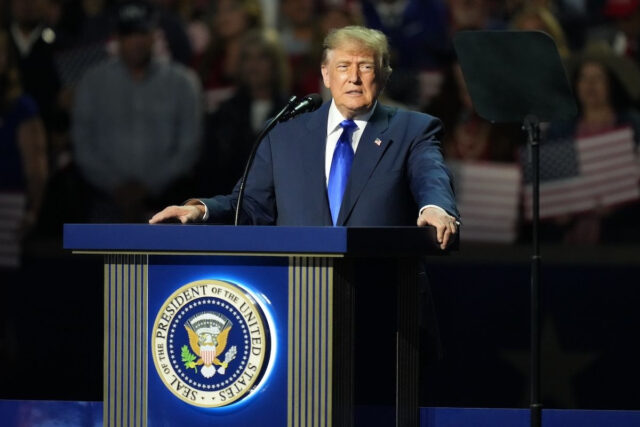
Trump announced his latest proposal on September 9, 2026, during the Republican Party’s midterm convention in Dallas.
He said every adult U.S. citizen would receive $5,000 if Republicans won both chambers of Congress in November.
The proposal, which Trump called the Trump Dividend, was expected to cover approximately 240 million adults and cost roughly $1.2 trillion, according to a Reuters analysis using Census Bureau figures.
Vice President JD Vance suggested tariff revenue could help finance the payments. However, the money collected through tariffs was nowhere near enough to cover the projected cost.
FactCheck.org also examined Trump’s proposal and found that it would take more than six years of tariff revenue at the cited collection rate to generate enough money to cover the $1.2 trillion price tag.
There was another major obstacle: Congress would have to authorize the spending.
Trump suggested that he might not need congressional approval. However, the Constitution gives Congress control over federal spending and appropriations, meaning the administration cannot simply distribute $1.2 trillion without legal authority to spend it.
House Speaker Mike Johnson acknowledged the issue in September, telling reporters that he assumed Congress would need to act. He also pledged to work toward getting the proposal approved.
Despite Trump’s public assurances that the money would be distributed, no legislation establishing the $5,000 payment program was enacted.
Democrats’ midterm victories changed the political landscape
The November 3 midterm elections produced the outcome Trump had specifically said would prevent his dividend proposal from moving forward.
Democrats won control of both the House and Senate. Their victories shifted control of Congress and gave the party the ability to block much of Trump’s legislative agenda.
Because Republicans did not retain control of both chambers, the condition Trump attached to his $5,000 promise was not fulfilled.
The new Democratic majorities will take office in January 2027. Any effort to establish the payment program would therefore face a different Congress, with Democrats controlling both chambers.
Will Americans ever receive the $5,000 checks?
There is currently no approved $5,000 federal payment program tied to Trump’s dividend proposal. The administration has not established a payment schedule, eligibility process or distribution system for the money.
Even if Trump wanted to revive the idea, Congress would need to authorize the spending. The projected $1.2 trillion cost also raises questions about whether the payments would be financed through borrowing, additional revenue or another federal funding mechanism.
For Americans who were expecting a $5,000 deposit, there is no confirmed payment date and no guarantee that the proposal will become law.
The DOGE dividend never happened. The proposed tariff payments never materialized. And Trump’s latest $5,000 promise was tied to an election outcome that Republicans did not achieve.
For now, the $5,000 checks remain a political promise, not an actual federal benefit.