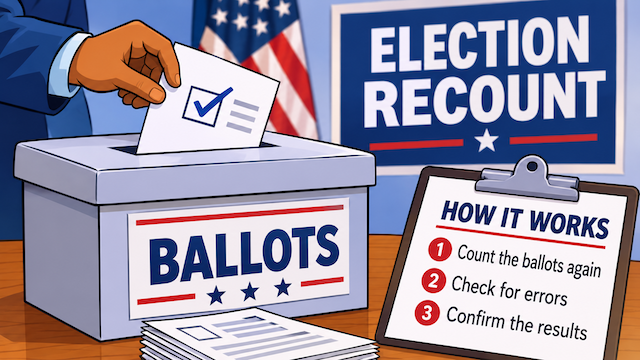
An election recount is a second count of the ballots in a race, done to confirm the first count was accurate, and it happens either automatically because the race was very close or because a candidate asks for one. It does not mean anyone did something wrong. It is a safety check built into the system for races decided by a handful of votes.
To see where a recount fits, start with what comes before it. The numbers reported on election night are unofficial. In the days afterward, local officials hold a canvass, which is the official review of the counts, where they add mail ballots that arrived on time and provisional ballots that were verified. Certification is the official sign-off on the final totals. A recount is a separate step that can come after the canvass, when the margin between candidates is small enough that state law allows or requires a second count.
States trigger an election recount in two main ways. In an automatic recount, state law requires one whenever the margin falls under a set threshold, often a fraction of one percent. In a requested recount, a candidate, and in some states a voter or a group, asks for one, usually by a deadline and sometimes by paying the cost if the margin is above a certain size. The thresholds, the deadlines and who pays all vary by state, so there is no single national rule.
The political news that affects your wallet, your rights and your vote, broken down in plain language. Free in your inbox.
There are also two kinds of recount. A machine recount runs the ballots through the scanners again, which can catch a scanner setting that was wrong or a mark that was missed the first time. A hand recount means election workers look at paper ballots one at a time, usually in teams with observers from both campaigns watching. Hand counts are slower, and they come up when a machine cannot settle a question, such as a ballot where the voter filled in the oval only partly. Officials then decide what the voter intended using rules set in advance.
Florida offers a clear example, based on its state law. A machine recount happens automatically when the margin is 0.5 percent or less, and a hand review of ballots the machines could not read happens when the margin is 0.25 percent or less. In a race where 100,000 votes were cast, a half percent margin is 500 votes. Under that kind of rule, no candidate has to ask and nobody has to prove a problem. The law simply requires the second look.
Some states handle close races differently. A few, Mississippi among them according to election reporting, do not have a recount law at all. In those places a candidate who wants ballots reviewed generally has to go to court and file an election contest, where a judge decides whether any ballots will be rechecked and what counts as a valid challenge.
Recounts rarely change who wins. Most of the time they move the totals by a small number of votes, because the ballots were counted correctly the first time. They matter because they build trust in a close result and because they come with a cost, since taxpayers or candidates pay for the staff and time, and because a recount delays certification, which can delay the date a winner is confirmed.
For everyday life, this explains why a race can stay unsettled for days or weeks and why that is usually the system working, not breaking. Local seats such as school board, county commission and city council can be decided by a few dozen votes, and every one of those ballots can matter. A state or county election office publishes the recount rules, thresholds and deadlines that apply where a person lives, and it is the place to confirm them.