


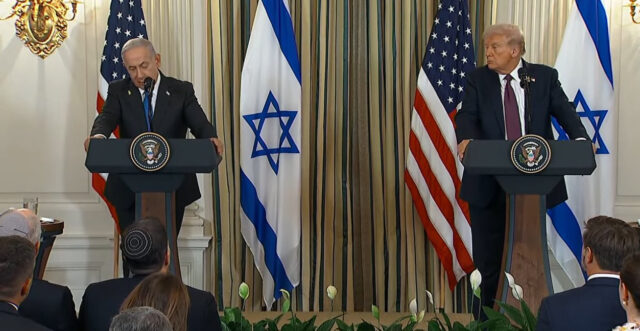
The U.S. and Israel are preparing plans for a possible attack on Iran in early November, after the U.S. midterm elections, a person briefed on the two countries’ war planning told NPR on Thursday.
According to NPR’s source, who spoke on condition of anonymity, Israel had initially planned to strike Iran in mid-October, about two weeks before Israeli elections on October 27, but President Trump objected. The U.S. is now amassing forces in the region to be ready to attack by early November, though the preparations could also be part of a pressure campaign to push Iran toward a diplomatic deal.
Israeli Prime Minister Benjamin Netanyahu, seeking reelection, is campaigning on a threat to topple Iran’s regime.
Iran’s foreign minister, Abbas Araghchi, told Iranian state media Thursday: “We are just as prepared for diplomacy as we are for war.” He added, “Any scenario is conceivable, including the possibility of an attack by the U.S. and Israel.” Iranian state media also quoted a security source saying Iran would retaliate against U.S. interests in the region and the assets of countries participating in the war if Iranian officials or civilian infrastructure were attacked.
The U.S. and Israel launched the war on Iran on February 28, killing its supreme leader and senior officials. Since then the sides have failed to uphold a ceasefire and traded strikes over control of the Strait of Hormuz, which Iran has blocked since the war began. Iranian state media said seven oil tankers in the strait were targeted by the Revolutionary Guard on Thursday, four catching fire and three hitting naval mines. The Revolutionary Guard has also threatened data centers and underwater internet cables in the Gulf if attacks resume.
The economic toll is mounting. A new International Monetary Fund report cited by NPR says disruptions to energy, shipping, tourism, and trade have delivered substantial shocks across the Gulf, with Iraq, Kuwait, and Qatar all expected to see economic contractions of around 16% this year, and Saudi Arabia and the UAE in recession. The IMF says if the war continues and energy disruptions persist, oil will average $130 a barrel in 2027.
