

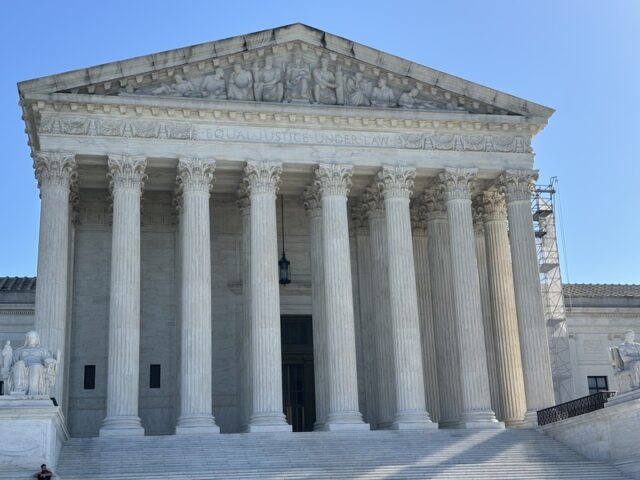
The Supreme Court this week rejected the Trump administration’s emergency request to end gender-affirming care for transgender people in federal prisons, preserving access to medical treatment while a legal challenge to the policy continues.
The court’s decision leaves in place a lower-court order blocking the Bureau of Prisons from implementing restrictions on treatments including hormone therapy and gender-affirming surgery. The administration had asked the justices to lift the injunction while its appeal proceeded.
The brief unsigned order offered no explanation for the decision. Conservative Justices Samuel Alito and Clarence Thomas indicated they would have granted the administration’s request.
The ruling represents a setback for President Donald Trump’s efforts to restrict transgender-related medical care across the federal government. It does not resolve the underlying lawsuit or determine whether the administration’s policy is ultimately lawful.
“This is a critical ruling for our clients and all transgender people in Bureau of Prisons custody,” said Li Nowlin-Sohl, a senior staff attorney with the American Civil Liberties Union’s LGBTQ & HIV Project.
“The denial of medically necessary health care, including gender-affirming health care, to people in prison is a violation of their fundamental constitutional rights,” Nowlin-Sohl said.
Trump policy would end hormone therapy and other treatments
The dispute stems from an executive order Trump issued after returning to office in January 2025 directing the federal government to stop funding gender-affirming care for transgender people in federal custody.
The Bureau of Prisons subsequently adopted a policy prohibiting gender-affirming medical treatments for inmates diagnosed with gender dysphoria. The restrictions would end hormone therapy, prohibit gender-affirming surgeries and eliminate certain social accommodations, including access to items such as wigs, makeup and gender-affirming clothing.
The policy would continue to allow psychiatric services and other mental health treatment.
The administration has argued that the restrictions reflect updated scientific information and address security and prison-administration concerns. In its Supreme Court filing, the Justice Department said the treatments’ perceived benefits did not outweigh those concerns.
The government also argued that the Bureau of Prisons had appropriately reconsidered its previous approach to treating gender dysphoria.
Lawsuit challenges restrictions on medical care
The legal challenge began in March 2025, when two transgender men and one transgender woman incarcerated in federal facilities in New Jersey, Minnesota and Florida sued the administration. The class-action case seeks to protect transgender inmates diagnosed with gender dysphoria from losing access to treatment.
The plaintiffs argue that abruptly ending medically necessary care could cause serious harm, including worsening depression, anxiety, suicidal thoughts and self-harm. They have also challenged the administration’s decision-making process, arguing that prison officials failed to adequately justify reversing longstanding medical policies.
The case covers approximately 1,000 transgender inmates, according to the lawsuit’s initial estimates. The American Civil Liberties Union and the Transgender Law Center are among the organizations representing the plaintiffs.
U.S. District Judge Royce Lamberth, a Reagan appointee, blocked the restrictions in June 2025. After the Bureau of Prisons issued a revised policy in February 2026, the court again barred the government from enforcing the restrictions and ordered officials to continue providing care under the previous policy while the litigation proceeded.
Lamberth concluded that the government had likely violated federal administrative law by failing to adequately account for its own experience providing treatment. He also questioned the administration’s justification for changing the policy.
The U.S. Court of Appeals for the District of Columbia Circuit declined to lift the injunction in September, prompting the administration to seek emergency relief from the Supreme Court.
The justices’ decision leaves the lower-court protections in place as the case continues.
Supreme Court’s decision comes amid broader transgender rights battles
The ruling stands in contrast to several recent Supreme Court decisions that have allowed restrictions affecting transgender people to take effect.
The court has upheld state laws restricting transgender athletes’ participation on girls’ and women’s sports teams and allowed the Trump administration to enforce restrictions on transgender military service and passport sex markers while legal challenges continued. It has also upheld state bans on certain gender-affirming treatments for transgender minors.
Wednesday’s order does not establish a broad constitutional right to gender-affirming care or settle the legal questions raised by the prison policy. Instead, it determines that the administration cannot immediately implement the challenged restrictions while the case proceeds under the existing court order.
For transgender people in federal custody, the immediate consequence is that access to gender-affirming treatment must continue under the lower court’s injunction.
The Justice Department’s challenge remains unresolved, leaving open the possibility of further appeals as the case moves through the courts.