Poli Alert Politics & Civics
Related Articles


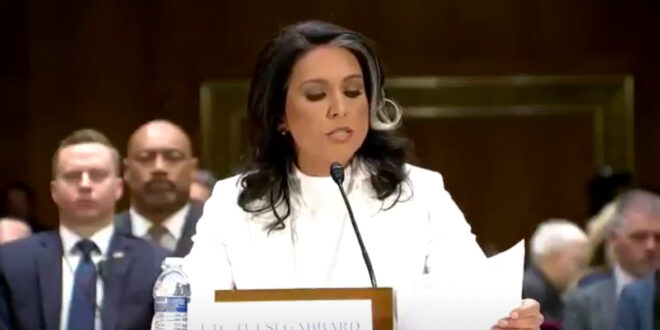
Tulsi Gabbard announced Friday that she is resigning as President Donald Trump’s director of national intelligence, ending a turbulent tenure marked by repeated clashes over military intervention and growing questions about her standing within the administration.
In a resignation letter posted to X, Gabbard said she was leaving the role to support her husband as he battles bone cancer. Her final day in office will be June 30.
“While we have made significant progress at the ODNI — advancing unprecedented transparency and restoring integrity to the intelligence community — I recognize there is still important work to be done,” Gabbard wrote.
Trump confirmed her departure on Truth Social, praising Gabbard for doing a “great job” during her roughly 15 months leading the Office of the Director of National Intelligence.
The president said Gabbard’s deputy, Aaron Lukas, will serve as acting DNI following her departure. Lukas previously worked at the CIA and alongside Richard Grenell during Trump’s first administration.
Gabbard’s exit comes after months of internal friction over the administration’s increasingly aggressive foreign policy, particularly following the U.S.-Israeli military campaign against Iran.
A longtime critic of American foreign intervention, Gabbard built her political identity opposing what she described as costly and unnecessary wars. During her time as a Democratic member of Congress and later as a Trump ally, she frequently warned against military escalation abroad.
But Trump’s second term has featured a far more interventionist approach than many expected.
Gabbard was notably absent from several key national security decisions and operations. She was not present at Mar-a-Lago when Trump and Israeli officials coordinated strikes against Iran earlier this year, nor did she participate in the administration’s initial congressional briefings explaining the military action.
She also was not involved in early planning surrounding the January operation targeting Venezuelan leader Nicolás Maduro or Trump’s later decision to bomb Iranian nuclear facilities.
Her uneasy relationship with the administration’s hawkish wing became increasingly visible over the past year.
Last June, Gabbard released a video warning about the dangers of nuclear conflict, a message that reportedly angered Trump and sparked internal discussions about firing her. Reports later surfaced that Trump again considered removing her after congressional testimony in April in which she stopped short of fully endorsing the administration’s justification for the war in Iran.
Her position weakened further after senior aide Joe Kent resigned in protest over the conflict and publicly questioned whether Iran posed an imminent threat to the United States.
During subsequent hearings before congressional intelligence committees, lawmakers pressed Gabbard on whether she agreed with Kent’s criticism. While she defended administration policy overall, she notably avoided fully embracing the White House’s rationale for military action.
At one Senate hearing, Gabbard opened her testimony by emphasizing she was not appearing before Congress to offer her “personal views or opinions,” an unusual disclaimer that fueled speculation about divisions inside the administration.
Gabbard now becomes the latest high-profile departure from Trump’s Cabinet during his second term. Former Homeland Security Secretary Kristi Noem exited the administration in March, while Trump removed former Attorney General Pam Bondi last month. Former Labor Secretary Lori Chavez-DeRemer also resigned earlier this year.
Reaction to Gabbard’s resignation quickly split along political lines.
Tom Cotton, the Republican chairman of the Senate Intelligence Committee, thanked Gabbard for her service and expressed support for her family during her husband’s illness.
Meanwhile, Democratic lawmakers sharply criticized her tenure overseeing the intelligence community.
Mark Warner, the committee’s top Democrat, said the role should be filled by “an experienced intelligence professional” focused on foreign intelligence matters rather than domestic political issues.
Adam Schiff offered sympathy for Gabbard personally while delivering a scathing assessment of her leadership.
“While the circumstances around her departure are deserving of our sympathy, let’s be clear: Tulsi Gabbard’s only positive contribution to our nation’s national security is her resignation,” Schiff said in a statement.
Gabbard’s resignation leaves another major vacancy in an administration already grappling with internal divisions over foreign policy, military escalation and the expanding role of the intelligence community.