Poli Alert Politics & Civics
Related Articles

U.S.-Canada trade tensions escalated Tuesday as the Trump administration’s ban on nearly $1 billion worth of Canadian imports, including alcoholic beverages, dairy products and motorcycles, took effect.
The ban represents a small fraction of the roughly $880 billion in annual two-way trade between the neighboring countries, but it marks another escalation in President Donald Trump’s widening trade fight with one of the United States’ closest economic partners.
The latest measures took effect at 12:01 a.m. Eastern time Tuesday and were imposed in retaliation for Canadian tariffs on U.S. goods.
Alcohol makes up most of banned imports
The ban covers an estimated $967 million in Canadian imports, based on 2025 trade data, according to Jacob Jensen, director of trade policy at the center-right American Action Forum.
About 87% of the affected goods are alcoholic beverages, including beer, liquor, sparkling wine and brandy.
The administration targeted the products after several Canadian provinces responded to earlier U.S. tariffs by restricting sales of American alcohol.
The ban also covers certain dairy products, including whey, amid a longstanding dispute over Canada’s protection of its dairy industry. U.S. exporters have complained about Canada’s high tariffs on dairy imports above established quotas.
Motorcycles are also included.
Bombardier Recreational Products, a Quebec-based manufacturer, said its three-wheel Can-Am Spyder and Canyon motorcycles will be barred from the U.S. market. The company said the immediate impact should be limited because most production and shipments for the current season have already been completed.
Trade war escalates
The latest action follows Trump’s decision earlier this year to impose 50% tariffs on roughly $20 billion in Canadian imports, citing what his administration says are unfair Canadian trade practices affecting U.S. dairy, automobile and alcohol producers.
Canada responded with its own tariffs on U.S. goods.
The new import restrictions are largely aimed at products already subject to steep tariffs, meaning their economic impact could be limited.
But trade experts warn that the measures could encourage further retaliation and make negotiations more difficult.
“This marks yet another escalation in the trade war,” Jensen said.
USMCA faces new uncertainty
The dispute also complicates negotiations over the future of the United States-Mexico-Canada Agreement, the North American trade pact that replaced NAFTA during Trump’s first term.
Most goods traded within North America receive preferential treatment under the agreement, but Trump’s tariffs have increasingly challenged the framework.
Trump has repeatedly criticized Canada’s trade policies and has encouraged Canadian manufacturers to move production to the United States. He has also repeatedly suggested that Canada should become the 51st U.S. state, remarks that have fueled opposition to his trade policies among Canadians.
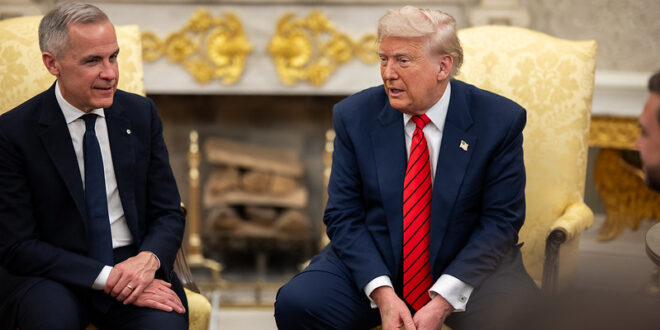
Canadian Prime Minister Mark Carney has responded by seeking to reduce his country’s dependence on the U.S. market.
The United States accounted for more than 70% of Canada’s exports last year. Carney has pledged to expand Canada’s trade with other countries and has pursued closer economic ties with the European Union, India and China.
“There is now a price to be paid for access to the United States market,” Carney said earlier this month.
Gabriel Brunet, a spokesman for Canada’s trade minister, said Ottawa’s priority was protecting Canadian workers, farmers, families and businesses while diversifying the country’s trading relationships.
Neither side signals retreat
Trump has predicted Canada will eventually return to the negotiating table.
“They’re gonna come in and they’re gonna say, ‘Sir, we are sorry,’” Trump told reporters Monday. “I think a deal will be made but it’s gonna be fair.”
Trade attorney Childress said the dispute could last for months because neither the tariffs nor the import bans are likely to cause enough economic disruption by themselves to force either side to back down.
For businesses on both sides of the border, the immediate uncertainty is likely to continue as Washington and Ottawa weigh their next moves.