Poli Alert Politics & Civics
Related Articles


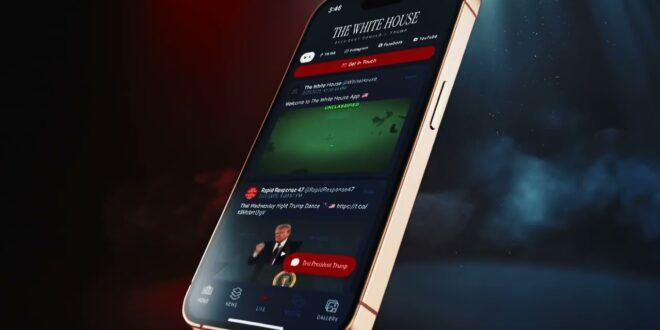
The Trump administration is promoting its official White House app as a direct line between President Donald Trump and the public. But cybersecurity researchers say that access comes with a less visible cost: extensive data collection and third-party tracking that raise questions about how Americans’ information is handled.
The app surged in visibility after the White House launched Trump TV, a 24/7 stream promoted as an alternative to traditional news coverage during a weeklong dispute between the administration and several major media organizations. The White House said Americans were going directly to the presidency rather than relying on television cameras or news outlets.
But security researchers who analyzed the app’s code and network traffic found that much of its digital activity occurs outside WhiteHouse.gov.
A March network analysis by cybersecurity firm Atomic Computer found that just 23% of the app’s network requests during its testing went directly to WhiteHouse.gov. The remainder went to third-party services including OneSignal, Elfsight, YouTube and Google’s advertising infrastructure. Researchers said the app transmitted information including users’ IP addresses, device information, time zones, session activity and a persistent identifier to OneSignal.
The findings raise a basic question for a government app promoted as an official channel of the White House: How much information does the government’s digital platform collect about the people using it, and who ultimately has access to that information?
Researchers flag gap between disclosures and data flows
Atomic Computer’s analysis found that the app’s iOS privacy manifest declared that no data was collected, while the researchers observed the transmission of several categories of device and usage information during their testing. The researchers said the app also contained multiple OneSignal frameworks and other third-party software.
The analysis did not establish that the White House is currently receiving or using users’ precise GPS coordinates. Researchers said the app contained location-tracking infrastructure, but their traffic testing did not show GPS coordinates being transmitted. They did find that the app was sending IP addresses, device information, session data and a persistent identifier to OneSignal.
The distinction matters because the most alarming claims surrounding the app go beyond what the available testing demonstrates.
What is documented is that third-party services receive certain information generated by the app. What remains less clear is how that information is ultimately used, retained or shared beyond those services.
The White House’s privacy policy says information may be shared with other government agencies in response to lawful law enforcement requests or to protect WhiteHouse.gov from security threats. It also says activity on third-party platforms is governed by those platforms’ own privacy policies.
The app’s privacy disclosures have changed
The privacy picture has also evolved as the app has been updated.
Apple’s current App Store listing says the developer may collect contact information, device identifiers, usage data and diagnostic information, although it says the data is not linked to the user’s identity. Google Play likewise says the app may collect and share personal information, app activity and device or other identifiers.
That is different from the earlier iOS privacy manifest examined by researchers, which they found to be effectively empty.
Atomic Computer said subsequent updates removed or changed some of the app’s more controversial features, including downgrading its location permission and removing certain code. But the researchers said significant third-party tracking infrastructure remained.
A government app with a political audience
The privacy concerns take on added significance because of what the White House is using the app to deliver.
When the app launched in March, the White House described it as a way for Americans to receive breaking news, watch presidential events, follow administration priorities and send messages directly to the government.
That mission has increasingly intersected with the administration’s broader effort to communicate directly with supporters.
The White House’s Trump TV stream emerged after the administration restricted access for CNN, MS NOW and Politico and television networks temporarily halted their pool coverage. The administration promoted the stream as a way for Americans to receive presidential messaging directly rather than through traditional broadcasters.
That makes the app more than a conventional government information portal. It is also part of an increasingly direct communications strategy in which the administration controls the content, presentation and distribution of presidential messages.
Cybersecurity researcher Philip Fields, cited in the original analysis, argued that users attracted by that messaging are also providing information about themselves that could potentially be valuable to the administration.
The potential uses of such information are broad. Data generated by a digital platform can be used for analytics, audience targeting, content personalization and other purposes. But there is no public evidence establishing that the Trump administration is using the app’s data to target individual users for political purposes.
Third-party software adds another layer
The app’s reliance on outside technology providers also complicates the question of accountability.
Atomic Computer identified OneSignal, Elfsight, Google, YouTube and other third-party services in its network traffic testing. In one session, researchers recorded 31 unique hosts and 206 app-generated requests, excluding iOS system traffic.
The researchers said OneSignal received information that included IP address, device model, operating system, session count, session duration and a persistent identifier.
The White House privacy policy says personally identifiable information is restricted to employees, contractors and vendors who need access to perform official duties and that information may be shared with other government agencies in specified circumstances.
Still, the technical architecture means that users are not simply communicating with WhiteHouse.gov. Their devices are also communicating with commercial technology companies whose own systems and privacy practices become part of the chain.
Federal security requirements raise additional questions
Federal agencies are subject to cybersecurity and information-security requirements governing government information systems. The administration itself has emphasized cybersecurity as a government-wide priority, including through a June memorandum establishing cybersecurity requirements for federal national security systems.
The unusual nature of the White House app has drawn additional attention because the administration has pushed agencies to place it on government-issued mobile devices.
Government Executive reported in May that the administration directed agencies to assist with installing the app across government-furnished mobile phones in the executive branch.
That means concerns about the app’s security architecture extend beyond ordinary consumers who voluntarily download a news application. Federal employees may encounter the software in an official-device environment.
Contractor received more than $1.5 million
The app and related White House digital services are supported by 45Press, an Ohio-based technology company.
Federal contracting records show that the Executive Office of the President awarded 45Press a purchase order in February 2026. The current contract amount is listed at about $1.72 million, with roughly $1.52 million obligated and a potential value of more than $8.3 million if options are exercised.
The contract is described as information-technology services, including business application and development support.
The financial relationship adds another layer to questions about how the administration built and maintains the platform, particularly as security researchers continue to identify issues with its underlying software.
The unanswered questions
The White House has promoted the app as a faster, more direct way for Americans to engage with the presidency. But the more important question may be what happens on the other side of that connection.
Security researchers have documented third-party data flows and discrepancies between earlier privacy disclosures and observed network activity. The White House’s own privacy policy acknowledges that information may be shared with government agencies in certain circumstances and that third-party services operate under their own privacy policies.
None of that establishes that the administration is secretly building political profiles of app users, selling their information or referring users to law enforcement. Those claims require evidence that has not been publicly established.
But the documented data flows do raise questions about whether Americans downloading an official government app can reasonably understand what information is being collected, where it goes and who ultimately controls it.
For an administration increasingly encouraging Americans to bypass traditional media and receive presidential messaging directly, those questions are becoming harder to dismiss as merely technical concerns.