Poli Alert Politics & Civics
Related Articles



President Donald Trump announced Monday that his name will be attached to a new class of U.S. Navy battleships expected to carry nuclear-capable weapons, marking an extraordinary personalization of a major military program and reviving a type of warship the United States has not used in combat in more than three decades.
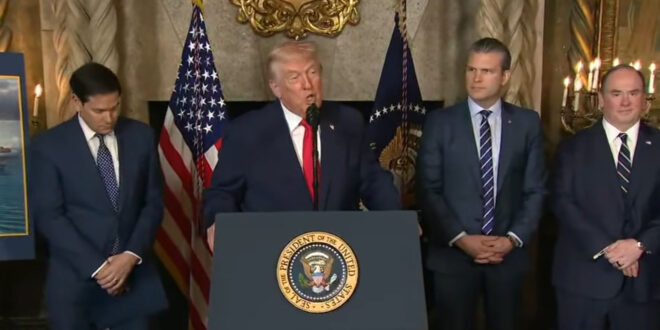
Speaking at an event at his Mar-a-Lago estate, Trump and Navy Secretary John Phelan described the vessels as “Trump-class battleships,” with the first ship — the USS Defiant — billed as the “largest, deadliest and most versatile” warship in the world.
The ships, according to administration officials, would be equipped with conventional and hypersonic missiles, electronic rail guns, high-powered lasers and a nuclear-armed sea-launched cruise missile. The Navy would oversee the design and construction, with the Defense Department saying the first vessels could be ready early next decade.
“We envision that these ships will be the first of a whole new class of battleships to be produced in the years to come,” Trump said, adding that he wants between 20 and 25 built. “Hopefully we never have to use them, but there will never be anything built like these.”
Reviving a long-abandoned warship class
Battleships — massive, heavily armored vessels built around large-caliber guns — have largely disappeared from modern navies, supplanted by aircraft carriers, submarines and missile-armed destroyers. The last time the U.S. Navy used battleships in combat was during the 1991 Gulf War.
Trump said the idea dates back to his first term.
“These have been under design consideration for a long time, and it started with me,” he said. “I said, ‘Why aren’t we doing battleships like we used to?’”
Defense analysts have long questioned whether battleships offer meaningful advantages in modern naval warfare, where long-range missiles, drones and cyber capabilities dominate. The administration has not released cost estimates, detailed design plans or an explanation of how the ships would fit into existing naval doctrine.
Phelan said the vessels would include a nuclear-armed sea-launched cruise missile, a detail likely to raise additional scrutiny from arms-control advocates and members of Congress, particularly given longstanding U.S. efforts to limit the spread of tactical nuclear weapons.
Trump’s direct imprint on federal institutions
Trump said he would personally involve himself in the ships’ design.
“I’m a very aesthetic person,” he said.
The announcement fits a broader pattern in Trump’s second term of placing his name, likeness or branding on public institutions and government assets — a practice that has drawn criticism from ethics experts and Democrats who argue it blurs the line between the presidency and personal legacy-building.
In recent weeks, a Trump-appointed board voted to rename the John F. Kennedy Center for the Performing Arts the Trump-Kennedy Center. Trump’s name was also added to the U.S. Institute of Peace headquarters, and the Interior Department displayed a mock-up of a 2026 national park pass bearing his image.
Several of those actions are already facing legal challenges, though the administration argues the moves fall within executive authority.
Geopolitical messaging — and ambiguity
Trump said the new battleships were not aimed at any single adversary.
“It’s a counter to everybody,” he said. “It’s not China. We get along great with China. It’s just everybody.”
Still, the announcement comes amid rising tensions with China and Russia and an ongoing U.S. military buildup across multiple regions. The Navy has struggled in recent years with shipbuilding delays, cost overruns and readiness issues, raising questions about whether such an ambitious program is feasible.
Neither the Pentagon nor the Navy provided details on congressional authorization, funding mechanisms or how the program would be reconciled with existing shipbuilding priorities.
For now, the Trump-class battleships remain a conceptual centerpiece of the president’s broader “peace through strength” agenda — one that combines expansive military ambition with an unusually personal stamp from the commander in chief.