Poli Alert Politics & Civics
Related Articles


President Donald Trump declared Wednesday that the tentative ceasefire between the United States and Iran had effectively collapsed after both nations exchanged new military strikes, signaling a sharp escalation in hostilities and casting doubt on the future of diplomatic efforts.
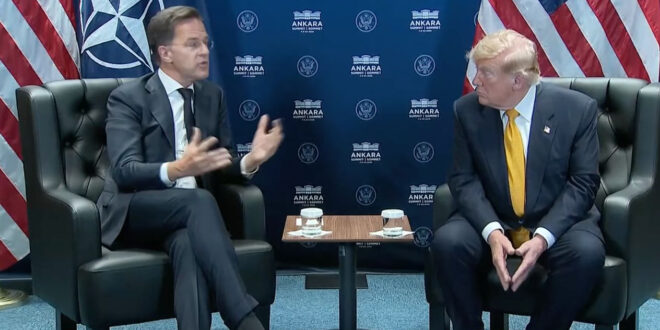
Speaking during a meeting of NATO leaders, Trump dismissed the prospect of meaningful negotiations with Tehran after U.S. forces launched more than 80 strikes against Iranian military targets in response to recent attacks on commercial shipping in the Strait of Hormuz.
“I think it’s over,” Trump said of the ceasefire. “They’re scum. They’re sick people. They’re led by sick people, and they’re vicious, violent people.”
Trump said he would not prevent U.S. negotiators from continuing diplomatic discussions but expressed little confidence they would succeed.
“They can talk, but I think they’re wasting their time,” he said. “They’re a bunch of lying guys. They’re bad people, and frankly, I don’t want to waste my time with them.”
Iran launches retaliatory attacks
The latest escalation came after Iran launched overnight attacks targeting U.S. military facilities in Bahrain and Kuwait. The Islamic Revolutionary Guard Corps said it struck 85 American military sites, according to Iran’s semiofficial Fars news agency.
Officials in Kuwait said the country’s air defenses intercepted two ballistic missiles and 13 drones. Bahrain’s Interior Ministry said warning sirens were activated and residents were instructed to seek shelter as a precaution.
The full extent of damage from the attacks was not immediately clear.
U.S. Central Command said American forces responded by striking more than 80 Iranian military sites, including air defense systems, command-and-control facilities, coastal radar installations, anti-ship missile systems and dozens of vessels associated with the Islamic Revolutionary Guard Corps.
According to the military, the operation was intended to reduce Iran’s ability to continue attacks against commercial shipping moving through the Strait of Hormuz.
Ceasefire unravels
The renewed fighting represents a major setback for the preliminary agreement reached last month between Washington and Tehran to reopen the Strait of Hormuz while negotiations continued over Iran’s nuclear program and potential sanctions relief.
The waterway, which carries roughly one-fifth of the world’s oil shipments, had been largely reopened under the agreement after Iran halted commercial traffic following the outbreak of war earlier this year.
The ceasefire now appears to have collapsed well before negotiators’ planned 60-day timeline for reaching a broader agreement.
Both governments accused the other of violating the deal.
Iran’s Foreign Ministry said Washington escalated tensions by revoking a waiver allowing certain Iranian oil sales, while parliamentary Speaker Mohammad Bagher Ghalibaf declared that “the era of bullying and extortion is over.”
Oil prices rise amid uncertainty
The renewed conflict rattled global energy markets.
After initially falling, Brent crude oil futures climbed more than 5% to above $78 per barrel as investors weighed the possibility that continued fighting could again disrupt shipping through the Strait of Hormuz.
Recent attacks have already damaged several commercial vessels. The United Kingdom Maritime Trade Operations, a monitoring organization affiliated with Britain’s Royal Navy, reported that three tankers sustained damage while transiting the strategic waterway in recent days.
Diplomatic hopes fade
Trump had previously promoted the ceasefire as a path toward limiting Iran’s nuclear ambitions while restoring stability to global energy markets.
The president acknowledged Wednesday that negotiations had repeatedly stalled, saying Iranian officials publicly contradicted understandings reached during private talks.
“We make a deal. Everyone’s agreed. No nuclear weapon,” Trump said. “We make a deal. They go outside, joke to the press, they say we never even talked about it.”
Iranian officials have recently appeared more publicly following days of national mourning after the death of Supreme Leader Ayatollah Ali Khamenei, who was killed during the opening stages of the conflict earlier this year.
The renewed military exchanges leave the future of diplomatic efforts uncertain as both nations continue to trade strikes and accusations.