Poli Alert Politics & Civics
Related Articles


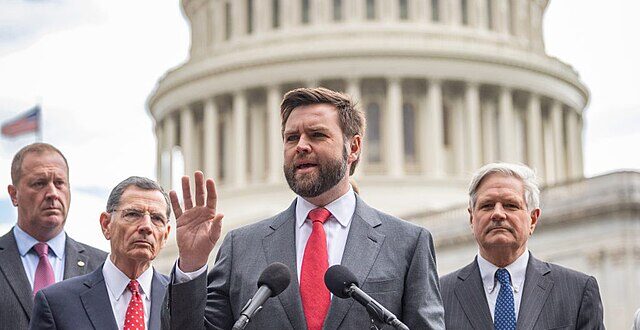
The U.S. Supreme Court on Tuesday struck down longstanding federal limits on how much national political party committees can spend in coordination with individual candidates, ruling the restrictions violate the First Amendment’s protection of free speech.
In a 6-3 decision, the court sided with the National Republican Senatorial Committee, the National Republican Congressional Committee and Vice President JD Vance, who challenged the campaign finance law after it restricted spending during his successful 2022 Senate campaign in Ohio.
Writing for the majority, Justice Brett Kavanaugh concluded that limits on coordinated expenditures by political parties infringe on constitutionally protected political speech.
“The First Amendment does not permit the government to impose arbitrary limits on coordinated political spending between political parties and their own candidates,” Kavanaugh wrote, extending the court’s decades-long expansion of campaign finance protections under the Constitution.
The case was brought by the NRSC, NRCC, Vance and former Rep. Steve Chabot, an Ohio Republican who unsuccessfully sought reelection in 2022. The Trump administration’s Federal Election Commission declined to defend the restrictions and instead supported the Republican challengers.
Court Expands Campaign Finance Protections
The ruling eliminates federal caps that limited how much national party committees could spend directly in coordination with candidates.
Under the law, political parties could already spend unlimited amounts independently on behalf of candidates, provided the expenditures were made without coordinating with campaigns. However, coordinated spending—such as paying for campaign consultants, candidate travel, fundraising efforts or event expenses—was subject to strict limits.
Those caps varied depending on the office being sought and the size of the electorate, reaching nearly $4 million for Senate races and approximately $127,000 for at-large House contests.
The Supreme Court concluded those restrictions impermissibly burden political speech protected by the First Amendment.
Republicans Celebrate, Democrats Warn of More Money in Politics
Republican leaders praised the ruling as a major victory for political parties and candidates.
In a joint statement, NRCC Chairman Rep. Richard Hudson of North Carolina and NRSC Chairman Sen. Tim Scott of South Carolina said the decision confirms that the federal government cannot impose “arbitrary limits” on how parties support their nominees.
“We are ready to fully support our candidates and put them in the strongest possible position to win in 2026 and beyond,” they said.
Democratic leaders sharply criticized the decision, arguing it further weakens safeguards designed to prevent wealthy donors and special interests from exerting excessive influence over elections.
In a joint statement, Democratic National Committee Chair Ken Martin, Democratic Congressional Campaign Committee Chair Rep. Suzan DelBene of Washington and Democratic Senatorial Campaign Committee Chair Sen. Kirsten Gillibrand of New York called the ruling “a win for billionaire donors and special interests.”
Builds on Citizens United
Tuesday’s ruling continues the Supreme Court’s broader trend of dismantling campaign finance restrictions.
The court’s conservative majority has consistently held that political spending constitutes protected speech under the First Amendment.
The decision follows the landmark 2010 ruling in Citizens United v. Federal Election Commission, which allowed corporations, unions and outside organizations to spend unlimited amounts independently to influence elections, leading to the rise of super PACs.
Supporters of the new ruling argue coordinated spending limits unfairly restricted political parties from supporting their own candidates, while critics contend the decision further erodes campaign finance protections intended to reduce corruption or the appearance of undue political influence.
With independent political spending already largely unlimited following Citizens United, legal experts note that the practical effect of coordinated spending caps had diminished over time. Tuesday’s decision removes one of the remaining federal restrictions on campaign spending by national political parties.