Poli Alert Politics & Civics
Related Articles


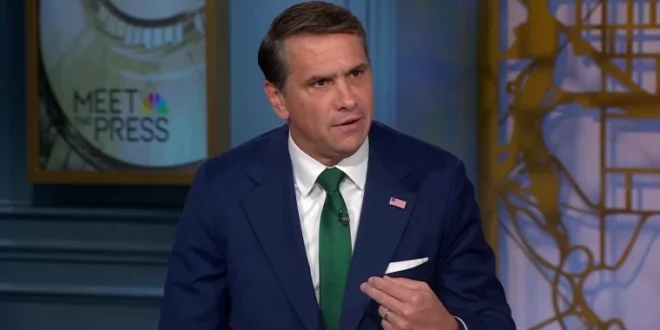
Attorney General Todd Blanche, President Donald Trump’s former personal lawyer, said Sunday that he is willing to disagree with the president on legal matters, but stopped short of promising that the Justice Department will always operate independently of the White House.
Blanche, who is entering his second week as the nation’s top law enforcement official, used appearances on Fox News and NBC’s “Meet the Press” to defend his independence amid bipartisan concerns about his close relationship with Trump.
“There’s a misnomer about President Trump, which is that he wakes up in the morning, calls me up and says, ‘Todd, go prosecute this,’” Blanche told Fox News host Shannon Bream. “That’s absolutely not the case.”
Blanche said Trump expects members of his administration to push back when they believe he is wrong.
“I think he would expect me to tell him no,” Blanche said when asked whether he could reject the president’s preferred course of action if his own legal judgment differed.
But when NBC’s Kristen Welker asked Blanche whether he would pledge that the Justice Department would “always act independently” of the White House, he declined.
“No, I’m not going to pledge that,” Blanche said. “And no attorney general should ever pledge that.”
That exchange is likely to intensify questions surrounding Blanche’s ability to separate the Justice Department’s law enforcement responsibilities from the political priorities of the president who appointed him.
Blanche says Trump’s views can influence DOJ decisions
Blanche also acknowledged that Trump’s opinions could factor into decisions about federal prosecutions.
Asked whether he would consider the president’s views if Trump believed a particular case should be pursued or revived, Blanche answered affirmatively.
“Yes, of course,” he said. “And I hope every attorney general in history would not answer that question differently.”
Blanche sought to draw a distinction between listening to the president and being ordered to prosecute someone.
He said Trump does not personally dictate prosecutions and maintained that the president would never ask him to take an unethical or illegal action.
“The president will never ask me to do something unethical or illegal. He never has. He never will,” Blanche told Welker.
Blanche also said he intends to act with integrity and expects the same from Justice Department prosecutors.
But his refusal to make a blanket commitment to DOJ independence leaves an important question unresolved: How much influence should a president have over decisions about who gets investigated or prosecuted by the nation’s top law enforcement agency?
Trump relationship puts Blanche under scrutiny
Blanche’s relationship with Trump is central to the concerns surrounding his appointment.
Before becoming attorney general, Blanche served as Trump’s personal attorney, giving him a direct relationship with the president that predates his government service.
His confirmation also exposed bipartisan skepticism.
Forty-nine senators, including two Republicans and all Senate Democrats, voted against his confirmation.
That opposition reflects concerns that Blanche’s previous role as Trump’s lawyer could make it difficult for him to independently oversee a Justice Department responsible for investigating and prosecuting matters involving the president, his political allies or his opponents.
Blanche’s Sunday interviews appeared aimed at addressing those concerns without distancing himself from Trump.
His message was essentially that he can disagree with the president while still taking Trump’s views seriously.
Democrats warn about political influence
Democratic leaders have continued to question whether the Justice Department under Blanche can maintain the independence traditionally expected of federal prosecutors.
House Minority Leader Hakeem Jeffries offered one of the sharpest assessments, describing Blanche’s Justice Department as “a wholly owned subsidiary of the Trump cartel.”
The criticism underscores the broader political challenge facing Blanche as he takes over an agency with enormous prosecutorial power.
Attorneys general traditionally serve as members of the president’s Cabinet while also overseeing a department whose prosecutors are expected to make decisions based on law and evidence rather than political loyalty.
That tension becomes particularly significant under a president who has repeatedly criticized prosecutors and federal investigations involving him and his political allies.
The independence question remains
Blanche’s comments do not establish that Trump is directing federal prosecutions. Blanche explicitly denied that characterization.
But his refusal to promise that the Justice Department will “always act independently” of the White House provides critics with a clear opening to question the limits of presidential influence.
At the same time, Blanche argues that independence does not mean ignoring the president.
Trump is the elected head of the executive branch, Blanche said in effect, and his views are relevant to the administration’s priorities.
The unresolved issue is where that influence ends.
For Blanche, the test will come not from what he says in television interviews but from how the Justice Department handles politically sensitive investigations and prosecutions — particularly those involving Trump’s allies, opponents and the president himself.