


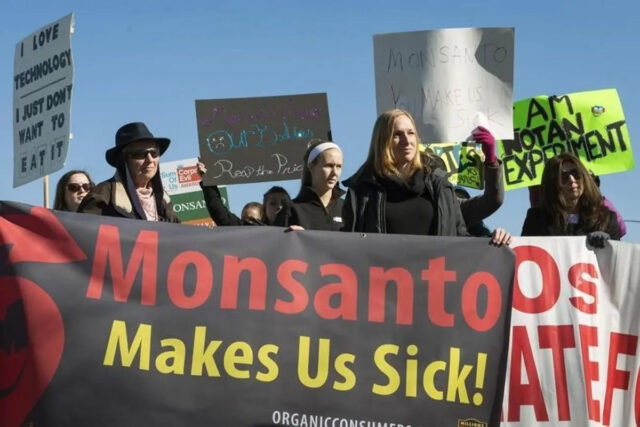
State courts cannot find liability for labeling shortcomings in pesticides and similar products because such products are covered by federal law, the U.S. Supreme Court said Thursday in a decision backing agricultural giant Monsanto in a Roundup cancer case.
The justices, in a 7-2 decision, threw out a $1.25 million verdict a Missouri court awarded to a man who said long-term use of the weedkiller Roundup caused him to develop non-Hodgkin lymphoma, a type of blood cancer.
The herbicide, produced by Monsanto, does not include any warning of carcinogenic material. Monsanto and parent company Bayer deny there is any link and the U.S. Environmental Protection Agency has routinely found that glyphosate, the active ingredient in Roundup, does not likely cause cancer.
The political news that affects your wallet, your rights and your vote, broken down in plain language. Free in your inbox.
Consumer and health advocates, though, said the decision provided companies immunity from health-related claims.
The decision created an unusual split for the conservative-dominated court, with Justice Brett Kavanaugh writing the majority opinion and his fellow conservative Justice Neil Gorsuch joining a dissent written by liberal Justice Ketanji Brown Jackson.
Federal law trumps state
The majority ruled that the Federal Insecticide, Fungicide, and Rodenticide Act, or FIFRA, which governs herbicide use, explicitly preempts state claims like the one awarded to John Durnell of St. Louis.
Roundup’s label complied with EPA regulations, to which states cannot add requirements, Kavanaugh wrote. Placing a cancer warning would open the company up to civil and criminal penalties for using a label the EPA did not approve, he said.
“In sum, federal law requires Monsanto to sell Roundup with the label that EPA approved at the initial registration and that EPA has subsequently re-approved on multiple occasions, that is, the label without a cancer warning,” he wrote.
“Durnell’s state tort claim, by contrast, would require Monsanto to add a cancer warning to its labels. That Missouri-law requirement is ‘in addition to’ and ‘different from’ Monsanto’s federal-law labeling obligations.”
In a statement, Bayer CEO Bill Anderson praised the ruling for providing regulatory certainty to farmers and the herbicide producer.
“This decision is good for American farmers who help feed the world,” he said. “It provides the regulatory clarity necessary for innovators like us to develop the agricultural tools that guarantee an affordable food supply.”
Closing the courthouse doors
In her dissent, Jackson wrote that the majority’s decision improperly prioritized national uniformity over consumer protection.
While the federal law does include a preemption clause, it also includes a provision against “false or misleading” statements. That provision covers the absence of a warning necessary to protect health and the environment, she wrote.
“Ultimately, the effect of the majority’s interpretation is both remarkable and regrettable, for it unjustifiably closes the courthouse doors to state tort plaintiffs like Durnell,” she wrote.
Advocates also criticized what they said was the ruling’s creation of legal immunity for manufacturers.
Bill Jordan, whose 40-year EPA career included three years as the deputy director of the Office of Pesticide Programs during the Obama administration, said in a statement distributed by the Environmental Protection Network, a coalition of former EPA officials, that the decision leaves people “with fewer tools to protect themselves.”
“When people are exposed to pesticides, they deserve honest warnings about the risks,” Jordan said. “If federal protections aren’t enough, states should be able to act before people get sick. This Supreme Court decision favors companies and takes away one of the important ways states can require stronger health warnings for the public.”
Farm bill amendment
U.S. Sen. Cory Booker said on a press call the decision reversed thousands of jury awards to people who said they were harmed by herbicides like Roundup.
The court “sided with the wealthy, powerful multinational corporations, reversing years and years of precedent, dismissing, ultimately, effectively hundreds and hundreds, in fact thousands, of cases,” the New Jersey Democrat said. “They sided with the big multinational corporations against the people.”
Booker said he would introduce an amendment to the farm bill to strip out the preemption clause.
He also suggested that corporate lobbying and campaign contributions influenced the decision.
“We have seen hundreds of millions of dollars, billions of dollars pouring into our political system, corrupting all three branches of government,” Booker said.
Missouri verdict
Durnell sued Monsanto and parent company Bayer in 2019, claiming that exposure to Roundup over two decades led to his cancer diagnosis. A Missouri trial court awarded him $1.25 million, and a state appeals court affirmed the ruling.
The Supreme Court was the first federal court to hear the case.
Federal law typically trumps state law, which Monsanto and the Justice Department emphasized during April oral arguments. Industry groups across the economy tend to support federal supremacy because it saves companies from complying with 50 separate regulatory schemes across states.





How is this different than the Master Tobacco Settlement?