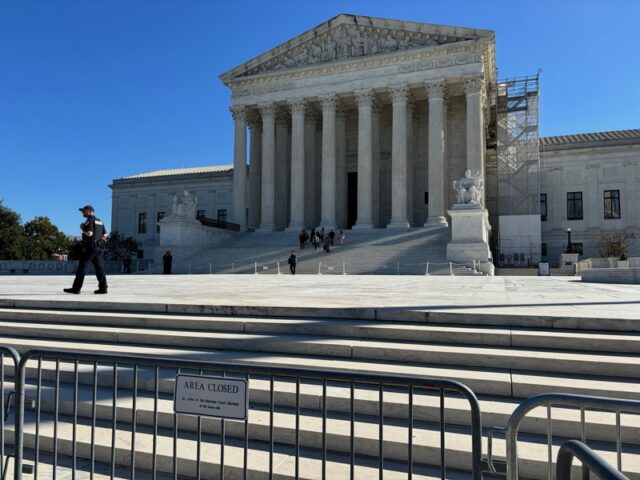
The Supreme Court agreed Friday to decide whether Donald Trump’s asylum restrictions at the southern border are legal, taking up a case over a policy that has blocked most migrants who cross the border from even asking for protection.
The justices added the case, Mullin v. Refugee and Immigrant Center for Education and Legal Services, in an order list released Nov. 13 after their private conference. SCOTUSblog reported that arguments will likely be held next spring. A decision is expected by the end of June.
Asylum is a legal protection that lets a person stay in the United States if they can show they were persecuted, or fear persecution, in their home country because of their race, religion, nationality, political opinion or membership in a particular social group. Federal law has long said a person who arrives in the country may apply for it, whether they came through an official crossing or not.
The political news that affects your wallet, your rights and your vote, broken down in plain language. Free in your inbox.
Trump signed a proclamation on Jan. 20, 2025, his first day back in office, declaring that an “invasion is ongoing at the southern border.” It suspended entry for people it described as engaged in that invasion and said they could not seek protections such as asylum. Guidance from the Department of Homeland Security then barred migrants covered by the policy from applying for asylum and allowed them to be removed quickly, without some of the hearings federal law normally requires. The AP reported that the asylum restrictions also reach migrants who arrive at official border crossings without certain medical or criminal history information, and that they stay in place until Trump decides the “invasion” has ended.
Thirteen people who say they were persecuted or tortured in their home countries, along with three immigrant rights nonprofits, sued in federal court in Washington. U.S. District Judge Randolph Moss ruled in July 2025 that the administration had gone beyond its legal authority. He certified a class covering everyone who is or would be subject to the proclamation, struck down the Homeland Security guidance and barred officials from carrying it out.
In April, a panel of the U.S. Court of Appeals for the D.C. Circuit largely upheld that ruling. Judge J. Michelle Childs wrote the majority opinion, joined by Judge Cornelia Pillard. Judge Justin Walker partly dissented, writing that a president can deny all asylum applications but agreeing that the government cannot send people to places where they would be persecuted. The appeals court put its ruling on hold while the government appealed, so the asylum restrictions remain in effect today.
In the government’s appeal, Solicitor General D. John Sauer argued that the border was overwhelmed and that suspending entry and cutting off asylum were central to Trump’s response. He argued that Trump acted within his own powers and the powers Congress gave him to keep noncitizens out, and that federal immigration law bars lower courts from issuing the kind of order Moss issued. The administration credits the policy with helping bring border crossings down, according to the AP.
The challengers argue that a president cannot create a new removal system that wipes out protections Congress wrote into law. They told the court that border apprehensions had already fallen more than 90 percent from their peak before the proclamation took effect. Immigrant rights groups have said the medical and criminal history requirement is often impossible to meet for people running from violence, the AP reported.
The justices agreed to decide whether the proclamation and the guidance behind the asylum restrictions are legal, and whether Moss had the power to grant relief that broad. They turned down the government’s request to also review whether the class of migrants in the lawsuit was properly certified.
The case joins several immigration fights already before the court. In June, the justices backed the government’s power to turn away asylum seekers when border crossings are deemed too crowded, and in September they allowed the administration to resume deporting migrants to countries other than their own. Arguments in that third country deportation case, Department of Homeland Security v. D.V.D., are set for Dec. 9.
The ruling will decide whether a person who reaches the southern border can still ask for asylum at all, or whether a president can shut that door on his own by declaring an invasion. Until the justices rule, the asylum restrictions stay in place.