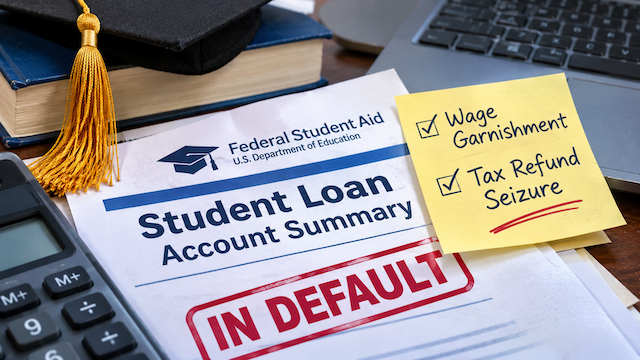
More than 9 million Americans are in student loan default, owing about $234 billion combined, and student loan experts say the Education Department could begin garnishing their paychecks and taking their tax refunds as soon as next year.
Stateline, a nonprofit news service, reported the figures on Nov. 12 using Education Department data. A federal student loan goes into default after a borrower misses scheduled payments for at least 270 days. Millions more borrowers are behind on payments and at risk of joining them.
For most of the last six years, the government did not chase borrowers who stopped paying. Payments and collections were frozen during the pandemic, and the Education Department canceled its contracts with private collection agencies during that period. The department announced in May 2025 that it would restart involuntary collections, then paused them again in January of this year. In its January announcement, the department said it was delaying administrative wage garnishment, which takes money directly from a paycheck, and the Treasury Offset Program, which lets the government keep federal tax refunds and other federal payments to cover a debt. Under Secretary of Education Nicholas Kent said collections “will function more efficiently and fairly after the Trump Administration implements significant improvements” to repayment under the 2025 tax and spending law. The department gave no end date for the pause.
The political news that affects your wallet, your rights and your vote, broken down in plain language. Free in your inbox.
That pause may not last much longer. Betsy Mayotte, president and founder of The Institute of Student Loan Advisors, told Stateline she expects collections to start in 2027. The Education Department did not respond to Stateline’s questions, and it has not announced a restart date.
The government has also changed who will do the collecting. Newsweek reported that the Education Department and the Treasury Department signed an agreement in March that moves loans already in student loan default to Treasury’s Cross Servicing Program, which can use private contractors to collect federal debts.
Once student loan default collections resume, a borrower who has gone at least 360 days without paying can have up to 15 percent of their pay garnished and can lose federal tax refunds through the Treasury Offset Program, according to Newsweek. CBS News reported that the offset program can also reach federal salaries and Social Security benefits. Borrowers must get written notice before the government takes their money, and CBS reported that the notice must come at least 30 days before wages are garnished.
The burden is not spread evenly. Stateline found that Mississippi, Louisiana and New Mexico have the highest rates of student loan default in the country, with more than a quarter of borrowers in each state in default. Massachusetts, New Hampshire, Utah and Wisconsin had the lowest rates, at 15 percent. A Federal Reserve Bank of New York analysis cited by Stateline found that 13 percent of student loans in Louisiana and Mississippi went into default in late 2025 and early 2026, and that every state saw at least 5 percent go into default.
Preston Cooper of the American Enterprise Institute, a conservative think tank, told Stateline that the government “did not do a very good job of communicating the fact that repayment was starting again for real.”
Borrowers in default still have ways out before collections begin. The Education Department says borrowers can enter a repayment or rehabilitation agreement with their defaulted loan servicer, and rehabilitation means making an agreed set of payments to bring the loan back to good standing. The 2025 law now allows a second rehabilitation for borrowers who already used their one chance. Borrowers can also consolidate, which combines old loans into a new federal loan and moves it out of default. The department has also offered a new income driven repayment plan since July 1, 2026, which ties monthly payments to income. It warns that it reports defaults to the credit bureaus, which can damage a borrower’s credit, and it urges borrowers in default to contact their loan servicer now.
What happens next depends on when the Education Department and Treasury announce that student loan default collections are back on. Borrowers can check their loan status and servicer information at StudentAid.gov, the department’s official student aid site.