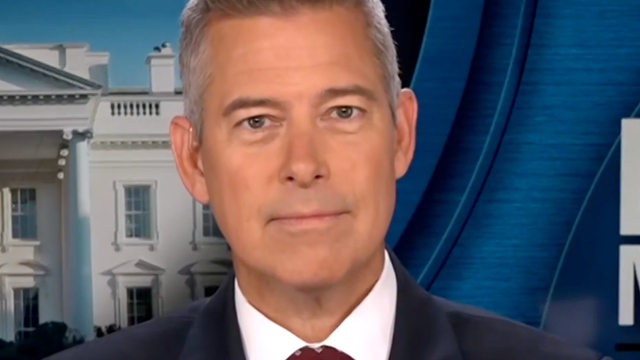
Transportation Secretary Sean Duffy faced pointed questions about accountability for the nationwide FAA ground stop Sunday morning, acknowledging that the aviation shutdown happened under his leadership while repeatedly pointing to previous administrations for the problems that contributed to the crisis.
During appearances on CNN’s State of the Union, NBC’s Meet the Press and ABC’s This Week, Duffy defended his handling of the disruption, which temporarily grounded flights across the country Friday and left airlines struggling to recover throughout the weekend.
CNN anchor Dana Bash directly challenged Duffy about his responsibility for the breakdown.
The political news that affects your wallet, your rights and your vote, broken down in plain language. Free in your inbox.
“As the secretary, do you take responsibility for what happened?” Bash asked.
Duffy acknowledged his position as head of the Transportation Department but immediately shifted attention to the condition of the aviation system he inherited.
“When we do work and things go wrong, of course, I’m the secretary,” Duffy responded, before adding, “I take responsibility for what was given to me by prior administrations.”
His response reflected a recurring argument throughout Sunday’s interviews: While Duffy acknowledged overseeing the agency responsible for the nation’s air traffic control system, he maintained that decades of inadequate investment had left the infrastructure vulnerable to failure.
The exchange became even more direct during NBC’s Meet the Press, when Duffy was asked whether he owed the American public an apology for the disruption.
“It happened on my watch,” Duffy acknowledged.
However, he declined to apologize, arguing that his department was moving aggressively to repair problems that existed before he took office.
“I can’t apologize for what was passed off to us,” Duffy said.
He added that he and Donald Trump were working to fix the system, describing the administration’s modernization efforts as moving at a pace not seen at the FAA or Transportation Department in decades.
The remarks came after Friday’s nationwide ground stop forced the Federal Aviation Administration to temporarily halt departures because of a malfunction involving critical air traffic control communications infrastructure.
The disruption caused thousands of flight cancellations and delays, stranding passengers and creating problems that continued after the FAA restored operations.
Federal officials have traced the malfunction to telecommunications equipment involved in replacing aging copper connections with modern fiber-optic technology.
During his appearance on ABC’s This Week, Duffy provided additional details about the investigation, explaining that technicians were examining equipment installed at a facility in El Dorado, Arkansas, and a related problem involving a system in Amarillo, Texas.
The equipment was part of a network operated by defense and technology contractor L3Harris.
Duffy said investigators were examining how a router involved in the upgrade could have transmitted excessive data across the national air traffic control network, disrupting other equipment.
ABC co-anchor Martha Raddatz also pressed Duffy about the possibility of deliberate sabotage.
Duffy said investigators had identified the person who performed the installation and did not believe the individual intentionally caused the disruption.
“Now we know who did the install. A good American patriot we believe, a veteran,” Duffy said.
He added that investigators did not believe the installation was an attempt to sabotage the network but acknowledged that officials still lacked a definitive explanation.
“We don’t actually have the root cause,” Duffy said.
The FAA, FBI and L3Harris are continuing to examine the equipment and installation procedures to determine exactly what triggered the failure.
Duffy also acknowledged that the government had not anticipated a single equipment problem spreading through the network on such a large scale.
That admission raises additional questions about the safeguards used to protect the nation’s aviation infrastructure during maintenance and upgrades.
Although the system contains equipment installed long before Duffy took office, the Transportation Department remains responsible for overseeing the FAA and ensuring that modernization projects are conducted safely.
The investigation has not established whether the disruption resulted from defective equipment, an installation mistake, weaknesses in the existing network or a combination of factors.
Duffy has used the incident to renew his push for additional federal funding, arguing that the nation’s outdated aviation infrastructure cannot be fully modernized without a larger congressional investment.
He has requested approximately $50 billion to overhaul the system, substantially more than the $12.5 billion Congress previously approved for aviation modernization.
During his ABC interview, Duffy argued that the existing funding was designated for specific improvements and could not be used to build the telecommunications network he wants.
He said a replacement network could be completed by late 2028 or early 2029 if Congress provides the necessary money.
For travelers, the immediate concern remains the reliability of the aviation system and whether another technical failure could cause a similar nationwide shutdown.
The FAA has defended the decision to ground flights as a necessary safety precaution while controllers dealt with unreliable communications and data systems.
However, the decision to stop departures is separate from the question of whether the underlying malfunction could have been prevented.
Duffy’s Sunday interviews left that issue unresolved. He acknowledged that the crisis occurred under his leadership but declined to apologize for the condition of the system, repeatedly emphasizing problems he said were inherited from previous administrations.
Investigators must now determine what caused the failure, whether proper safeguards were in place and what changes are necessary to prevent another nationwide aviation disruption.