Poli Alert Politics & Civics
Related Articles


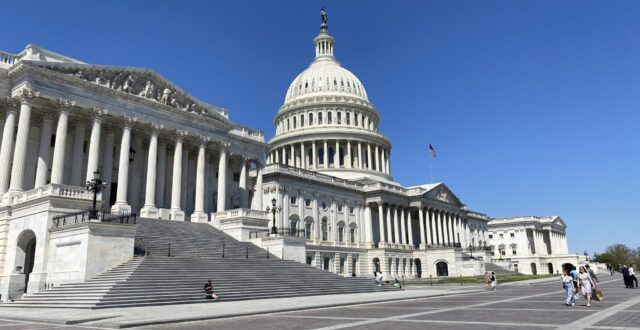
The Senate on Wednesday narrowly rejected a renewed effort to curb President Donald Trump’s military campaign against Iran, marking the first major congressional test of Republican support for the war after the expiration of the War Powers Act’s 60-day limit on unauthorized military operations.
The War Powers Resolution failed in a 49-51 vote, allowing Trump to continue military operations without explicit congressional authorization despite mounting questions about the legality, costs and scope of the conflict.
The measure, introduced by Sen. Jeff Merkley, sought to require congressional approval for continued U.S. military involvement in Iran following the expiration of the statutory 60-day period granted under the War Powers Resolution of 1973.
While most Senate Republicans backed Trump, several GOP senators broke ranks.
Sen. Lisa Murkowski voted in favor of limiting the president’s war powers for the first time since the conflict began, joining Sen. Susan Collins, who again supported the resolution after previously backing similar efforts earlier this year.
Sen. Rand Paul also voted in favor of the measure, continuing his opposition to the administration’s military campaign.
Meanwhile, Sen. John Fetterman was the lone Democrat to oppose the resolution, maintaining his previous support for the administration’s military posture toward Iran.
Sen. Pete Ricketts did not vote.
Trump launched the military campaign against Iran on Feb. 28 alongside Israel following escalating regional tensions and disputes surrounding Iran’s nuclear program.
The conflict, formally named Operation Epic Fury by the administration, has resulted in the deaths of 13 American service members and injuries to 404 others, according to the latest Pentagon figures.
Pentagon officials testified before Congress Tuesday that the war has already cost approximately $29 billion, a figure that does not include damage sustained by U.S. military facilities from Iranian missile and drone strikes.
The fighting has also disrupted global shipping and energy markets after Iran moved to restrict traffic through the Strait of Hormuz, contributing to rising oil prices and inflation worldwide.
The administration has argued the 60-day War Powers clock effectively paused after the United States and Iran agreed to a ceasefire in April.
However, Trump acknowledged Monday that the ceasefire was on “massive life support” following renewed exchanges between U.S. and Iranian forces in the Strait of Hormuz.
Iranian officials have disputed that a true ceasefire exists, pointing to an ongoing U.S. naval blockade around Iranian ports.
Merkley argued Wednesday that continued hostilities meant Congress still had a constitutional obligation to authorize further military action.
“Both sides are still engaged in hostilities,” Merkley said. “And so I don’t accept that the 60-day clock is suspended.”
Legal scholars and congressional Democrats have argued the administration’s interpretation of the War Powers Act stretches the law beyond its intended limits.
Senate Majority Leader John Thune urged Republicans to support Trump while the president conducts sensitive diplomatic meetings overseas, including high-stakes talks this week with Chinese President Xi Jinping in Beijing.
“He’s negotiating with the Chinese on a whole range of issues, some of which bear on national security, and I think it would be best if everybody hung together and supported the president,” Thune told reporters Wednesday morning.
The vote highlighted the continuing divide in Congress over executive war powers, particularly as the Iran conflict becomes increasingly intertwined with broader geopolitical tensions involving China, global energy markets and nuclear diplomacy.
The War Powers Resolution of 1973 was enacted following the Vietnam War to limit a president’s ability to engage U.S. forces in prolonged conflicts without congressional authorization.
Presidents from both parties have frequently challenged or bypassed aspects of the law, leading to recurring constitutional disputes between Congress and the executive branch.
Trump’s Iran campaign has intensified those debates as the administration insists the operation remains limited and strategically necessary to prevent Iran from obtaining nuclear weapons.
Critics, however, argue the military campaign has expanded far beyond its original scope and now risks entangling the United States in a prolonged regional conflict without clear congressional approval.
The issue has also become politically sensitive as rising fuel costs and inflation tied to the conflict weigh on Trump’s approval ratings ahead of the 2026 midterm elections.
The House is expected to consider a similar War Powers Resolution as early as Thursday, setting up another contentious debate over Congress’ role in authorizing military action.
Even if the measure were to pass both chambers, Trump would almost certainly veto it, requiring a two-thirds majority in Congress to override the president.
Meanwhile, lawmakers in both parties are expected to continue scrutinizing the administration’s handling of the conflict as casualties, military spending and economic fallout continue to mount.