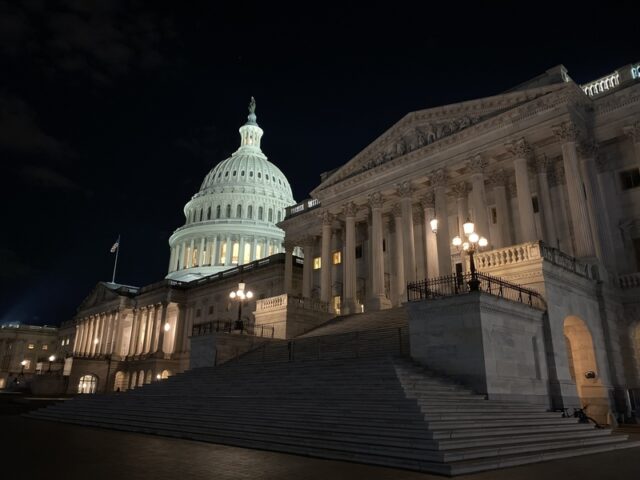
The Senate passed a sweeping permitting bill Thursday night by a vote of 62 to 33, sending to the House a measure that would speed up federal approval of power lines, pipelines, wind and solar farms, mines and oil drilling projects while adding rules meant to keep the cost of powering data centers off household electric bills. Permitting is the process federal agencies use to review and sign off on large construction projects, including the environmental studies that come before construction can start.
Fourteen Democrats joined nearly all Republicans in voting yes, according to Politico. Thirty one Democrats voted no, along with two Republicans, Sen. Josh Hawley of Missouri and Sen. Mike Rounds of South Dakota, Roll Call reported. Politico said Hawley and Rounds objected to the bill’s expansion of federal power over electric transmission lines.
The bill, S. 5653, known as the Bipartisan American Affordability and Jobs Act, was written by the top Republican and top Democrat on the two Senate committees that handle energy and the environment: Sen. Shelley Moore Capito, a West Virginia Republican, and Sen. Sheldon Whitehouse, a Rhode Island Democrat, who lead the Environment and Public Works Committee, and Sen. Mike Lee, a Utah Republican, and Sen. Martin Heinrich, a New Mexico Democrat, who lead the Energy and Natural Resources Committee.
The political news that affects your wallet, your rights and your vote, broken down in plain language. Free in your inbox.
The permitting bill changes how reviews are done under several major laws, including the National Environmental Policy Act, the 1970 law that requires federal agencies to study a project’s effects on the environment before approving it, as well as the Endangered Species Act, the Clean Water Act, the Federal Power Act and the National Historic Preservation Act, according to Roll Call. Politico reported that it shortens deadlines for environmental reviews and limits when projects can be challenged in court.
The measure also gives the Federal Energy Regulatory Commission, the independent agency that oversees the interstate electric grid and natural gas pipelines, new authority over interstate transmission lines. Roll Call said the bill includes provisions intended to make sure ordinary electricity customers are not stuck paying the cost of bringing power to data centers, the giant computer facilities that run artificial intelligence and cloud services and are driving a surge in demand for electricity.
Another section gives project developers a way to go to court when an administration discriminates against certain kinds of energy or tries to revisit permits for ideological reasons. Roll Call reported that the provision is meant in part to respond to the Trump administration’s moves to delay or block solar and wind projects. Republicans, meanwhile, pushed for faster approval of interstate natural gas pipelines, Politico reported.
No amendments were voted on beyond the revised version of the bill the Senate adopted Wednesday. Roll Call reported that Oregon Democrats Ron Wyden and Jeff Merkley refused to agree to a time limit on debate after Republicans would not allow simple majority votes on some of their proposals. Wyden wanted a vote on banning data centers on federal public lands, and Merkley sought to keep data centers from getting the bill’s protections against future presidents revoking permits.
“This bill has threaded a needle the likes of which this chamber has not seen in a while,” Capito said before the vote, according to Roll Call. Merkley, speaking before the vote, said he was “hoping to have a full opportunity to address the many legitimate concerns that stakeholders have raised.”
Business and energy groups backed the permitting bill, including the American Petroleum Institute, the American Clean Power Association, the U.S. Chamber of Commerce and the National Association of Manufacturers, Roll Call reported, along with labor groups, according to Politico. The Sierra Club, the Natural Resources Defense Council, a coalition of 17 Democratic led states, and tribal groups including the National Congress of American Indians opposed it. Senate Democrats who voted no said the bill went too far in rolling back environmental rules and lacked the support of most tribal groups, Politico reported. The White House said in a formal statement of administration policy this month that it supports the bill.
The permitting bill now goes to the House, where Roll Call reported a vote is expected after the Thanksgiving recess. House Speaker Mike Johnson told Politico, “It may be a suspension bill, but if not, we’ll do it by rule.” Suspension is a fast track procedure that skips floor amendments but requires a two thirds vote, which would mean Johnson needs Democratic support. Bringing it up “by rule” would require only a simple majority.
House Minority Leader Hakeem Jeffries, who is expected to become speaker when Democrats take control of the House in January, has said “we certainly need to get permitting reform done” but that the bill “falls short” and needs changes to its environmental review and tribal provisions, Politico reported. Republicans hope to send the bill to Trump before the current Congress ends on January 3, but Politico noted that attendance could be a problem, since some House Republicans who lost their races in November have been less likely to return for votes.
If the permitting bill becomes law, it could change how quickly new power lines and energy projects get built near communities across the country and who pays for the electricity that data centers need, two questions that land directly on monthly utility bills.