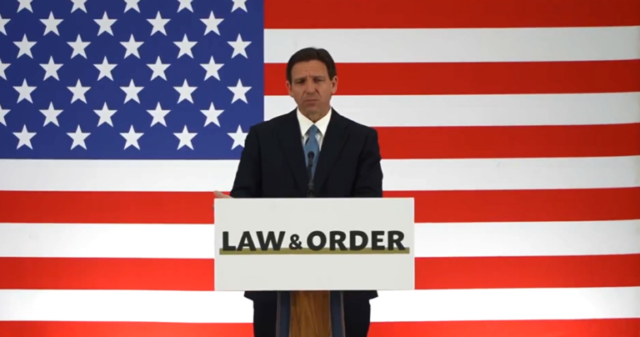
Florida executions reached a new annual record Thursday as the state put 71-year-old Thomas Mitchell Overton to death, marking its 20th execution of 2026 and surpassing the previous record of 19 set just last year under Republican Gov. Ron DeSantis.
Overton was executed by lethal injection November 19 at Florida State Prison in Raiford for the 1991 murders of Michael and Susan MacIvor, a married couple killed inside their home in the Florida Keys.
According to the Associated Press, Overton was pronounced dead at 6:19 p.m. He maintained his innocence throughout his decades on death row and continued denying responsibility for the killings in his final statement.
The political news that affects your wallet, your rights and your vote, broken down in plain language. Free in your inbox.
“I never killed anyone,” Overton said before his execution.
The execution marks the second consecutive year Florida has broken its own annual record since the U.S. Supreme Court allowed capital punishment to resume in 1976. The state carried out 19 executions in 2025, already an unprecedented number in its modern death penalty history.
DeSantis has overseen the increase through his authority to sign death warrants, which authorize the state to carry out executions after prisoners have exhausted the required legal proceedings.
Florida’s execution schedule has accelerated considerably compared with earlier years. The state carried out six executions in 2023, one in 2024 and 19 in 2025 before reaching 20 this year.
Overton was convicted in 1999 of murdering Michael and Susan MacIvor in their Tavernier home in August 1991. Prosecutors presented forensic evidence linking him to the crime scene, including DNA evidence that became central to the case.
His attorneys continued challenging aspects of that evidence and the constitutionality of his death sentences. Overton also received his sentences under Florida’s former capital punishment system, which permitted death sentences based on nonunanimous jury recommendations.
Florida’s death penalty laws have undergone several major changes following court rulings and legislative action.
In 2023, DeSantis signed legislation allowing a death sentence when at least eight of 12 jurors recommend execution. The law replaced a unanimous jury recommendation requirement that Florida had adopted following earlier court decisions.
Under the current law, a jury must still unanimously determine that at least one legally recognized aggravating factor exists before a defendant can be eligible for the death penalty. Aggravating factors are circumstances, such as particular features of a murder, that can make a crime eligible for capital punishment.
Overton’s personal history also received attention during the legal proceedings surrounding his execution.
According to the Death Penalty Information Center, Overton was a U.S. Army veteran and a survivor of the Arthur G. Dozier School for Boys, a former Florida reform school where generations of children experienced documented physical abuse and mistreatment.
Florida formally apologized to survivors of the institution in 2017 following investigations that exposed decades of abuse.
The U.S. Supreme Court denied Overton’s final request for a stay of execution Thursday, allowing the state to proceed.
The record number of Florida executions comes as the state’s death penalty system faces continued examination over sentencing standards, forensic evidence, the handling of appeals and the legal protections available to prisoners facing execution.
The Death Penalty Information Center has documented Florida’s rising execution numbers and the legal issues raised in individual cases. The organization tracks capital punishment nationwide and provides research on death penalty laws and practices.
Nationally, executions have fluctuated in recent years but remain below the levels recorded during the late 1990s, when the United States reached its modern peak of 98 executions in 1999.
Florida’s record also reflects the significant authority governors hold over the timing of executions. Although courts determine whether death sentences are legally valid, Florida’s governor signs the warrants establishing when executions will take place.
Prisoners may continue seeking judicial review after a warrant is signed, and courts can issue stays that temporarily halt an execution. Florida also allows prisoners to request executive clemency, which can reduce a death sentence if approved through the state’s constitutional process.
Florida has additional executions scheduled for December, although one has already been temporarily halted.
DeSantis issued a stay of Ricardo Gonzalez’s December 1 execution pending a psychiatric evaluation to determine whether he is competent to be executed. Another execution is scheduled for December 10.
If additional executions proceed, Florida’s annual total could rise further before the end of 2026.
With Overton’s death, Florida has now carried out 39 executions in less than two years, exceeding the state’s combined total for many earlier multiyear periods and establishing consecutive annual records under DeSantis.