

House Democrats displayed deep divisions over U.S. support for Israel on Wednesday as more than 100 members voted to eliminate billions of dollars in aid to the country, highlighting an increasingly public split within the party over America’s role in the conflict in Gaza.
The amendment, introduced by Rep. Thomas Massie, R-Ky., sought to eliminate approximately $3.3 billion in U.S. assistance to Israel. Massie offered the proposal as an amendment to the annual State Department appropriations bill, which the House later approved.
The amendment failed in a 314-104-10 vote.
Massie was the only Republican to support the measure. Among Democrats, however, the vote exposed a nearly even divide, with 103 members voting in favor of cutting the aid, 98 voting against the proposal and 10 voting “present.”
Democratic leaders split
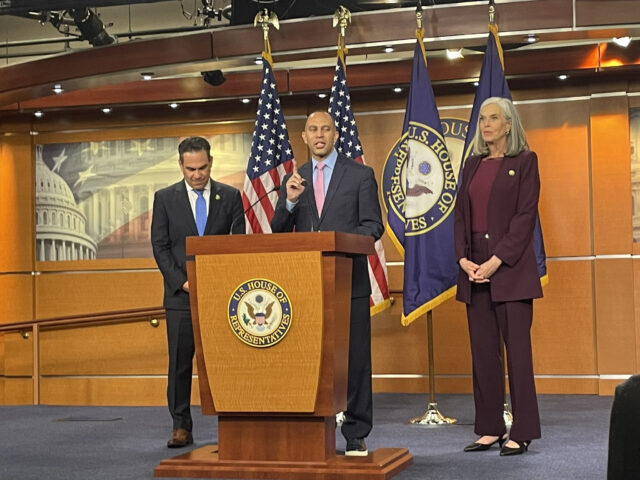
The vote also underscored differences among top Democratic leaders, who typically present a united front on major legislative issues.
House Minority Leader Hakeem Jeffries, D-N.Y., urged members to oppose the amendment, arguing it would have broader consequences beyond military assistance.
In a letter sent to House Democrats before the vote, Jeffries said the proposal was “overly broad” because it would restrict funding for humanitarian aid, refugee resettlement efforts, peace-building programs and operations at the U.S. Embassy.
He also argued the amendment could limit the United States’ ability to confront Hamas and Hezbollah.
Despite opposing the measure, Jeffries acknowledged the party’s internal disagreements and said Democratic leadership would not pressure members to vote one way or the other. He also reiterated his call for what he described as a “major reset” in the U.S.-Israel relationship.
House Democratic Whip Katherine Clark of Massachusetts broke with Jeffries by announcing she would support the amendment.
“The status quo is not tenable,” Clark said in a statement before the vote.
She said her support did not reflect agreement with every aspect of the Republican-sponsored amendment but instead represented a belief that U.S. policy toward Israel should change.
“While Democratic members will make different decisions on this amendment in good faith, we are absolutely united in our shared goal of permanent peace,” Clark said.
Progressive influence grows
The vote comes amid growing pressure within the Democratic Party over continued U.S. military support for Israel.
Recent Democratic primary elections have seen several incumbents who backed Israel lose to progressive challengers critical of Israeli military operations and U.S. assistance.
Rep. Greg Casar, D-Texas, chairman of the Congressional Progressive Caucus, acknowledged concerns that the amendment would also affect humanitarian programs but argued ending military assistance was the more significant objective.
“More Democrats than ever before voted to stop sending money to Benjamin Netanyahu’s government, despite the fact that this amendment was an imperfect vehicle for our movement,” Casar said after the vote.
He described the outcome as “a victory for the millions of Americans who have demanded an end to U.S. taxpayer support for the Israeli military’s war crimes.”
Debate likely to continue
Although the amendment failed by a wide margin, the number of Democratic lawmakers supporting it reflected a significant shift from previous years, when bipartisan backing for military aid to Israel faced little organized opposition in Congress.
The debate is expected to remain a central issue within the Democratic Party as lawmakers continue to consider foreign aid spending and as candidates campaign ahead of the midterm elections.