

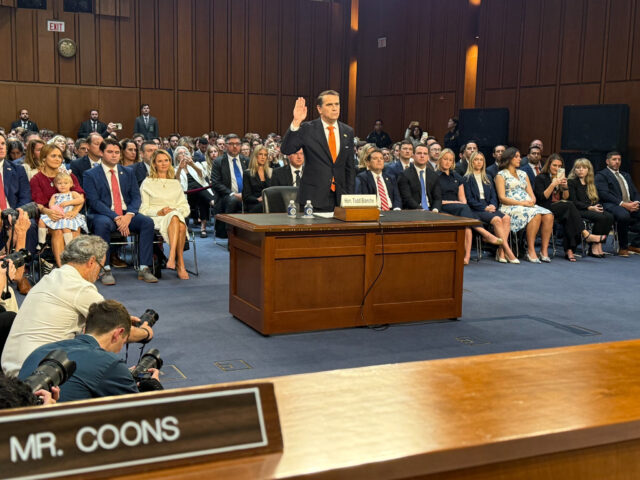
Acting Attorney General Todd Blanche faced bipartisan scrutiny Wednesday during his Senate confirmation hearing, where lawmakers questioned his role in a controversial settlement tied to President Donald Trump, the Justice Department’s handling of the Jeffrey Epstein investigation and the agency’s independence under the second Trump administration.
Appearing before the Senate Judiciary Committee, Blanche vowed that if confirmed as attorney general, the Justice Department would not oppose congressional efforts to permanently eliminate a proposed $1.776 billion “anti-weaponization” fund that critics have described as unconstitutional and politically motivated.
The hearing unfolded before a narrowly divided Judiciary Committee, now split 11-10 following the death of Sen. Lindsey Graham, R-S.C. A bouquet of white roses marked Graham’s vacant seat during the proceedings.
Republicans press Blanche on settlement fund
Much of the hearing centered on the settlement reached after Trump agreed to drop his $10 billion lawsuit against the Internal Revenue Service over the disclosure of his tax returns.
The agreement included plans for a $1.776 billion fund intended to compensate individuals whom the administration described as victims of political “weaponization.” The proposal immediately drew criticism from lawmakers who argued it could become a taxpayer-funded pool benefiting Trump allies, including pardoned Jan. 6 defendants.
Sen. Thom Tillis, R-N.C., called the proposal a “turkey” that “should never be paid out.”
“I want to stick a fork in this turkey of a 1776 fund,” Tillis said.
Blanche insisted the fund is effectively dead.
“I’m under oath today, and I’ve said it’s dead repeatedly,” Blanche testified. “No money went from the Treasury to any other account.”
When Tillis suggested Congress could permanently eliminate the proposal through legislation, Blanche said the administration would not oppose that approach.
Sen. John Cornyn, R-Texas, also questioned why the settlement had not been formally modified to remove the fund.
Democrats question tax immunity
Democratic lawmakers focused on another provision of the IRS settlement that they argued shields Trump, his family and the Trump Organization from certain government tax enforcement actions.
Sen. Dick Durbin, D-Ill., accused the administration of creating a legal arrangement unavailable to ordinary Americans.
“It’s hard to explain to the American people that no one is above the law when that type of document was signed by you,” Durbin told Blanche.
Blanche rejected that characterization, saying the settlement followed standard IRS practices and did not provide immunity for future tax obligations.
The confirmation hearing came two days after a federal judge sharply criticized the IRS settlement, ruling that Trump had attempted to use the courts to legitimize an unconstitutional agreement while describing the litigation as manufactured.
Epstein files remain under scrutiny
Lawmakers also questioned Blanche about the Justice Department’s handling of files related to convicted sex offender Jeffrey Epstein and whether additional records could still become public.
Blanche defended what he described as a “Herculean” review of millions of investigative documents while acknowledging mistakes in the redaction process that briefly exposed identifying information belonging to some victims.
“There were mistakes that were made,” Blanche said. “Whenever we learned that any victim’s name had been improperly not redacted, we immediately took the document down and fixed it.”
Several Epstein abuse survivors attended the hearing, with some wearing shirts displaying the blacked-out redactions contained in previously released government files.
Durbin urged Blanche to personally meet with victims within the next month, but Blanche declined, citing ongoing litigation involving the case.
Instead, he said Justice Department prosecutors remain available to meet with survivors and pledged continued investigations into anyone who committed crimes connected to Epstein.
Sen. Cory Booker, D-N.J., criticized Blanche’s refusal, noting that Blanche previously met with convicted Epstein associate Ghislaine Maxwell.
Confirmation outlook uncertain
Blanche, a former federal prosecutor who later served as Trump’s personal defense attorney, has overseen the Justice Department since former Attorney General Pam Bondi departed earlier this year.
His confirmation remains uncertain in the closely divided Senate, where several Republican senators have occasionally broken with Trump on key nominations.
During the hearing, Blanche defended the president’s constitutional authority to issue pardons, including Trump’s sweeping clemency for roughly 1,600 people charged in connection with the Jan. 6, 2021, attack on the U.S. Capitol, but declined to offer his personal opinion on those decisions.
The Judiciary Committee is expected to vote on Blanche’s nomination in the coming weeks before it advances to the full Senate.