

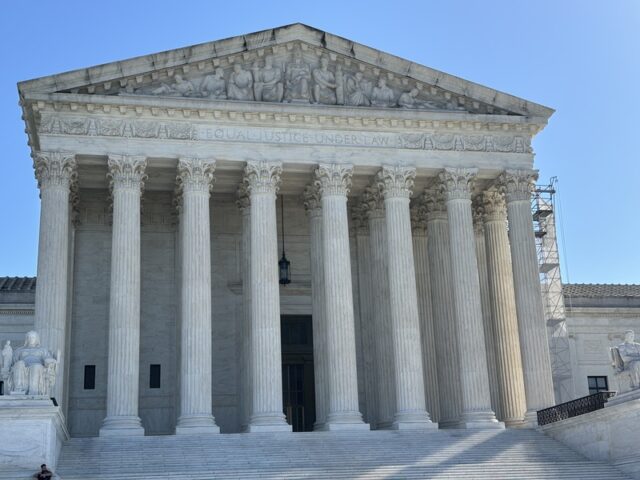
House Republicans failed Wednesday to advance a constitutional amendment that would permanently set the Supreme Court at nine justices, as Democrats increasingly embrace the once-fringe idea of expanding the court.
The House voted 212-206, falling well short of the two-thirds majority required for a constitutional amendment. Rep. Don Davis, D-N.C., was the only Democrat to join Republicans in supporting the measure.
The resolution, introduced by Rep. Andy Biggs, R-Ariz., would amend the Constitution to require that the Supreme Court consist of one chief justice and eight associate justices.
The Constitution does not set the number of Supreme Court seats. Congress established six justices in 1789, and the size changed several times before reaching nine in 1869.
Democrats Reject Permanent Limit
House Democratic leadership urged members to vote against the amendment, arguing that permanently fixing the court at nine seats would remove Congress’ constitutional authority to determine its size.
Democrats also said Republicans were using the vote as a political messaging tool ahead of the 2026 midterms.
The measure was one of several votes House Republican leaders scheduled to highlight issues they argue demonstrate a Democratic shift to the left.
Republicans have increasingly warned that Democrats could expand the court if they regain control of Congress and the White House.
House Speaker Mike Johnson, R-La., said Republicans would keep the court at nine seats if they remain in power.
Court Expansion Moves Into Democratic Mainstream
Wednesday’s vote does not provide a definitive measure of Democratic support for expansion. Many Democrats still oppose adding seats or have not taken a position.
But support for expansion has grown within the party, fueled in part by decisions from the Supreme Court’s conservative majority.
The court overturned the constitutional right to abortion established by Roe v. Wade, narrowed some applications of the Voting Rights Act and ruled that Trump has immunity from prosecution for certain official acts.
Former Vice President Kamala Harris has also supported revisiting the issue, while Rep. Jim Clyburn, D-S.C., recently endorsed expanding the court from nine to 13 justices.
The Fight Could Extend Beyond 2026
Constitutional amendments require two-thirds support in both the House and Senate before the ratification process can begin, making the Republican proposal unlikely to advance under the current political landscape.
But the debate over the court’s size is unlikely to disappear.
Democrats who support expansion see it as a potential response to what they view as an increasingly conservative and powerful Supreme Court. Republicans argue that adding seats would undermine the court’s independence and create a cycle in which each party expands the bench when it gains power.
With the 2026 midterms approaching, the issue gives both parties another opportunity to define the stakes of control over Washington — and could remain a major Democratic policy debate heading into the 2028 presidential election.