


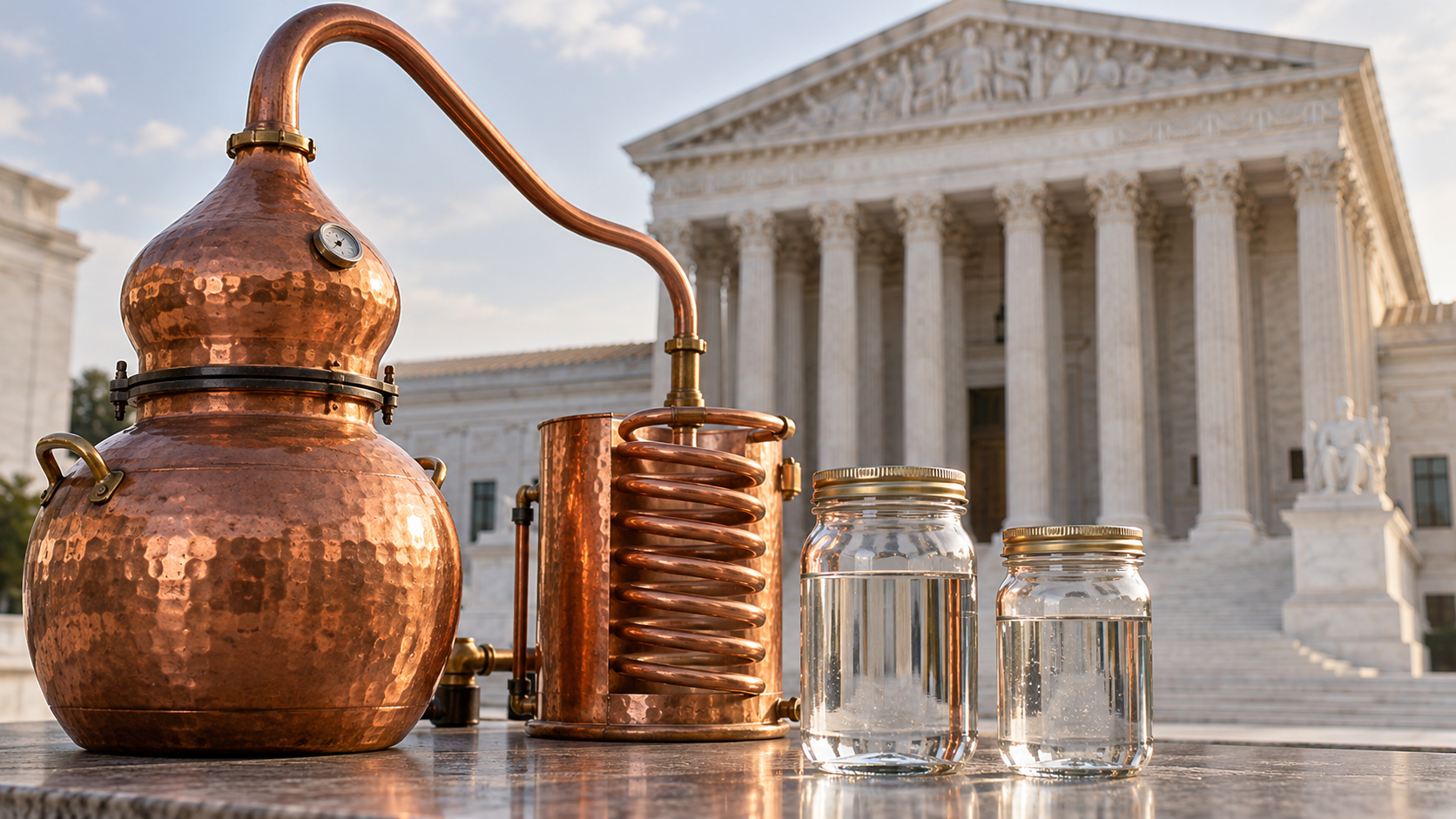
The Supreme Court has agreed to decide whether the federal home distilling ban, a law on the books since 1868, is constitutional. The ban makes it a crime to make whiskey, vodka or any other hard liquor at home, even if you never sell a drop.
The court announced on Monday, October 19, that it will hear the case, called Department of Justice v. McNutt. The order was unsigned and gave no explanation, which is normal when the justices agree to take a case. Agreeing to hear it does not signal how they will rule.
Most people do not realize how strict the law is. Under federal law, you can legally brew beer or make wine at home for personal use. Distilling is different. Running a still in your home or backyard can bring up to five years in prison and a $10,000 fine.
The home distilling ban came out of the years right after the Civil War, a period known as Reconstruction. Liquor taxes were a major source of money for the federal government, and Congress wanted to stop people from making alcohol in secret and skipping the tax. Banning distilling at home kept production in commercial facilities where the government could inspect it and collect.
The people challenging the law say that reasoning no longer holds up. The case was brought by Scott McNutt, a hobbyist who owns a still and wants to experiment with making spirits at home, along with the Hobby Distillers Association, a nonprofit that first sued in a Texas federal court in 2023. Their lawyers include the Buckeye Institute, a conservative legal and policy group.
Their argument centers on what are called enumerated powers. The Constitution gives Congress a specific list of powers, and Congress cannot pass laws outside that list. The government has defended the home distilling ban as part of its power to tax. The challengers say a ban on home distilling does not raise any tax money at all, so it cannot be justified as a tax law. In their filings, they wrote that the case raises fundamental questions about the limits of federal power and the powers left to the states and the people.
Lower courts split on that question. In April, the Fifth Circuit Court of Appeals, which covers Texas, Louisiana and Mississippi, sided with McNutt. That court reasoned that the ban actually shrinks the government’s tax base by keeping home distillers out of the market entirely. Meanwhile, the Sixth Circuit, which covers Ohio, Michigan, Kentucky and Tennessee, upheld the ban in a similar case brought by John Ream, a brewpub owner from Newark, Ohio, who wants to make whiskey at home for himself. When federal appeals courts disagree like that, the law means one thing in some states and something else in others, which is often what pushes the Supreme Court to step in.
The Trump Justice Department is defending the law. Solicitor General D. John Sauer, the lawyer who argues for the federal government before the Supreme Court, claims the ban still serves its original purpose by keeping distilling in places where taxes are harder to dodge. He also argues that home distillers can more easily hide their operations or avoid required inspections. Government lawyers wrote that Congress acted 160 years ago in response to a long history of people evading the liquor tax.
There is also a safety side to distilling. The process involves heating alcohol, which produces flammable vapor, and homemade setups can be dangerous when they are not built or handled correctly.
The court chose to review McNutt’s case, the one the Justice Department preferred. Ream’s case is expected to be decided based on how the justices rule in this one. Oral arguments, when lawyers for both sides present their cases to the justices, are expected early next year, with a decision likely by June or July 2027.
