 Poli Alert Politics & Civics
Related Articles



Fewer inspectors. Major food recalls. And now an administration-backed beef import plan that has left consumers with unanswered questions about where their meat comes from.
That combination is fueling a growing debate over the Trump administration’s approach to food safety as federal agencies responsible for inspecting food, tracking outbreaks and responding to contamination face significant staffing losses.
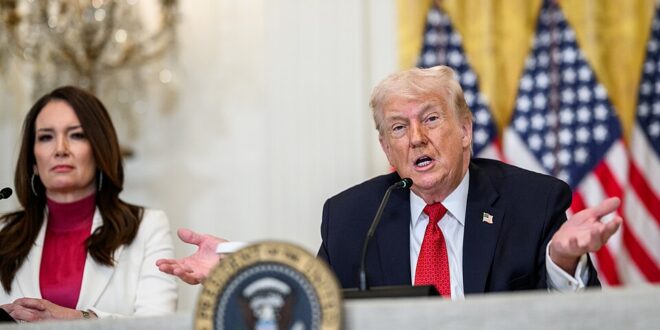
At the same time, President Donald Trump is turning to foreign beef imports as a short-term response to soaring grocery prices, announcing plans to allow up to 300,000 metric tons of ground beef into the United States over 90 days without additional out-of-quota tariffs.
Trump says the move will increase supply and lower prices for consumers. But the administration has not initially identified which countries will supply the beef or which exporters have agreed to sell it at the 25% discount Trump has promised.
That lack of transparency is raising questions at a particularly sensitive moment for the nation’s food-safety system.
Food recalls are putting the system under scrutiny
The United States has seen a series of significant food recalls and outbreaks this year involving pathogens including Cyclospora, Salmonella and E. coli.
The FDA and CDC are currently investigating a multistate Cyclospora outbreak linked to shredded iceberg lettuce supplied by Taylor Farms de Mexico. The FDA says the outbreak has involved illnesses in nine states, with nearly 2,000 people reporting exposure to Taco Bell locations and at least 98 hospitalizations as of its latest update. The agency says no deaths have been reported in that outbreak.
Other recalls this year have involved eggs, jalapeños, berries and other products, contributing to growing public concern about the country’s ability to detect and contain foodborne illnesses.
The number of recalls alone, however, does not prove that federal staffing cuts caused the outbreaks. Food-safety experts have cautioned that recall totals can fluctuate for many reasons, including improved detection and reporting.
But there is little dispute that the federal workforce overseeing food safety has gotten smaller.
Data compiled from federal workforce records show substantial staffing losses at agencies including the USDA, FDA and CDC since Trump returned to office. The USDA’s Food Safety and Inspection Service, which oversees the safety of meat, poultry and processed egg products, also has experienced workforce reductions.
That has raised concerns among food-safety advocates about whether agencies have enough personnel to conduct inspections, investigate outbreaks and respond quickly when contaminated products enter the marketplace.
The beef plan adds another layer of uncertainty
Trump’s beef strategy is aimed at a problem consumers can see every time they visit the grocery store: beef prices remain extraordinarily high.
The U.S. cattle herd has fallen to its lowest level in decades, limiting the domestic supply available for slaughter. Ground beef prices have climbed sharply as demand remains strong and supplies remain constrained.
Trump’s answer is to temporarily increase imports.
Under the plan, as much as 300,000 metric tons of ground beef could enter the country over a 90-day period without the additional tariffs that would otherwise apply. Trump has said the imported beef will be sold at 25% below current market prices.
But important details remain unresolved.
The administration has not initially disclosed which countries will provide all of the additional beef or which exporters have made the promised price commitment. The White House has refused to provide those details when asked on several occasions.
That matters because imported beef is already an important part of the U.S. ground-beef supply chain.
The question for consumers is not simply whether imported beef is safe. Imported meat is subject to federal inspection requirements.
The question is how much information consumers will have about what they are buying.
The ‘mystery meat’ problem
The United States no longer requires mandatory country-of-origin labeling for beef sold to consumers after Congress repealed the requirement in 2015.
That means a shopper buying ground beef generally cannot look at the package and determine where every component of that product originated.
The issue becomes more complicated when imported beef trimmings are blended with domestic beef.
For consumers, the result can be a supply chain that is difficult to see.
That does not mean the imported beef is contaminated or unsafe. It means consumers have limited information about its origin.
And that distinction is important.
The administration is asking Americans to trust the federal inspection system at the same time that federal agencies responsible for food safety have experienced substantial workforce losses.
The administration says it is strengthening food safety
The Trump administration strongly disputes the idea that its policies are weakening food safety.
The Department of Health and Human Services has announced a series of initiatives under Robert F. Kennedy Jr.’s “Make America Healthy Again” agenda, including efforts to change federal oversight of food ingredients and remove certain outdated authorizations for food additives. HHS has described those moves as efforts to modernize and strengthen the country’s food-safety system.
The administration has also argued that reducing federal bureaucracy can make government more efficient without compromising public safety.
But critics say staffing is different from bureaucracy.
Inspectors, investigators and epidemiologists are the people who physically inspect facilities, investigate contamination and trace products when Americans become sick.
A smaller workforce does not automatically mean an unsafe food supply. But it can reduce the government’s capacity to respond when something goes wrong.
That is why the intersection of staffing cuts, food recalls and increased imports has become so politically charged.
Ranchers are angry, too
Trump’s beef plan has generated unusual opposition from within his own political coalition.
The National Cattlemen’s Beef Association, which represents more than 175,000 cattle producers, criticized the plan, arguing that flooding the market with cheaper imported beef could undermine domestic ranchers’ ability to rebuild the U.S. herd.
The organization supports lower grocery prices but argues that imports are not a substitute for rebuilding domestic cattle production.
Republican lawmakers from agricultural states have made similar arguments.
Their concern is straightforward: If American ranchers are already struggling with high costs and historically low cattle inventories, importing large quantities of cheaper beef could make it harder — rather than easier — for them to rebuild their herds.
Economists have also questioned whether the import plan will have a significant effect on grocery prices because the proposed volume represents only a small portion of total U.S. beef consumption.
A short-term fix with long-term questions
Trump is trying to solve two politically difficult problems at once: high food prices for consumers and a depleted American cattle herd.
The beef import plan could provide some additional supply and potentially put downward pressure on prices.
But rebuilding the domestic cattle herd will take years, not months. And the administration’s approach raises questions about what happens to the domestic industry after the 90-day import window closes.
The food-safety questions are similarly bigger than one shipment of beef.
Americans need to know that the government has enough inspectors and investigators to protect the food supply. They need a system capable of tracing contaminated products quickly when outbreaks occur. And they deserve meaningful information about where the food on their plates comes from.
The central issue is not whether every imported steak or hamburger is dangerous. There is no evidence establishing that.
It is whether Americans should be expected to place more trust in a federal food-safety system at the same time the government has fewer people available to oversee it — while expanding a supply chain that can leave consumers with surprisingly little information about where their beef originated.
That’s the gamble at the heart of Trump’s food-safety agenda.

