


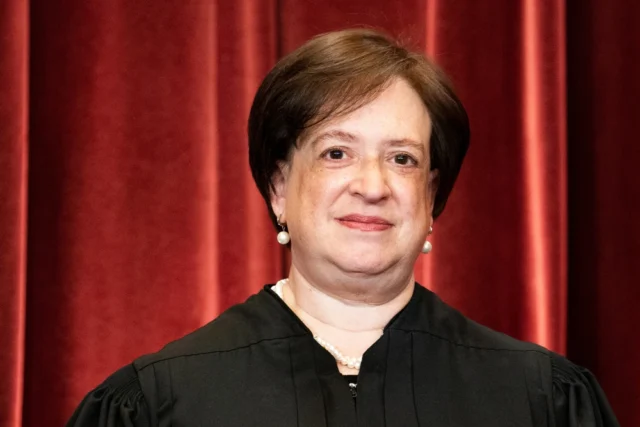
Supreme Court Justice Elena Kagan delivered a sharp rebuke of the court’s conservative majority Tuesday, accusing it of weakening American democracy through rulings that have expanded partisan gerrymandering, reduced protections for minority voters and loosened restrictions on money in politics.
Kagan, one of the court’s three liberal justices, argued that the majority has failed to account for the real-world consequences of its decisions, including the erosion of competitive congressional districts and the growing influence of wealthy donors in elections.
“Part of the reason why the court got it wrong was a kind of lack of the appropriate concern or understanding of the consequences of their decisions,” Kagan said during remarks at Catholic University’s law school in Washington.
She added that the court had ignored the harmful effects of its rulings on the political system.
“I do think in all these areas the court has blinded itself to the very deleterious effects of their rulings on how the political system works and has created a democracy that doesn’t work as well as it should,” she said.
Her remarks come less than two weeks before the Nov. 3 midterm elections, as states across the country engage in an unusually contentious battle over congressional district boundaries.
Kagan targets partisan gerrymandering
Kagan singled out the Supreme Court’s 2019 decision in Rucho v. Common Cause, which held that claims of extreme partisan gerrymandering presented political questions beyond the reach of federal courts.
The ruling left challenges to partisan congressional maps largely to state courts, state constitutions and political processes, giving lawmakers greater latitude to draw districts designed to benefit their parties.
Kagan argued that the decision has helped fuel an escalating contest between Republicans and Democrats to redraw districts for partisan advantage.
“Both parties have been engaged in a race to the bottom in terms of doing these partisan gerrymanders,” she said.
Several states have redrawn congressional maps ahead of this year’s elections in an effort to increase their parties’ chances of winning seats. Texas launched the latest round of mid-decade redistricting at President Donald Trump’s urging, followed by other states, including California.
Kagan warned that heavily engineered maps weaken voters’ ability to influence election outcomes and make competitive races less common.
When lawmakers draw districts that sharply limit voters’ ability to elect their preferred candidates, she said, the result is “very destructive of our democracy.”
Such maps can also push candidates toward ideological extremes because they face greater pressure to win party primaries than to appeal to voters across the political spectrum.
The result, Kagan said, is a political system that becomes even more polarized.
Voting Rights Act protections under pressure
Kagan also criticized the court’s recent decisions limiting the reach of the Voting Rights Act, the landmark 1965 law enacted to combat racial discrimination in voting.
A ruling this year restricting the use of race in redistricting has prompted Republican-led states to eliminate or redraw majority-Black congressional districts, intensifying the national debate over minority representation.
Kagan described the court’s approach as an “evisceration” of the Voting Rights Act, arguing that the decisions have weakened protections intended to ensure minority voters can participate meaningfully in elections.
The disputes over district boundaries have become a major political battleground before the midterms, with both parties seeking to maximize their congressional representation through redistricting.
The consequences extend beyond which party wins control of Congress, Kagan suggested. By reducing the number of competitive districts and limiting the electoral influence of some communities, the maps can diminish voters’ confidence that their participation will affect political outcomes.
Justice warns about money in politics
Kagan also criticized the Supreme Court’s repeated decisions striking down campaign finance restrictions, including a ruling in June that invalidated longstanding limits.
She said the growing role of money in elections has become a source of frustration for Americans who believe political candidates are too dependent on wealthy donors and outside spending groups.
“I think you know the people of America look around this political system and think that all this money, chasing all these political candidates, is a nightmare, and they’re right,” Kagan said.
The court’s campaign finance jurisprudence has generally emphasized protections for political spending under the First Amendment. Critics argue that the decisions have made it harder for lawmakers to limit the influence of wealthy individuals and organizations in elections.
Kagan’s comments reflect a broader divide on the court over how to balance constitutional protections for political expression against concerns about unequal influence in the democratic process.
Kagan questions expanding presidential power
During a question-and-answer session with law professor Joel Alicea, Kagan also raised concerns about rulings that have given Trump greater authority over federal agencies Congress designed to operate with some independence from the White House.
She warned against concentrating too much power in the presidency, arguing that an overly powerful executive could weaken the institutions intended to check presidential authority.
There is a “danger of one president being able to ride roughshod over all the other institutions of government and over the people,” Kagan said.
Her remarks come amid broader legal disputes over the boundaries of presidential power and the independence of agencies responsible for carrying out laws passed by Congress.
Despite her criticism of the conservative majority, Kagan pushed back against claims that the Supreme Court simply approves Trump’s agenda.
She pointed to cases in which the president lost, including the court’s decision striking down his sweeping tariffs.
The court remains “deeply conservative,” Kagan said, but in some cases it has “definitely pushed back on the president.”
A broader dispute over the court’s role
Kagan’s remarks offer a pointed account of how she believes the court’s conservative majority is reshaping the political system, from voting rights and congressional representation to campaign finance and executive authority.
Her criticism also highlights the divide between the court’s conservative and liberal wings over whether its decisions protect constitutional principles or undermine the institutions that make democratic government work.
With control of Congress at stake in November and redistricting disputes continuing across the country, the effects of those rulings are becoming increasingly visible in the electoral landscape.
For Kagan, the central concern is not simply which party benefits from individual decisions, but whether the cumulative impact leaves voters with less influence over their government.
The court’s conservative majority has repeatedly defended its rulings as grounded in constitutional text, precedent and limits on judicial power. Kagan’s warning, however, underscores the unresolved question at the heart of the debate: how far the courts should go to protect the democratic process when the rules governing elections are themselves shaped by partisan interests.
