


The pitch is no longer subtle. Vote Republican, and the money flows. Vote the other way, and it stops.
President Trump keeps promising “incentives” on the campaign trail that are explicitly contingent on Republicans winning the midterms, part of a pattern of using the power of his office as a carrot to advance his political ambitions.
The centerpiece is the check. At his Kansas rally Monday, Trump told the crowd that if they elect a Republican House and Senate on November 3, “you’ll get $5,000. And if we lose, you get nothing.”
The list keeps growing. At the same Kansas rally, the administration rolled out the $8 billion Harvest Fuel Relief Program, one-time payments to farmers confirmed by the USDA and reported by Reuters. Seniors have been promised $90 Medicare premium rebates. At Tuesday’s Oval Office launch of the WHIP fraud whistleblower program, tipsters were offered rewards of up to $30,000, with vlogger Nick Shirley receiving the first $10,000 check on camera.
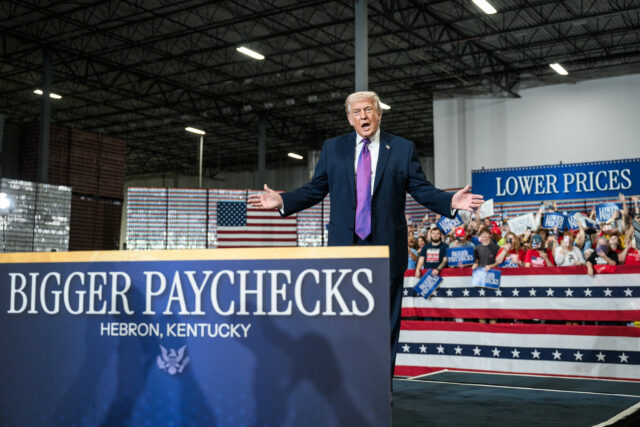
At Tuesday night’s Greenville, North Carolina rally, Trump claimed the Pentagon will invest $1.5 billion in state chip production, a figure Reuters reported without confirmation of whether it is new money or a repackaged earlier commitment, while Commerce Secretary Howard Lutnick announced a Sibelco silicon and quartz manufacturing investment of “hundreds of millions.” At the Kentucky rally on Oct. 17, Trump announced a conditional $100 million Department of War investment in Antheia pharma, explicitly tied to Republicans winning.
The Wall Street Journal reported Tuesday night that the White House is also discussing executive orders in the final days before the midterms aimed at high prices, including one on reducing housing costs.
Democrats are calling the strategy what it looks like: an attempt to buy the election with public money and public announcements. The voters are not fully sold either. A Journal poll last month found 64 percent of voters called the $5,000 checks a bad idea.
None of the headline promises arrive before Election Day. The checks depend on an election outcome and, in most cases, on action that has not happened yet. What is real, right now, is the offer itself, repeated at rally after rally in the states that will decide Congress.
Two weeks out, the campaign is a price list. The question voters are being asked is not whether the promises are good policy. It is whether they are for sale.
