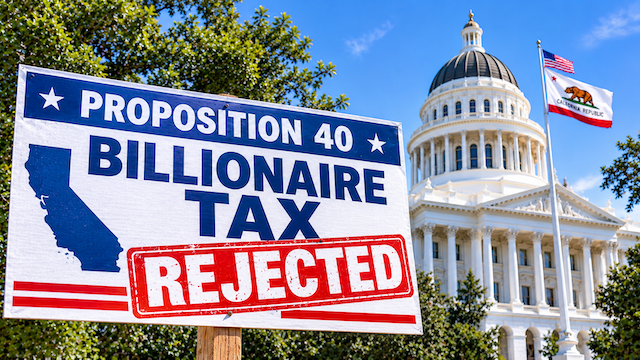
California voters have rejected Proposition 40, a proposed tax on billionaire wealth that supporters said could have generated approximately $100 billion for healthcare, food assistance and education over five years.
The Associated Press called the measure for opponents on Monday, Nov. 9, after several days of ballot counting. The latest results reported by KQED showed approximately 53.1% of voters opposing the proposal and 46.8% supporting it.
Proposition 40 would have established a one-time 5% tax on the net worth of individuals with assets exceeding $1 billion who were California residents as of Jan. 1, 2026. The measure was expected to affect approximately 200 of the state’s wealthiest residents.
The political news that affects your wallet, your rights and your vote, broken down in plain language. Free in your inbox.
The proposal was introduced by Service Employees International Union-United Healthcare Workers West (SEIU-UHW), which argued that California needed additional revenue to address major reductions in federal healthcare funding under legislation signed by Trump.
Under the proposal, 90% of the money collected would have gone toward healthcare services, while the remaining 10% would have supported food assistance and education-related programs.
Supporters projected the tax could generate approximately $100 billion over five years. However, California’s nonpartisan Legislative Analyst’s Office estimated the measure would generate tens of billions of dollars, a lower projection than the union’s estimate.
The campaign became one of the most expensive ballot fights in California’s history, with some of the state’s wealthiest technology executives contributing heavily to the opposition.
Google co-founder Sergey Brin contributed more than $100 million to Building a Better California, a political committee working to defeat Proposition 40. According to the Associated Press, opponents raised approximately 10 times more money than supporters.
The opposition also included Gov. Gavin Newsom, the California Teachers Association, Planned Parenthood and the California Medical Association.
Newsom and other opponents argued that taxing billionaire wealth could encourage wealthy residents and business executives to relocate, potentially reducing state income tax revenue and creating additional pressure on California’s budget.
The debate also exposed divisions among Democrats. While Sen. Bernie Sanders and the California Democratic Party supported the proposal, Newsom argued against the tax, saying he disagreed with the approach despite sharing concerns about wealth inequality.
The results also revealed differences among voters. According to the Associated Press, most California voters younger than 30 supported Proposition 40, while approximately 70% of voters age 65 and older opposed it. Voters with household incomes of $100,000 or more were also more likely to vote against the measure.
For California residents, the rejection means the state will not collect the proposed one-time billionaire wealth tax or receive the additional revenue supporters hoped would help offset healthcare funding reductions.
The campaign behind Proposition 40 has indicated it could return with another wealth tax proposal in 2028 if state lawmakers do not develop another solution to protect healthcare funding.
Although the measure failed, the debate over taxing extreme wealth and replacing federal healthcare dollars is likely to remain an issue in California politics.