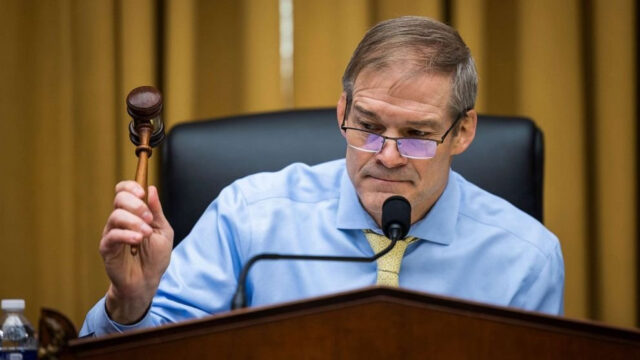
Rep. Jim Jordan (R-Ohio) has been elected the next House minority leader, defeating Rep. Steve Scalise (R-La.) in a Republican leadership contest as the party prepares to surrender control of the chamber to Democrats in January.
Jordan’s election puts the longtime chairman of the House Judiciary Committee in charge of a Republican conference facing a major political transition following the 2026 midterm elections.
He will succeed Speaker Mike Johnson (R-La.) as the top Republican leader in the House when the 120th Congress convenes in January 2027.
The political news that affects your wallet, your rights and your vote, broken down in plain language. Free in your inbox.
The leadership contest came after Republicans lost their House majority, giving Democrats control of the chamber and the opportunity to pursue their legislative agenda and conduct investigations into the Trump administration.
Jordan defeated Scalise, who currently serves as House majority leader. The two Republicans previously competed for the House speakership in 2023 after former Speaker Kevin McCarthy was removed from the position. Neither secured enough support at the time, and Republicans ultimately selected Johnson.
Jordan built his leadership campaign around his experience overseeing congressional investigations and his willingness to challenge Democrats. In his pitch to Republican colleagues, he argued that the party needed an active leadership team prepared to respond to the incoming Democratic majority.
“I am battle-tested on the oversight front and I know the Democrats’ playbook,” Jordan wrote in a letter to colleagues ahead of the election, according to The Associated Press.
He also argued that Republicans could not simply spend the next two years criticizing Democrats. The party would need to develop a clear political message and work toward regaining the House majority in 2028.
Scalise, meanwhile, made the case that his years in Republican leadership and fundraising experience made him the better choice. He highlighted his work raising millions of dollars for House Republicans during the midterm campaign and emphasized the need for party unity.
The leadership election also marked a transition for Johnson, who announced that he would not seek to lead House Republicans after the party’s midterm losses.
Jordan’s new position will put him at the center of the Republican response to Democratic control of the House. Democrats are expected to use their committee majorities to investigate actions taken by the Trump administration, while Republicans will have fewer opportunities to advance legislation through the chamber.
Jordan, a co-founder of the House Freedom Caucus, has spent years as one of the most prominent Republican voices in congressional investigations and oversight. His experience on the Judiciary Committee is expected to shape how Republicans approach upcoming battles with Democrats.
Democrats are preparing to elevate House Minority Leader Hakeem Jeffries (D-N.Y.) to speaker when the new Congress begins. If elected, Jeffries would become the first Black speaker of the House.
The change in leadership will take effect in January, when the new Congress is sworn in. Until then, Republicans will continue operating with their current leadership structure as lawmakers finish the remaining business of the 119th Congress.