Poli Alert Politics & Civics
Related Articles


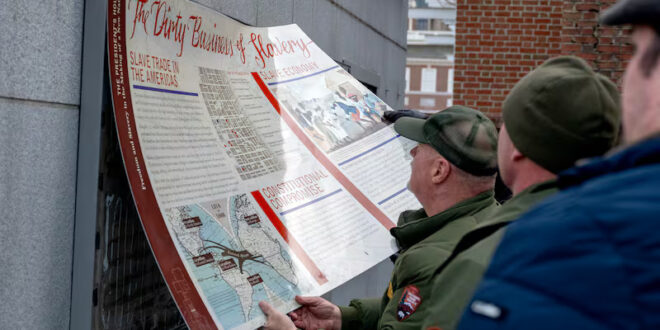
A federal appeals court has cleared the way for the Trump administration to replace interpretive exhibits at Philadelphia’s President’s House, allowing officials to move forward with changes to a slavery memorial that critics say will diminish the history of slavery in the nation’s first executive mansion.
The U.S. Court of Appeals on Friday issued its formal mandate finalizing a June 18 ruling that allows the Interior Department and the National Park Service to remove and replace informational panels at the President’s House site, where President George Washington enslaved nine people while serving as the nation’s first president.
The court’s action came one day after the Interior Department asked for the mandate to be issued immediately, arguing the updated exhibits should be installed without further delay.
“The President’s House is an important national historical site, and the Government submits that the President’s House exhibits should be fully installed without further delay,” the department wrote in its filing.
The Interior Department did not immediately indicate whether the new panels would be installed before Independence Day celebrations marking the nation’s 250th anniversary.
The dispute stems from a lawsuit filed in January by the City of Philadelphia seeking to block the Trump administration from altering the memorial after officials removed many of its interpretive panels without prior notice.
The exhibit, which opened in 2010 following years of advocacy by historians, civic leaders and community organizations, documents the lives of the enslaved men and women held by Washington while he lived at the President’s House between 1790 and 1797.
A federal judge had temporarily ordered the administration to preserve the exhibit while litigation continued, but the appeals court dissolved that injunction in June.
On Friday, Philadelphia filed a motion asking the court to reconsider, arguing the city was not given sufficient time to respond to the federal government’s request for an expedited mandate.
Critics Call Changes ‘Whitewashing’
Opponents of the overhaul argue the administration’s revisions would sanitize the history of slavery and soften Washington’s role as an enslaver.
Michael Coard, founder of the Avenging the Ancestors Coalition, which spent years advocating for creation of the memorial, said the proposed changes would amount to “whitewashing” history.
“What Trump wants to do and plans to do is to literally whitewash and censor the site,” Coard said.
He criticized the administration’s proposed language, saying it emphasizes Washington’s reported discomfort with slavery while downplaying the brutality experienced by the hundreds of enslaved people he owned during his lifetime.
Washington enslaved more than 300 men, women and children at his Mount Vernon estate in Virginia, including those forced to work at the President’s House in Philadelphia.
Coard also objected to the planned removal of images depicting violence against enslaved Black people, arguing those historical realities are essential to understanding slavery’s legacy.
“The President’s House site has become basically a test case,” Coard said. “They want to see what the Trump administration can do with this, and if they can destroy this, they can destroy similar sites across the country.”
Administration Cites Executive Order
The Interior Department has defended the changes, saying they are consistent with President Donald Trump’s March 2025 executive order titled “Restoring Truth and Sanity to American History.”
The order directed federal agencies to remove what it described as “negative,” “divisive” and historically unbalanced materials from national parks, museums and other federally managed historical sites.
An Interior Department spokesperson said the revised exhibit would continue acknowledging slavery while presenting a broader interpretation of the nation’s founding.
“The new proposed panels underscore our commitment to celebrating and acknowledging the full breadth of our nation’s history,” the department said.
The revised exhibit language, published earlier this year on the National Park Service website, includes references to Washington’s personal discomfort with slavery and describes enslaved workers at the President’s House as having “a modicum of autonomy,” language critics argue minimizes the institution’s cruelty.
Broader Debate Over Historical Interpretation
The case has become one of several legal and political battles surrounding the Trump administration’s efforts to reshape how American history is presented at federally operated sites.
Historians and civil rights advocates have warned that altering exhibits addressing slavery, racism and discrimination risks obscuring important aspects of the nation’s past. Supporters of the administration’s approach argue many federal historical displays have placed disproportionate emphasis on America’s failures rather than its achievements.
The President’s House memorial sits just steps from Independence Hall and the Liberty Bell, placing it among the nation’s most visited historical landmarks.
The legal fight over its exhibits comes as the United States celebrates the 250th anniversary of its founding, with competing visions emerging over how the country’s history should be remembered and presented to future generations.