Poli Alert Politics & Civics
Related Articles



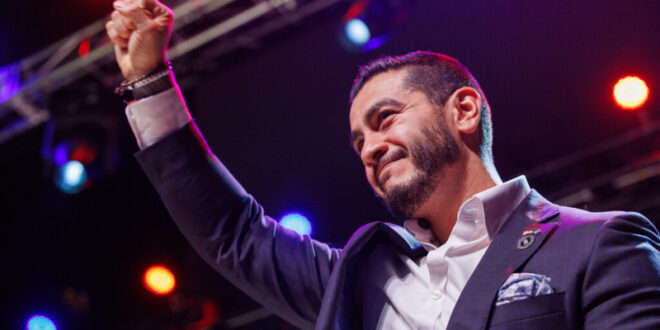
After a grueling primary that saw attacks from Republicans and establishment Democrats alike, Abdul El-Sayed has won in his race to be the party’s nominee to face Republican former U.S. Rep. Mike Rogers in the November general election.
Unofficial election results show that El-Sayed was on track to win the race over contender and U.S. Rep. Haley Stevens (D-Birmingham). The Associated Press called the race for El-Sayed at 9:58 a.m. Wednesday.
El-Sayed, holding his election night victory party in Detroit, addressed his supporters at about 1 a.m. and said it was too close to call at that point.
“Know that the billionaires, corporations, and the special interests-they weren’t going to give up light. We all knew they were going to spend their money,” El-Sayed said. “We didn’t know they were going to spend $70 million of their money. We didn’t know that they were going to outspend us $11 to $1. And yet we’re still standing.”
State Sen. Mallory McMorrow (D-Royal Oak), who had dropped out of the race in early July, endorsed El-Sayed based on NBC News making the call just before 2 a.m.
“I’m proud to give Abdul my full endorsement and support as we head to November together as a unified party,” McMorrow said in a release. “Take it from me — this was a brutal primary. But whatever differences there were between the candidates in this race, those differences are nothing compared to the contrast in November. Donald Trump and Mike Rogers are banking on all of us being too bruised, too proud, and too hurt to come back together to beat them. Let’s prove them wrong.”
Shortly after the AP called the race for El-Sayed, Stevens issued a statement of congratulations and support for the general election fight ahead.
“I want to congratulate Abdul El-Sayed on winning the Democratic nomination for U.S. Senate. He is a doctor, a community health official, a Rhodes Scholar, and a dedicated Michigander. I am proud to offer my support as he takes on Mike Rogers in the general election,” Stevens said. “This was a thorough and rigorous campaign that brought out the full span of views within the Democratic Party – and that is why we have primaries. I am proud to have put up my hand to serve, and prouder to continue to work together to make sure this Senate seat remains blue, that we flip the United States Senate and continue the work for Michigan.”
El-Sayed, the son of Egyptian immigrants, would be the first Muslim U.S. senator if elected in November.
The win sets up a showdown with Rogers, who ran uncontested in the Republican primary. Rogers has been able to gather resources, mainly cash, while the Democrats battled it out wire-to-wire.
Rogers — who lost his 2024 race against current U.S. Sen. Elissa Slotkin (D-Holly) — has $4.41 million cash on hand according to pre-primary FEC filings.
Meanwhile, between April 1 and June 30, El-Sayed raised $4.57 million and spent $4.37 million, leaving him with $2.7 million cash on hand.
El-Sayed has carved out a lane that had pundits calling him both a Barack Obama-type figure for the Democrats and Michigan’s less-socialist Zohran Mamadani. El-Sayed routinely disavowed the democratic socialist label that followed some of his key policy planks, saying he was a capitalist who sees its inherent flaws and wants to fix them.
He did so by centering his campaign on Medicare for All, new leadership in the U.S. Senate, overtures on anti-corporate election interference and on upending decades of U.S. foreign policy — namely, military and diplomatic aid to Israel. While Stevens focused on kitchen table issues like affordability, resistance to the administration of President Donald Trump and rebuilding the might of Michigan’s manufacturing, El-Sayed captured the growing disdain within the Democratic Party for corporate money in politics and the U.S. relationship with Israel. El-Sayed was the first candidate in the race to declare his belief that Israel had committed genocidal actions in its ongoing war with Hamas in Gaza.
As Stevens played to the middle, El-Sayed banked on Michigan’s Democrats joining his new coalition, which included young college-aged or college-educated progressives, union members, climate and anti-fascist activists, and women who were quickly becoming the core of the resistance movement against Trump and the actions of his administration.
Until just the last few weeks before Tuesday’s primary, El-Sayed had been framed as the race’s underdog. Although progressives had shown some strength this year with wins in New York for Mamdani and others, a great many pundits and election observers questioned whether the growing wave of progressive populism could find a root in Michigan, often called the purplest of Midwestern swing states.
El-Sayed had some name recognition from his 2018 Democratic gubernatorial bid, which he lost decisively to current Gov. Gretchen Whitmer, and his time as a progressive celebrity working in the Bernie Sanders sphere of influencers and podcasters. That attracted people like Sanders to his campaign effort, but also more controversial figures like streamer and commentator Hasan Piker.
Whitmer, who had given Stevens a late endorsement, was quick to offer congratulations to all of the Democratic nominees following El-Sayed’s win.
“Congratulations to Jocelyn Benson, Abdul El-Sayed, and every Democrat who won up and down the ballot. They’ve got my support as we fight like hell, together, to win in November,” Whitmer said in a press release. “There was a lot of passion and energy in these primaries, and that’s a good thing—Democrats are ready to beat Republicans across the state. We’re all united by our shared goal: getting things done for the people of Michigan. We know there’s so much on the line this November—health care, costs, our fundamental freedoms. That’s why it’s time to come together, get to work, and win in November.”
For many Dearborn voters that Michigan Advance spoke with Tuesday, there was great enthusiasm to give a progressive like El-Sayed a chance.
Jalen Black, a security guard, said he was most excited to cast his ballot for El-Sayed after voting for him in 2018. Black said El-Sayed’s politics are the closest to his, pointing to his stance against Israel’s actions in Gaza, progressive policies on housing and healthcare, and focus on getting money out of politics.
Black, 27, told the Advance outside of the Dearborn Administrative Center after casting his ballot, that he thought the Democratic Party was “largely out of touch” with people.
“I think it’s mostly pandering at this point,” Black said.
Black said that politicians and the media have been Islamophobic and “weirdly antagonistic” towards Dearborn, referencing the response to the Uncommitted movement in 2024.
“Instead of actually making the attempt to understand Dearborn,” Black said, they were just “pointing the finger and making it seem like they’re irrational”
Gabriella Dias, a video editor, was also casting her ballot at the Dearborn Administrative Center late Tuesday afternoon. She said she was most excited about the Senate race.
“I think it’s an important thing as human beings to care about each other, and I think the first step is in local politics,” Dias, 24, said.
Dias said her generation isn’t politically involved enough, so she has been trying to get her friends to vote. She said she’s “disillusioned” the with American political system and was glad to see a candidate like El-Sayed.
“I think a lot of people like miss the opportunity to be civically involved because they think it’s very complicated. But I just think it’s an important thing to do, and I think it’s morally right to do so.”
Aside from Stevens, who was framed as the race’s frontrunner and establishment favorite from the minute she entered the race, El-Sayed also faced McMorrow, who was trying her best through the race to carve out her own name ID and set herself apart from Stevens and El-Sayed.
That proved difficult for McMorrow, who at times played progressive by attaching herself to issues that El-Sayed championed, including an aversion to corporate campaign donations, including from the American Israel Public Affairs Committee,which Stevens openly accepted, while also supporting Israel’s right to exist as the Jewish homeland in the Middle East.
McMorrow dropped out in July leaving the race to just Stevens and El-Sayed. The battle to the finish line that ensued was intense and at times politically bruising. Stevens attacked El-Sayed on everything from his commitment to transparency and his treatment of women throughout his political career. El-Sayed in turn hit Stevens on her corporate campaign cash and her acceptance of help from AIPAC — which spent more than $40 million on the race to boost her.
The race was coming down to the wire until last week when several polls began to indicate El-Sayed was moving ahead.
El-Sayed ultimately claimed victory Wednesday morning, advancing the progressives in a key state, and one that mimicked other Democratic socialist upsets seen across the nation in the 2026 cycle. He will now have to turn his attention not just to Rogers in the general election, but also to mending ties with Stevens’ supporters, as Democratic unity will be essential if the party wants to hold the seat being left vacant by the retiring U.S. Sen. Gary Peters (D-Bloomfield Township).
by Ben Solis, Michigan Advance
Minnah Arshad contributed to this story.
Michigan Advance is part of States Newsroom, a nonprofit news network supported by grants and a coalition of donors as a 501c(3) public charity. Michigan Advance maintains editorial independence. Contact Editor Jon King for questions: [email protected].