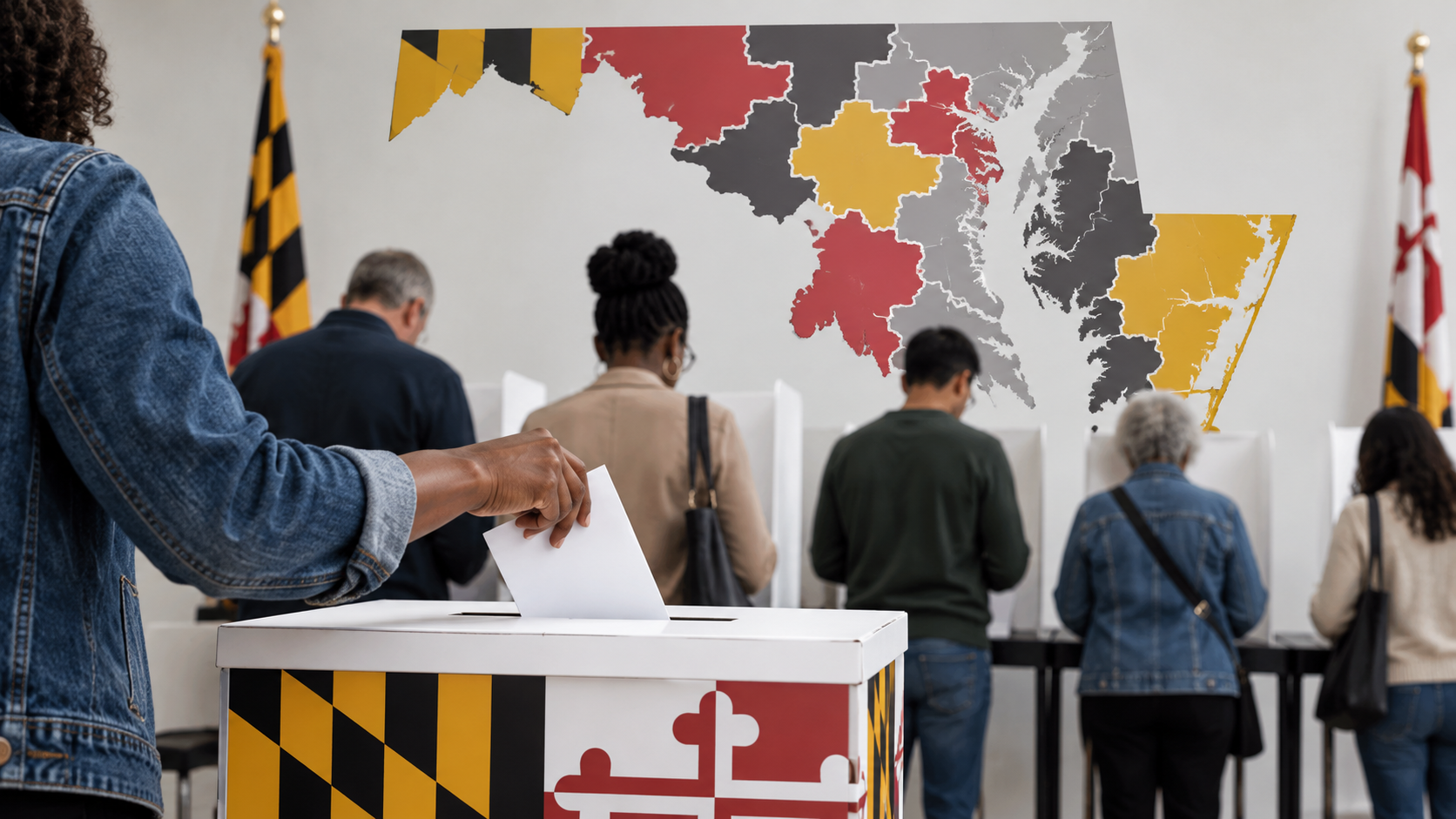
Maryland voters will decide on November 3 whether to change the state constitution to give lawmakers more freedom to redraw congressional maps, in a ballot item known as Maryland Question 3. Redistricting is the process of redrawing the boundaries of the districts that elect members of the U.S. House and state legislatures.
Question 3 would remove the constitutional requirement that congressional districts be compact, connected and equal in population, so those rules would apply only to state legislative districts. It would also let the General Assembly give the Supreme Court of Maryland original jurisdiction, meaning the power to hear a case first, over challenges to congressional maps. Those challenges currently have to start in a circuit court, according to the University of Maryland student newspaper The Diamondback.
Maryland lawmakers added the amendment to the ballot during a special session in August. Republicans, including state Senate Minority Leader Stephen Hershey and the Maryland Freedom Caucus, sued in Anne Arundel and Dorchester counties, and lower courts blocked the question. On Thursday, September 3, the Supreme Court of Maryland overturned those rulings in a divided decision, Bethesda Magazine reported.
The political news that affects your wallet, your rights and your vote, broken down in plain language. Free in your inbox.
Chief Justice Matthew Fader, writing for the majority, said the question as originally worded was misleading and violated due process requirements, mainly because of its reference to applicable federal laws as criteria for congressional boundaries. Rather than strike the question, the court replaced its text with the amendment’s purpose paragraph, and the State Board of Elections must use the rewritten version. Justices Steven Gould and Glenn Harrell dissented. Gould said it is not the court’s job to rewrite the question for the General Assembly.
Supporters and opponents describe the stakes differently. Gov. Wes Moore said the final decision on how maps are drawn belongs in the hands of Marylanders, not politicians. Hershey said the revised language fails to fully explain the amendment’s true effect. Republicans say the change would let Democrats redraw maps in the middle of a decade and could tilt all eight congressional seats toward Democrats. The Diamondback reported that a yes vote would allow the Democratic controlled legislature to redraw the maps, possibly eliminating the state’s one Republican held seat, District 1.
A University of Maryland, Baltimore County Institute of Politics survey of 776 likely voters found 53 percent planned to vote against Maryland Question 3, 25 percent planned to vote for it and 19 percent were unsure.
Two other questions are also on the Maryland ballot. Question 1 would require the governor to include in the annual state budget the money needed for terms agreed to by the state and its employee unions, and would create a neutral arbitrator to oversee contract disputes. Question 2 would change how vacancies are filled on the Commission on Judicial Disabilities, which investigates complaints against Maryland judges. Voters can confirm their polling place and hours with the Maryland State Board of Elections or their local board of elections.