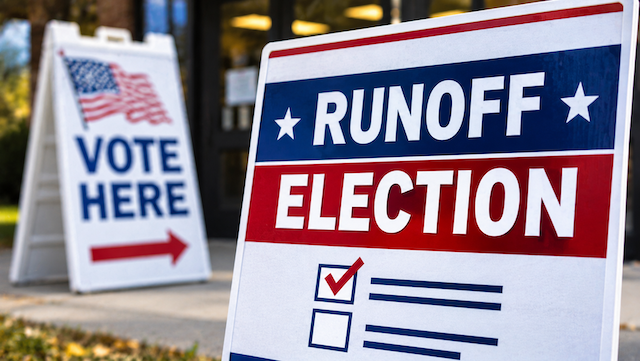
A runoff election is a second election held when no candidate wins enough votes the first time, usually a majority, so the top finishers face each other again until one of them does.
Most races in the United States are decided by plurality, which means the candidate with the most votes wins even if that is less than half. In a three way race, a candidate can win with 40 percent of the vote while 60 percent of voters chose someone else. A runoff election is designed to prevent that. States and cities that use runoffs require the winner to clear a set bar, most often 50 percent plus one vote. If nobody reaches it, the two candidates with the most votes advance to a new election a few weeks later, and whoever gets more votes in that head to head contest wins.
How it works depends on the state. Rules for runoffs are written into state law, and in some places city charters, so the threshold, the timing and the races covered differ from place to place. Georgia requires a majority to win a general election, so a race with three or more candidates can easily go to overtime. Louisiana also requires a majority and holds its runoffs in December. Texas uses runoffs for many local offices and for party primaries. Several Southern states, including Alabama and North Carolina, use runoffs in party primaries, when voters in the same party pick a nominee, though North Carolina only holds one if the second place finisher asks for it and the leader fell below its 30 percent threshold.
The political news that affects your wallet, your rights and your vote, broken down in plain language. Free in your inbox.
A runoff election is a brand new election, not a recount. Ballots from the first round are not counted again. Candidates campaign again, voters have to return to the polls or send in new mail ballots, and early voting usually opens again on a shorter schedule. In most states, a voter does not need to have voted in the first round to vote in the runoff, but the voter does need to be registered by the state’s deadline, which often passed long before the runoff date. That is why election offices urge people to check their registration well ahead of time.
Turnout is the biggest challenge in a runoff election. Runoffs often fall in December or the middle of summer, when fewer people are paying attention, and the number of voters usually drops from the first round. That means a smaller group of voters ends up choosing the winner, and each ballot carries more weight.
Supporters of runoffs say they give the winner a clear mandate, because a majority of the people who voted in the final round chose that person. Critics say the extra election costs taxpayers money, wears out voters and can hand the decision to a smaller and less representative group. Some places have moved to ranked choice voting, sometimes called an instant runoff, where voters rank candidates on one ballot and the runoff happens automatically during the count instead of weeks later.
The best known example in recent years came from Georgia. In the November 2020 election, neither of Georgia’s U.S. Senate races produced a majority winner, so both went to runoffs on Jan. 5, 2021. Democrats Raphael Warnock and Jon Ossoff won both seats, which split the Senate 50 to 50 and gave Democrats control through the vice president’s tie breaking vote. Two runoffs in one state decided which party ran the Senate for the next two years. Georgia went to another Senate runoff in December 2022, when Warnock defeated Herschel Walker.
Runoffs remain common after big elections. After the November 2026 midterms, for example, Georgia scheduled a Dec. 1 runoff for a state House seat where no candidate won a majority, Louisiana set Dec. 12 runoffs in two U.S. House races, and Texas set Dec. 12 runoffs for local offices that did not produce a majority winner.
A runoff election matters in everyday life because the offices on the line are often close to home: a state lawmaker who votes on school funding, a city council member who decides on policing and zoning, or a sheriff. Because turnout is lower, a few hundred votes can decide the outcome. Anyone living in a place with an upcoming runoff can confirm whether they are eligible, where to vote and when early voting opens with their county or parish election office or their state’s secretary of state.