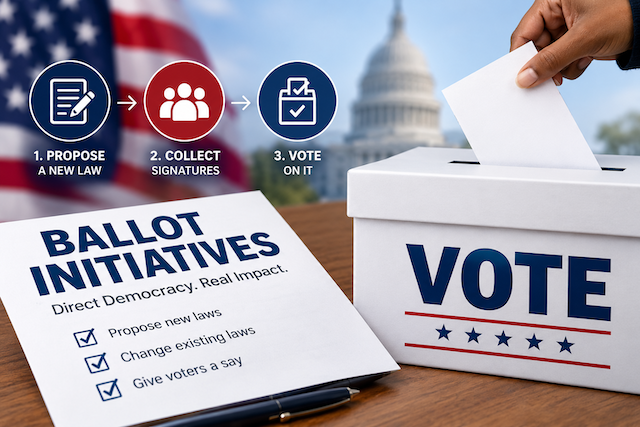
A ballot initiative is a proposed law or constitutional change that citizens, not lawmakers, put on the ballot so voters can approve or reject it directly.
Most laws are written and passed by elected officials in Congress or a state legislature. A ballot initiative skips that step. A group of residents, an advocacy organization or a political committee writes the text of a proposal, gathers signatures from registered voters to show there is enough public support, and then asks election officials to place the proposal on a statewide ballot. If the proposal gets a majority of votes, it becomes law or becomes part of the state constitution, depending on what the initiative was written to change.
The process is a form of direct democracy, a system where voters make decisions themselves instead of choosing representatives to decide for them. The United States does not have a national ballot initiative, so voters cannot use one to pass a federal law. Roughly half the states, mostly in the West and Midwest, let residents use some form of initiative at the state level. Each state sets its own rules, including how many signatures are needed, how long people have to collect them, and what subjects can be covered.
The political news that affects your wallet, your rights and your vote, broken down in plain language. Free in your inbox.
It helps to know how an initiative differs from two similar terms. A referendum is a vote on a law the legislature has already passed, and some states let citizens collect signatures to force that vote. A legislatively referred amendment is a change to a state constitution that lawmakers themselves place on the ballot, which is how many state constitutions get amended. Citizens do not gather signatures for those. An initiative is the one that starts with the people, not the legislature.
The steps usually look like this. Supporters file the proposed text with the state, and officials often review it and write a short ballot title and summary. Supporters then collect signatures within a set window. Election officials check the signatures and throw out any that are invalid, such as duplicates or those from people who are not registered. If enough signatures hold up, the measure is certified for the ballot. Opponents can organize a campaign against it, and courts sometimes hear challenges over whether a measure is legal or whether its ballot wording is fair.
Washington state offers a recent example. Voters there are deciding on November 3, 2026, whether to approve Initiative 645, which would repeal a 9.9% tax on household income over $1 million and prohibit taxes on income in general, according to Ballotpedia. Other initiatives on that same ballot cover school sports and parents’ rights in public schools. Whatever the outcome, those votes happen without lawmakers choosing the text voters see.
In some states, ballot initiatives have been used to raise the minimum wage, expand Medicaid, change how districts are drawn and legalize marijuana. That means a decision that could otherwise be stalled in a legislature can land directly in the hands of voters.
For everyday life, an initiative matters because the results can change things like your taxes, your wages, your health coverage or who draws your voting district. The wording on the ballot is the part most voters see, so it is worth reading the full text of a measure, not only the title. Your state’s secretary of state or election office publishes the official text and a voter guide for every measure on your ballot.