


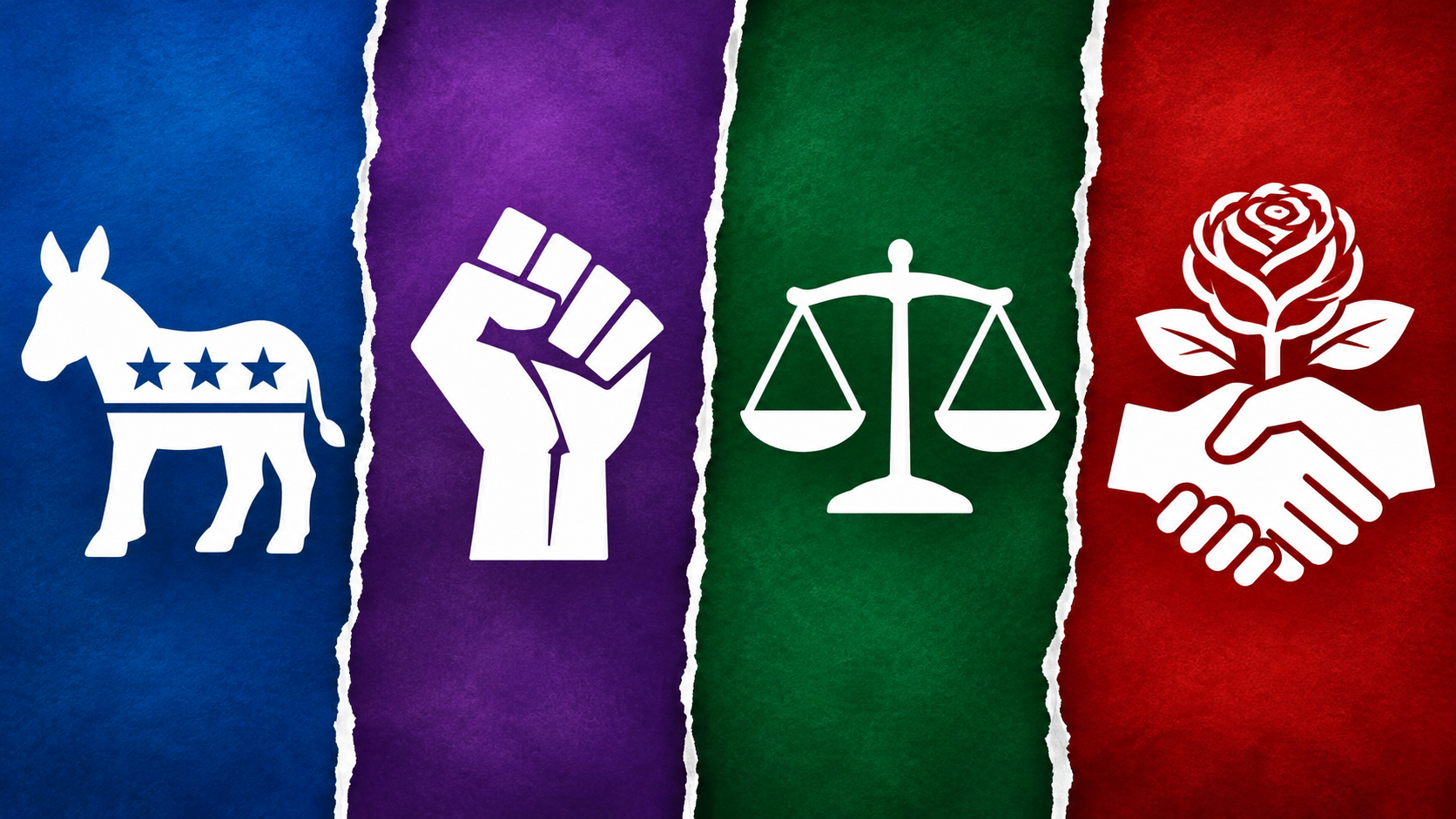
The political left in America is made up of several different groups, and the labels liberal, progressive, leftist and democratic socialist each mean something specific. Cable news and social media use them interchangeably, sometimes as praise and sometimes as insults. Once you know the difference, the fights inside the Democratic Party after a year of heated primaries get a lot easier to follow.
The easiest way to picture it is a line. Moderates and centrists sit closest to the middle. Liberals sit a little further left, and progressives push further still. Democratic socialists and other leftists sit at the far end, and some of them would argue they belong on a different line altogether.
Start with liberals, the biggest group on the political left. A liberal believes the American system mostly works and should be improved, not replaced. That means keeping capitalism, an economy built on private businesses competing for profit, while using government to regulate it and protect people from its worst effects. Liberals back Social Security, the Affordable Care Act, voting rights, abortion rights and civil rights protections. They tend to favor step by step change and are more willing to compromise to get a bill passed. Barack Obama governed this way, and so has most of the Democratic leadership in Congress for decades.
The political news that affects your wallet, your rights and your vote, broken down in plain language. Free in your inbox.
Moderate Democrats, also called centrists, share many liberal goals but move more carefully, especially on taxes and spending. They often represent swing districts, where they need votes from independents and some Republicans to win.
Progressives want the same basic system as liberals, just with much bigger changes delivered much faster. The name goes back to the Progressive Era of the early 1900s, when reformers broke up corporate monopolies, fought child labor and pushed for women’s right to vote. Today’s progressives push for Medicare for All, which would replace private health insurance with one government plan covering everyone. They also want higher taxes on billionaires and corporations, tuition free public college and aggressive action on climate change. Senator Elizabeth Warren is one of the best known progressives. The group Justice Democrats recruits progressive candidates to challenge sitting Democrats in primaries, and in 2026 its candidates won several of those races, including Adam Hamawy in New Jersey, Justin Pearson in Tennessee and Frederick Haynes in Texas. In Michigan, progressive Abdul El-Sayed beat centrist Representative Haley Stevens for the Democratic Senate nomination.
Democratic socialists see the problem differently. Liberals and progressives want to fix capitalism. Democratic socialists believe capitalism itself is what keeps working people struggling. They want workers and the public to have more control over major parts of the economy, like healthcare, housing and energy, and they want to get there through elections. That commitment to voting is what puts the “democratic” in democratic socialist. Senator Bernie Sanders, an independent who works with Democrats in the Senate, is the most famous democratic socialist in American politics, along with Representative Alexandria Ocasio-Cortez and New York City Mayor Zohran Mamdani. Many democratic socialists are members of, or have been backed by, the Democratic Socialists of America, an organization that runs its own candidates, usually on the Democratic ballot line.
The label still turns off a lot of voters. A Pew Research Center survey from January 2026 found Americans overall dislike leaders who call themselves democratic socialists more than they like them, 38% to 17%. Among liberal Democrats, 52% said they like those leaders and only 4% said they dislike them.
Leftist is the broadest and most loosely used term on the political left. Strictly speaking, a leftist is anyone who wants to move past capitalism entirely, which covers socialists, communists and anarchists. Many leftists do not see the Democratic Party as left at all. To them, liberals and even progressives are defending a system that needs to be replaced, and they say so loudly online. Meanwhile, Republicans and conservative media often use “leftist” as an insult for any Democrat, which is a big reason the word causes so much confusion.
Pew’s newest study of American political groups, released in June 2026, shows how divided the political left really is. It sorts Democratic leaning voters into several groups, including Loyal Liberals, the Order and Opportunity Left and Leftward Progressives. Leftward Progressives are the furthest left. Pew found 92% of them say the U.S. economic system is unfair, compared with 51% of all Americans. Two thirds of them like leaders who call themselves democratic socialists, and 70% wish there were more political parties to choose from. They also skew young and White: 79% are under 50 and 67% are White.
On actual policy, the lines between these groups blur. Economic ideas that once sat on the far left now have wide support. Reuters/Ipsos polling this year found that two thirds of independents support raising taxes on corporations and billionaires and providing government healthcare. The bigger fight is over who should carry those ideas. Establishment Democrats have openly worried about whether candidates tied to the left can win swing districts, and progressives are pointing to their 2026 primary wins as proof that they can.




